Editorial Annotation
Consent
Introduction
Statutory Text
Explanation
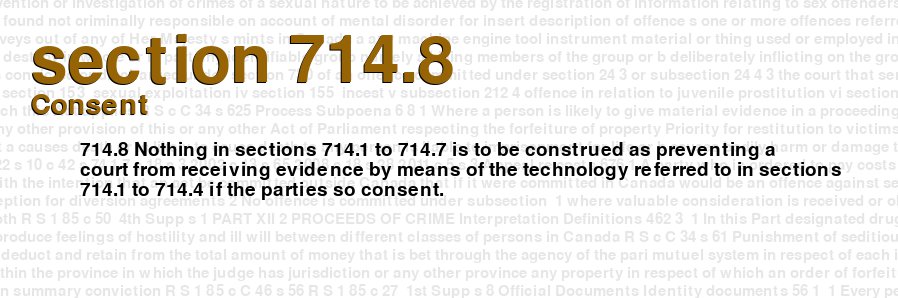
Section 714.8 of the Criminal Code of Canada provides a framework for the use of technology in court proceedings. This section clarifies that the provisions from sections 714.1 to 714.7, which outline the admissibility of recorded statements, do not preclude the use of technology to present evidence in court, given that the parties involved give their consent.
The use of technology in court proceedings has become increasingly prevalent in recent years. The ability to present electronic evidence such as text messages, emails, and audio/video recordings has greatly simplified the presentation of critical evidence in any court case. The use of technology in courts has virtually enhanced the efficiency, speed, and accuracy of the judicial system.
The consent requirement in Section 714.8 is essential to protect the rights of all individuals involved in the proceedings by ensuring they are informed, and their interests are safeguarded. The acceptance of evidence by technology can raise concerns about the authenticity, credibility, and reliability of such evidence. Therefore, the courts must be confident of the validity of the technology used to present evidence, and the consent of all parties accordingly.
In conclusion, Section 714.8 of the Criminal Code of Canada reflects the evolving use of technology in judicial proceedings. It provides a legal framework for the admissibility of technology-based evidence in criminal cases based on the consent of the parties involved. While technology can enhance the judicial process, it must be used with care and caution to guarantee its accuracy, reliability, privacy, and security.
Commentary
Section 714.8 of the Criminal Code of Canada is an important piece of legislation that allows for the use of modern technology when presenting evidence in a court of law. This section outlines that nothing in previous sections of the Criminal Code prevents a court from using technology to present evidence, as long as the parties involved consent to it.
This provision is significant because it acknowledges the changes that technology has brought to our society and legal system, ensuring that courts adapt to the times. In the past, evidence was presented through physical documents, witnesses, and other traditional means. However, with the advancement of technology, we now have access to digital technology that makes it easier to present evidence in court.
The Criminal Code of Canada outlines specific sections, including 714.1 to 714.4, which permit the use of technology in presenting evidence. These sections refer to digital technology such as video conferencing, audio recordings, and digital documents. These digital technologies can help to speed up the legal process, making it easier to present evidence and reach a verdict in a timely manner.
However, it is worth highlighting that the use of technology in court proceedings also has its challenges. There is a risk that the technology used may malfunction, which can lead to delays and errors in the legal process. Additionally, there is a concern around the security of digital evidence, as there is always the possibility of tampering or manipulation.
Despite these potential challenges, the use of technology in court proceedings offers numerous benefits that cannot be ignored. For instance, the use of video conferencing technology can enable witnesses who are unable to appear in court to testify remotely, providing a more comprehensive testimony that can contribute to the verdict. Additionally, digital documents can be easily shared between parties, simplifying the legal process and making it more efficient.
Overall, Section 714.8 of the Criminal Code of Canada provides a critical framework for using digital technology in legal proceedings. As our society continues to evolve, it is essential that our legal system keeps up with these changes to maintain fairness and efficiency. The use of technology in court proceedings has already proven its worth, and as long as the parties involved agree, it will continue to be an essential tool for presenting evidence.
Strategy
Section 714.8 of the Criminal Code of Canada allows courts to receive evidence by means of technology referred to in sections 714.1 to 714.4 with the consent of the parties. While this provision is intended to make court proceedings more efficient, it also raises several strategic considerations in criminal cases.
One of the key strategic considerations is the potential impact of technology on the reliability and accuracy of evidence. For example, if evidence is collected through forensic analysis of digital devices, there may be a risk of data tampering or manipulation. Defense lawyers may be particularly concerned about this issue, and may seek to challenge the validity of evidence obtained through technology.
Another strategic consideration when dealing with technology-enabled evidence is the complexity of the evidence itself. This may include issues related to data privacy, intellectual property rights, or the admissibility of evidence in court proceedings. In some cases, the evidence may be difficult to understand or interpret, requiring specialized knowledge or expertise.
Given these challenges, there are several strategies that can be employed when dealing with technology-enabled evidence in criminal cases. One strategy is to work with experts who have the necessary technical knowledge to understand and evaluate the evidence. This may involve collaborating with forensic analysts, data scientists, or software developers to assess the reliability and accuracy of the evidence.
Another strategy is to conduct a thorough review of the evidence to identify potential issues or inconsistencies. This may include analyzing metadata, conducting forensic analysis, or comparing the evidence with other sources of information.
A third strategy is to offer alternative forms of evidence that may be less reliant on technology. For example, witnesses may be able to provide testimony based on their observations or experiences, rather than relying solely on digital data. This can help to mitigate concerns about the reliability and accuracy of the evidence, while also providing a more complete picture of the case.
In conclusion, while technology-enabled evidence can be a valuable tool in criminal cases, it also raises several strategic considerations for lawyers and litigants. By working with experts, conducting thorough reviews, and offering alternative forms of evidence, criminal lawyers can navigate these challenges and effectively advocate for their clients in court.