Editorial Annotation
Costs of technology
Introduction
Statutory Text
Explanation
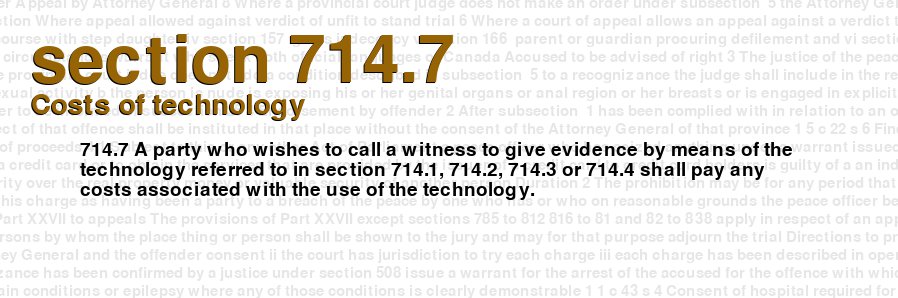
Section 714.7 of the Criminal Code of Canada outlines the responsibility of a party that intends to call a witness to give evidence through technology as stated in section 714.1, 714.2, 714.3 or 714.4. In this context, technology refers to audio or video conference, electronic means, facsimile or any other similar means of communication.
The section makes it clear that the party calling the witness must bear any costs associated with the use of the technology. This may include expenses related to the equipment necessary to facilitate the virtual communication, such as webcams, microphones, and video conferencing software. The party must also be responsible for the costs associated with the maintenance and operation of the equipment throughout the proceedings.
This provision has significance in cases where a witness is unable to appear in person, such as if they live in a different jurisdiction or are unable to travel. With the advance of technology, it is now feasible to use virtual means of communication to enable the witness to give evidence remotely. This provision also allows for the proceedings to continue in spite of any logistical challenges that may arise.
The primary purpose of this section is to ensure that any party calling a witness via technology is aware that they are responsible for the costs associated with the use of that technology. This provision highlights the importance of considering the use of technology in criminal proceedings and makes it more accessible for witnesses who may face challenges with travel or other logistical considerations. Overall, Section 714.7 of the Criminal Code of Canada seeks to mitigate the financial burden of using technology in criminal proceedings.
Commentary
Section 714.7 of the Criminal Code of Canada is a relatively straightforward provision that outlines the financial responsibility of parties who wish to utilize technological means to call witnesses to provide testimony in court proceedings. This section essentially stipulates that any party who wishes to call a witness to testify via technological means, such as videoconferencing or other remote communication technologies, must bear the costs associated with that use of technology.
One of the primary reasons for this provision is to ensure that the costs of utilizing technological means to call witnesses are not borne by the court system or other third parties. Using technological means to call witnesses can be highly beneficial, as it can help to reduce costs, increase efficiency, and make the criminal justice system more accessible to individuals who may be unable to travel long distances to attend court proceedings. However, it is essential to ensure that these benefits are not achieved at the expense of the court system or other parties.
By placing the responsibility for the costs of using technological means on the parties themselves, Section 714.7 ensures that those who stand to benefit from using these technologies bear the costs associated with their use. This can help to prevent abuse of the technological means and ensure that the criminal justice system operates efficiently. Ultimately, the provision ensures that the cost-benefit analysis of using technology to call witnesses is made by the parties themselves, rather than being imposed on others.
There are several important implications of Section 714.7. First, parties that wish to utilize technological means to call witnesses must be prepared to bear the costs associated with these technologies. This requirement may influence the decision of whether to use technology or not, as parties will need to weigh the costs against the benefits of using these means.
Additionally, the provision may have implications for access to justice. Individuals who are unable to bear the costs associated with using technological means to call witnesses may be disadvantaged, particularly if the use of this technology is essential to their case. This is an important consideration, and one which policymakers and lawyers must take into account when considering the use of technology in court proceedings.
Finally, Section 714.7 is reflective of a broader trend in the criminal justice system towards the increased use of technology. As technology continues to advance, courts may increasingly rely on remote communication technologies to facilitate testimony and other aspects of the criminal justice process. Section 714.7 ensures that any costs associated with these changes are borne by the parties themselves, rather than being imposed on third parties.
In conclusion, Section 714.7 of the Criminal Code of Canada is a crucial provision that ensures parties that wish to use technological means to call witnesses bear the costs associated with this use. While this provision contributes to the efficiency and accessibility of the criminal justice system, it may also have implications for access to justice and the broader use of technology in court proceedings. As such, it is essential that policymakers and legal professionals continue to monitor the proper implementation of this provision and consider its broader implications for the criminal justice system.
Strategy
Section 714.7 of the Criminal Code of Canada is a crucial provision that outlines the responsibility of a party wishing to call a witness to give evidence by means of technology to pay any costs associated with the use of the technology. The section provides strategic considerations for parties in criminal trials who are considering the use of technology to present evidence. The section presents an opportunity for parties to decide on the most effective strategies to present their cases while minimizing costs and resources used. In this article, we will examine some strategic considerations when dealing with this section of the Criminal Code of Canada and some strategies that could be employed.
One of the most significant strategic considerations when dealing with section 714.7 of the Criminal Code of Canada is the cost implication. The section provides that a party that seeks to use technology to present evidence in court must bear the costs associated with it. The cost of using technology to present evidence varies depending on the type of technology and the trial's complexity. Therefore, parties must determine whether they have the resources to pay for these costs before deciding to use the technology.
Another critical strategic consideration to make when dealing with section 714.7 is the potential benefits of using technology to present evidence. While the cost of using technology may be a concern, there are significant benefits to be gained from its use. One significant benefit is the opportunity for witnesses who are unable to attend court in person to testify remotely. Remote testimony saves time and resources and ensures that the case proceeds efficiently. Additionally, using technology to present evidence allows for the presentation of complex or technical evidence through visual aids. Such presentations are more effective in communicating complex or technical concepts to judges and juries.
When dealing with section 714.7 of the Criminal Code of Canada, it's also essential to consider the type of technology to be used. There are several types of technology that can be employed to present evidence in court, including video conferencing, live streaming, and telephonic communication. The party presenting evidence must identify the most appropriate technology to use based on the evidence's nature and the witness's location. For example, a witness who lives outside the country may require a different technology to one who lives within the country.
Effective communication between the parties involved in a trial is another strategic consideration to make when dealing with section 714.7. Parties must be able to agree on the most appropriate technology to use, the costs incurred and how they will be shared, and any other issues that may arise. This may require cooperation and collaboration amongst the parties, legal counsel, and the court.
Finally, when dealing with section 714.7 of the Criminal Code of Canada, parties must be aware of the potential limitations of using technology to present evidence in court. The technology used must provide reliable and accurate communication of the witness's evidence. There may be technical hitches such as internet connectivity, sound quality, or video resolution that could impact the reliability of the evidence. These issues could affect the probative value of the evidence, and parties must be aware of them.
In conclusion, section 714.7 of the Criminal Code of Canada is an essential provision that provides crucial strategic considerations when dealing with evidence presentation using technology. Parties must consider the cost implications, benefits of using technology, the type of technology, effective communication, and potential limitations before deciding to use technology. By considering these factors, parties can present their cases more effectively, minimize resources used, and ensure the evidence presented is reliable.