Editorial Annotation
Definition of data
Introduction
This section defines data as representations of information or concepts prepared for use in a computer system.
Statutory Text
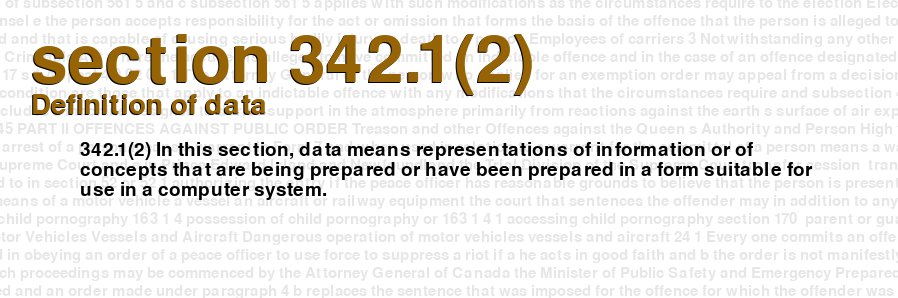
342.1(2) In this section, "data" means representations of information or of concepts that are being prepared or have been prepared in a form suitable for use in a computer system.
Explanation
Section 342.1(2) offers a definition of the term 'data' used in the section. The section is part of the Canadian Criminal Code and deals with the accessing of computer systems, stealing or falsifying data, and the distribution of information that has been obtained without authorization. The Section makes it a criminal offense to access a computer system without authorization, and to access specific types of data such as passwords and security codes.
The definition of 'data' provided in Section 342.1(2) is essential in clarifying the scope of what constitutes an offense in the context of this section of the Criminal Code. 'Data' refers to representations of information or concepts that are created or have been created for use in a computer system. This includes all kinds of digital information, such as text, images, audio and video files.
The Section is designed to protect computer systems and information from unauthorized access, theft, and tampering. It is important for law enforcement agencies to have the tools necessary to investigate and prosecute computer-related crimes, and Section 342.1(2) is an important part of those tools.
In summary, Section 342.1(2) of the Canadian Criminal Code provides a definition of the term 'data' as used in this section. The purpose of the Section is to prevent unauthorized access to computer systems and the misuse of information contained within those systems. This Section is crucial in the prevention and prosecution of computer-related crimes.
Commentary
Section 342.1(2) of the Criminal Code of Canada is a crucial provision that defines the term "data" as it applies to the Computer-related Offences provisions of the Code. This provision is significant because it clarifies that data, in Canadian law, is not just limited to electronic files or documents. Rather, it encompasses all representations of information or concepts that are prepared or being prepared in a form suitable for use in a computer system.
This broad definition of data recognizes that information is not limited to traditional forms like paper or hard drives. In today's digital age, data can take many forms, including emails, text messages, social media posts, and even voice memos. As technology continues to evolve and new methods of communication arise, it is important that the law remains adaptable and can encompass these various forms of data.
The importance of this provision is also highlighted by the fact that it is used in the context of several criminal offences related to computer misuse. For example, Section 342.1(1)(b) of the Criminal Code criminalizes "fraudulent use of a computer system or data", while Section 342.3(1)(c) makes it an offence to "possess any data with the intent to commit an offence." These provisions rely on a clear definition of the term "data" in order to properly apply to a broad range of actions, from stealing passwords to accessing private information on a computer system.
Moreover, the definition of data in Section 342.1(2) has been referenced in numerous cases where individuals have been charged with computer-related offences. For instance, in R. v. Huszti, the Ontario Court of Appeal considered whether an email containing sexually explicit photos was "data" under the Criminal Code. The court ultimately found that it was, citing Section 342.1(2) as support for this conclusion.
In addition to aiding in the interpretation and application of criminal offences related to computer misuse, Section 342.1(2) serves as a reminder of the central role that technology plays in modern society. It acknowledges that data and information are critical components of many aspects of life, from personal communications to business operations. As such, the importance of protecting these digital assets in accordance with Canadian law cannot be overstated.
Overall, Section 342.1(2) of the Criminal Code of Canada is a crucial provision that defines the term "data" as it applies to computer-related offences. This definition is essential for ensuring that the law remains adaptable to new forms of technology and communication, and provides a clear framework for prosecuting those who commit offences related to computer misuse.
Strategy
Section 342.1(2) of the Criminal Code of Canada defines "data" as any form of information or concept that has been prepared or is being prepared for use in a computer system. This section is critical, especially in the contemporary world where the use of digital systems and electronic communication is on the rise. The section criminalizes any unauthorized access to computer systems, attempts to commit fraud using electronic devices, and interception of electronic communication.
To ensure compliance with the Criminal Code of Canada, individuals, businesses, and organizations must adopt strategic considerations to protect their computer systems and electronic communication. One of the primary strategies is implementing stringent access controls, which ensure that only authorized personnel access critical systems. This could involve enforcing strong passwords and two-factor authentication protocols.
Another strategic consideration is maintaining regular software updates and patches. These updates are essential in addressing known vulnerabilities in software and ensuring that devices are protected against cyber-attacks.
Encryption is also critical when dealing with sensitive data. Encryption involves the use of algorithms to scramble data and render it unreadable to unauthorized persons. Implementing encryption protocols across electronic communication and computer systems ensures that data remains confidential and secure.
Businesses and organizations should also establish comprehensive incident response plans to detect, respond to, and recover from cyber-attacks. Incident response plans outline the steps that individuals and organizations should take in the event of a cyber-attack, including isolating affected systems, notifying authorities, and restoring operations.
In conclusion, strategic considerations are essential when dealing with section 342.1(2) of the Criminal Code of Canada. Strategies such as implementing access controls, software updates and patches, encryption, and incident response plans will help protect computer systems and electronic communication from cyber threats. Adopting these strategies will ensure that individuals, businesses, and organizations comply with the law and protect themselves from cybercriminals.