Editorial Annotation
Evidence of character
Introduction
This section allows evidence of an offenders character and repute to be admitted in certain circumstances.
Statutory Text
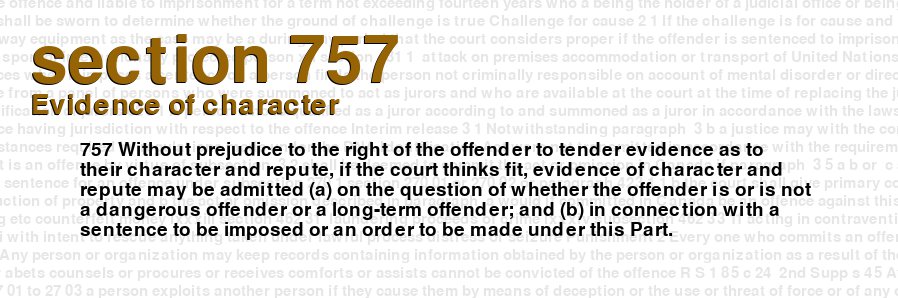
757 Without prejudice to the right of the offender to tender evidence as to their character and repute, if the court thinks fit, evidence of character and repute may be admitted (a) on the question of whether the offender is or is not a dangerous offender or a long-term offender; and (b) in connection with a sentence to be imposed or an order to be made under this Part.
Explanation
Section 757 of the Criminal Code of Canada deals with the admissibility of evidence related to the character and repute of an offender in the court of law. The section allows for the admission of such evidence under certain circumstances, without prejudice to the right of the offender to present their own evidence of character and reputation.
The first context in which character and repute evidence can be admitted is when the court is considering whether the offender is a dangerous offender or a long-term offender. The designation of dangerous offender or long-term offender has significant implications for the offender's sentence and future dangerousness. As such, character and repute evidence can be relevant to establish the likelihood of rehabilitation, potential future dangerousness, and the extent of the offender's criminal history.
The second context in which evidence of character and repute can be admitted is in relation to the sentence to be imposed or a court order made under Part XXIV of the Criminal Code. This includes the sentencing for a range of serious offences, such as murder, sexual assault, and drug trafficking, where the court must consider factors such as the gravity of the offence, the offender's culpability, and the need for deterrence and rehabilitation.
In both contexts, character and repute evidence can be used to provide context and perspective about the offender's life and background, and their potential for rehabilitation and reintegration back into society. However, the admission of such evidence is not automatic or mandatory, and the court must use its discretion in determining the relevance and admissibility of character and repute evidence in a particular case.
Overall, Section 757 of the Criminal Code of Canada recognizes the importance of considering an offender's character and repute in certain contexts, while balancing the need for justice, accountability, and rehabilitation in criminal sentencing and court proceedings.
Commentary
Section 757 of the Criminal Code of Canada outlines the admissibility of evidence regarding an offender's character and repute. The section acknowledges the right of the offender to present evidence of their character and repute, but additionally permits the court to consider such evidence on its own accord.
The section specifies two instances in which evidence of character and repute may be admitted. Firstly, in cases where the court must determine whether an offender is a dangerous offender or a long-term offender. This determination is significant as it can result in longer periods of incarceration or specific conditions being imposed upon the offender's release. In these cases, evidence of an offender's character and repute can provide insight into their likelihood of reoffending and their ability to follow conditions of release.
Secondly, evidence of character and repute may be considered in connection with a sentence to be imposed or an order to be made under this Part. This allows the court to consider an offender's past behavior and actions, as well as the opinions of others regarding their character, when making decisions about an appropriate sentence or order. This consideration can be especially important given the potential for disparities in sentencing and the need to ensure that sentences are proportionate to the gravity of the offense and take into account all relevant circumstances.
One potential concern with the admission of evidence of character and repute is the potential for bias. This evidence may be based on subjective impressions of an offender's character, rather than objective evidence of their actions and behavior. Additionally, there is a potential for the court to rely too heavily on this evidence, rather than considering all relevant factors, including the nature of the offense and the need to protect the public.
However, the use of evidence of character and repute can also serve important purposes. It provides a more nuanced understanding of an offender's history and potential for future harm, and can help to determine the most appropriate sentence or order for a given offender. It can also help to ensure that unjustified disparities in sentencing are avoided, as all relevant factors are considered in making decisions.
In conclusion, section 757 of the Criminal Code of Canada allows for the consideration of evidence of character and repute in certain circumstances. While there are potential concerns about bias and over-reliance on this evidence, its use can also serve important purposes in ensuring fair and proportionate sentencing decisions. Ultimately, whether or not to admit evidence of character and repute is a decision for the court to make on a case-by-case basis, weighing the potential benefits and risks of such evidence.
Strategy
Section 757 of the Criminal Code of Canada presents an opportunity and a challenge for defense counsel. The section allows for the admission of evidence of character and repute, but the decision to do so should be carefully considered and strategically employed. Below are some strategic considerations when dealing with this section of the Criminal Code of Canada and some possible strategies that could be employed.
Strategic Considerations
1. Timing: The timing of when to present evidence of character and repute is crucial. It should be presented at the most opportune moment to have the greatest impact. Ideally, the evidence should be presented when the judge is most sympathetic to the offender's circumstances.
2. Relevance: The evidence of character and repute must be carefully selected and presented only if it is relevant to the case. It is crucial to determine the relevance of the evidence to avoid presenting irrelevant information that could damage the offender's credibility.
3. The nature of the charges: The nature of the charges should be considered when deciding whether to present evidence of character and repute. If the offense is violent or sexual in nature, it may be difficult to present strong character evidence. In contrast, if the offender is charged with a non-violent offense, it may be more feasible to present evidence of their good character.
4. The strength of the evidence: The quality of the evidence of the offender's character and repute is an essential consideration. It is more effective to present strong evidence, rather than weak or contradictory evidence that could weaken the case.
5. The risks: There are risks associated with presenting evidence of character and repute. The prosecution may cross-examine friends or family members who testify on behalf of the offender. This may lead to unintended damage to the offender's credibility if the witnesses are not prepared or confident on the stand.
Possible Strategies
1. Choose the right witnesses: Counsel should choose witnesses who can testify convincingly on behalf of the offender. It is essential to ensure that the witnesses have a strong personal relationship with the offender and can provide specific examples of their positive character.
2. Focus on positive attributes: Counsel should focus on presenting evidence of the offender's positive attributes, such as their honesty, generosity, and work ethic. This is to humanize the offender in the eyes of the court and present a positive image.
3. Avoid negative testimony: Counsel should avoid presenting negative character evidence about the victim or the prosecution's witnesses, as this may backfire and harm the offender's case.
4. Present psychological evidence: Counsel may choose to present psychological evidence, such as expert testimony, that explains the offender's behavior and provides insight into their character. This may be particularly useful in cases where mental health issues or addiction are factors.
5. Prepare witnesses: Counsel should prepare witnesses in advance to ensure they are clear on the evidence they will present and are comfortable testifying in court. This will minimize any risk of cross-examination that could damage the offender's case.
Conclusion
In conclusion, section 757 of the Criminal Code of Canada presents both an opportunity and a challenge for defense counsel. Careful consideration of the evidence of character and repute, timing, and risks is essential. Preparing witnesses thoroughly is also crucial to presenting a strong case. These strategic considerations and possible strategies can help ensure that evidence of character and repute is presented effectively in court.