Editorial Annotation
Exception to long-term supervision life sentence
Introduction
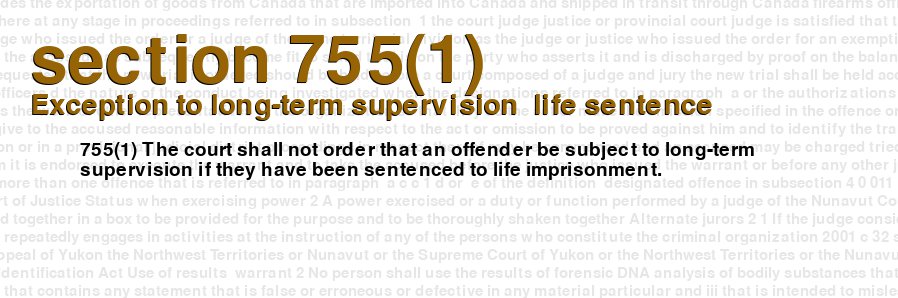
Offenders sentenced to life imprisonment cannot be subject to long-term supervision.
Statutory Text
Explanation
Section 755(1) is a provision within the Criminal Code of Canada that outlines the circumstances under which an offender can be subject to long-term supervision. Specifically, it states that if an offender has been sentenced to life imprisonment, the court cannot order that they be subject to long-term supervision.
Long-term supervision is a form of community supervision that is imposed on offenders who have completed their sentence but are still considered to pose a risk to public safety. It can involve curfews, regular check-ins with a parole officer, and other restrictions on the offender's behaviour.
The purpose of long-term supervision is to monitor the offender's behaviour and prevent them from committing further crimes. However, it is not a punishment in and of itself. Rather, it is a means to ensure public safety and encourage rehabilitation.
The reason that Section 755(1) prohibits the court from ordering long-term supervision for offenders who have been sentenced to life imprisonment is because life imprisonment is already considered the most severe penalty that can be imposed in Canada. The length of a life sentence varies, but it generally entails a minimum of 25 years in prison before the offender is eligible for parole. Thus, the court has already determined that the offender presents a significant risk to public safety and has imposed the harshest penalty available.
In summary, Section 755(1) of the Criminal Code of Canada prohibits the court from ordering long-term supervision for offenders who have been sentenced to life imprisonment, as they are already subject to the most severe penalty available. This provision underscores the gravity of a life sentence in Canadian law and the importance of protecting public safety through the criminal justice system.
Commentary
Section 755(1) of the Criminal Code of Canada prohibits the courts from mandating long-term supervision for offenders who have already been sentenced to life imprisonment. This section represents the continued debate over the appropriate role for punishment and rehabilitation within the Canadian criminal justice system.
On one hand, long-term supervision can be an important mechanism for ensuring the safety of the public when it comes to potentially dangerous offenders. After all, even individuals who have received life imprisonment are still capable of committing violent or harmful acts if they are released back into the community without any form of supervision or support. By mandating long-term supervision for these offenders, the courts can help to mitigate this risk, thereby promoting public safety in the long term.
However, some argue that the idea of "long-term supervision" is fundamentally at odds with the idea of "life imprisonment". The latter is meant to be the most severe form of punishment available to the courts, reserved for the most serious of crimes and offenders. By adding an additional layer of supervision on top of this already severe sentence, critics argue that the courts are eroding the legitimacy of life imprisonment altogether.
Moreover, some worry that long-term supervision may represent an unnecessary financial burden on the criminal justice system. Supervising an offender for the rest of their life can be expensive, particularly if the individual requires ongoing therapeutic or mental health support. This might explain why the judges and legislators of Canada have limited the instances where long-term supervision may be mandated.
Ultimately, the debate over long-term supervision is a reflection of the larger tension between punishment and rehabilitation in the criminal justice system. Those who support more punitive measures tend to believe that offenders should be punished to the fullest extent of the law, while those who emphasize rehabilitation tend to believe that offenders should be given a chance to reform themselves and reintegrate into the wider community with the appropriate support.
Whether or not the prohibition on long-term supervision for those who have received life imprisonment is the right decision is a question of moral, economic, and social factors that will continue to divide informed opinion for the foreseeable future. Only one thing is certain, the topic of criminal justice reform in Canada is a never-ending saga which requires a careful balance of both concepts of punishment and rehabilitation.
Strategy
Section 755(1) of the Criminal Code of Canada prohibits courts from ordering long-term supervision for offenders sentenced to life imprisonment. This section poses a significant challenge for legal practitioners and courts when dealing with offenders who may have committed serious and violent crimes.
One strategic consideration when dealing with this section is the fact that offenders sentenced to life imprisonment are typically considered high-risk offenders who may pose a threat to society upon release. Therefore, it is essential to come up with comprehensive and effective strategies to mitigate this risk and protect the public. This may involve working with other criminal justice stakeholders, such as parole boards, correctional facilities, and community organizations, to develop appropriate risk management plans.
Another strategic consideration is that this section limits the options available to the courts when dealing with offenders. The prohibition on long-term supervision means that the courts cannot order an offender to be monitored in the community for an extended period after their release, which may be seen as a significant disadvantage in terms of public safety. In such cases, alternative strategies, such as the use of highly restrictive and intensive supervision and monitoring programs, may be considered to fill this gap.
Strategies that could be employed to address this limitation of the Criminal Code may include emphasizing the importance of post-release supervision and management in the sentencing hearing. The defense could argue that, even though long-term supervision is not available, other forms of supervision and monitoring may be necessary to protect the public and successfully reintegrate the offender into society. This argument may be particularly effective if supported by compelling evidence or expert testimony.
Another strategy is to explore other options available in the Criminal Code that may serve similar purposes as long-term supervision, such as intermittent and conditional sentences. Although offenders sentenced to life imprisonment are not eligible for these types of sentences, it may be possible to use them when appropriate for other offenders or for specific charges.
Furthermore, it may be possible to challenge the constitutionality of section 755(1) under the Charter of Rights and Freedoms. The defense could argue that the provision violates the offender's rights to liberty and security of the person, as well as their rights to equal protection under the law. This argument may require extensive legal research and analysis as well as a comprehensive understanding of Charter jurisprudence.
Overall, when dealing with section 755(1) of the Criminal Code of Canada, it is crucial to consider the unique circumstances of the case, the risks and needs of the offender, and the safety of the public. Employing a strategic and informed approach may help to ensure that appropriate and effective risk management strategies are put in place, despite the limitations of the law.