Editorial Annotation
Definition of court of appeal
Introduction
The definition of the court of appeal is provided for applications made under this Part of the Criminal Code.
Statutory Text
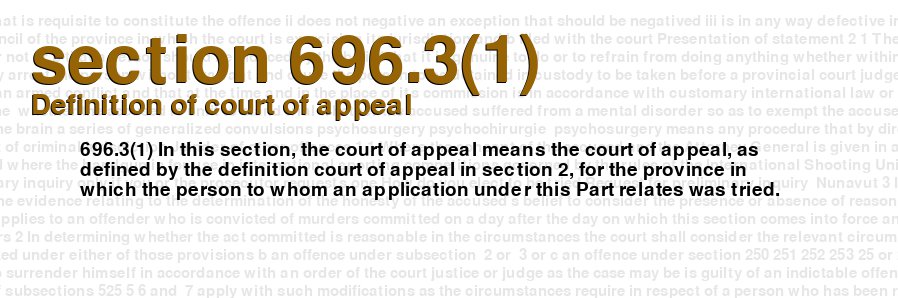
696.3(1) In this section, "the court of appeal" means the court of appeal, as defined by the definition "court of appeal" in section 2, for the province in which the person to whom an application under this Part relates was tried.
Explanation
Section 696.3(1) of the Criminal Code of Canada is a definition section that relates to Part XXI of the Code, which deals with appeals. Specifically, it defines the court of appeal" for the purposes of this Part as the court of appeal for the province in which the person being appealed was tried.
This definition is important because appeals are heard by different courts depending on the type of offence and the stage of the proceedings. In general, the court of appeal is the highest court in the province that has jurisdiction over criminal appeals. However, in certain cases, such as appeals from summary conviction offences or bail hearings, other courts may have jurisdiction.
By defining the court of appeal" in this way, section 696.3(1) ensures that individuals who are appealing their convictions or sentences know which specific court they need to apply to. This is important because different courts may have different rules and procedures for appeals, and it is crucial to follow these rules in order to have the appeal heard.
Overall, section 696.3(1) is a technical definition that clarifies the jurisdiction of the court of appeal for the purposes of Part XXI of the Criminal Code. It is an important provision for individuals who are appealing their convictions or sentences because it helps ensure that they apply to the correct court and follow the appropriate procedures.
Commentary
Section 696.3(1) of the Criminal Code of Canada is a provision that clarifies the definition of the term "court of appeal" in the context of an application under Part XXI of the Criminal Code. This provision is important because it provides a clear framework for the interpretation and application of Part XXI, which governs the appeals process for criminal convictions.
Part XXI of the Criminal Code provides a mechanism for individuals to appeal their criminal convictions to a higher court. This process enables defendants who have been convicted of a criminal offence to challenge the decision of the trial court and seek a new trial or have their conviction overturned. As part of this process, the application for appeal is typically made to the court of appeal for the province in which the defendant was tried.
Section 696.3(1) defines the term "court of appeal" as it relates to Part XXI. Specifically, it refers to the definition of that term in section 2 of the Criminal Code, which provides a general definition of the term "court of appeal". However, in the context of Part XXI, the term "court of appeal" takes on a specific meaning based on the province in which the defendant was tried.
The purpose of this provision is to ensure that individuals seeking to appeal their criminal convictions understand which court has jurisdiction to hear their application. By clarifying the definition of the term "court of appeal," section 696.3(1) provides greater certainty and clarity for individuals seeking to appeal their convictions. This is important because the appeals process can be complex, and individuals who are not familiar with the legal system may find it difficult to navigate.
Moreover, section 696.3(1) is also important because it highlights the importance of identifying the correct court of appeal when filing an application. If an individual files an application with the wrong court of appeal, it will likely be dismissed, and the individual will need to start the process over. This can be time-consuming and costly, and it may further delay the appeal process for the individual.
In conclusion, section 696.3(1) of the Criminal Code of Canada clarifies the definition of the term "court of appeal" in the context of an application under Part XXI. By providing a clear framework for the interpretation and application of Part XXI, this provision ensures that individuals seeking to appeal their criminal convictions have a better understanding of the appeals process and the court that has jurisdiction to hear their application. Overall, this provision is an important aspect of Canada's criminal justice system, as it ensures fairness and transparency in the appeals process.
Strategy
Section 696.3(1) of the Criminal Code of Canada is a critical provision that defines the court of appeal for the province in which the case is being tried. It's a crucial section that lawyers must consider when dealing with appeals and revisions in criminal cases. This provision sets out the jurisdictional reach of the appellate courts, which is crucial for the defendant when seeking a remedy for errors in the lower court proceedings.
One of the first strategic considerations in dealing with this section is to determine the intended outcome of the appeal. Defence counsel must consider whether the best course of action is to pursue a reversal of the conviction or sentence, to win a new trial or sentencing hearing, or to secure a remedy such as a stay of proceedings. The next step is identifying the relevant appellate court based on where the crime occurred, which determines which court of appeal has jurisdiction over the appeal.
Another strategy in dealing with this section is to understand the precedent set by past cases heard by the court of appeal. Familiarizing oneself with precedents helps counsel to understand the likely legal framework that will influence the outcome of the appeal. These precedents define a particular court of appeal and influence how they decide similar cases. Consequently, lawyers must consider the legal doctrines, and legal precedents that the Court will refer to when deciding the case.
Another strategy is to engage appellate counsel with appropriate experience. While trial lawyers concentrate on facts and oral persuasion, appellate lawyers are specialists in appeals and revisions, and they bring a unique set of skills and expertise to the proceedings. Experienced appellate counsel understands the legal doctrines and precedents, and can effectively present your case to the court of appeal.
Finally, one should conduct thorough research of any potential breaches of the Criminal Code of Canada. An analysis of the code can identify any errors made in the trial chambers, such as heresy, trial fairness, improper objections, jury selection and prosecutorial misconduct, allowing the appeal to be filed appropriately.
In conclusion, Section 696.3(1) of the Criminal Code of Canada plays an essential role in the Canadian justice system, and it determines the jurisdiction of the appeal that will be heard. Strategic considerations such as understanding the precedents, engaging experienced appellate counsel, researching the case, and defining the intended outcome of the appeal will all influence the success of an appeal and must all, therefore, be carefully considered.