Editorial Annotation
Identity fraud
Introduction
The Criminal Code of Canada section 403(1) makes it an offense for someone to fraudulently pretend to be someone else with the intention of gaining advantage, obtaining property, causing disadvantage, or avoiding arrest/prosecution.
Statutory Text
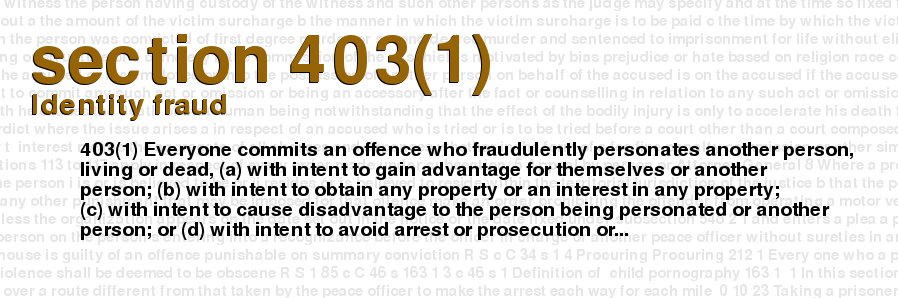
403(1) Everyone commits an offence who fraudulently personates another person, living or dead, (a) with intent to gain advantage for themselves or another person; (b) with intent to obtain any property or an interest in any property; (c) with intent to cause disadvantage to the person being personated or another person; or (d) with intent to avoid arrest or prosecution or to obstruct, pervert or defeat the course of justice.
Explanation
Section 403(1) of the Criminal Code of Canada outlines the offence of fraudulently impersonating another person, whether they are alive or deceased. This offence is considered serious as it can cause harm to individuals and society as a whole through the theft of property, harm to reputations or obstruction of justice.
The definition of fraudulent impersonation means that the individual acted with intent to deceive others by posing as someone else. This can include using a false name or identification, pretending to be someone they are not, or assuming the identity of a deceased individual.
The act of fraudulent impersonation is considered an offence if it is committed with the intent to gain an advantage or benefit for oneself or another person, to obtain property or interests in property, or to cause harm to the person being impersonated or another person. Additionally, this offence can also be committed with the intention to avoid arrest or prosecution or to obstruct, pervert or defeat the course of justice.
The Criminal Code of Canada recognizes the severity of this offence and provides for harsh penalties for those convicted. If found guilty, an individual may face imprisonment for up to ten years or a fine, or both.
Overall, Section 403(1) of the Criminal Code of Canada highlights the importance of maintaining the integrity of personal identities and protecting individuals from harm caused by fraudulent impersonation.
Commentary
Section 403(1) of the Criminal Code of Canada is concerned with fraudulent impersonation, an offence that is considered criminal under Canadian law. The section is explicit, defining the offence as committing fraud by pretending to be another person, either living or dead, with the intention of either gaining an advantage for oneself or another person, obtaining property or an interest in property, causing a disadvantage to the person being impersonated or another person, or obstructing the course of justice.
The use of fraudulent impersonation has become increasingly common in the modern era, with the advent of the internet and the ease with which personal information can be obtained by fraudsters. The ability to impersonate another person has allowed criminals to commit fraud, theft, identity theft, and a host of other criminal activities under the guise of someone else, often with little consequence. It is for this reason that Section 403(1) of the Criminal Code is necessary as a tool to discourage and punish fraudulent impersonation.
One of the key aspects of this section is the requirement that the person committing the offence does so with the intention of gaining some advantage under one of the situations mentioned in the section. This is essential for the establishment of the offence since without this requirement, any person who impersonates another could be charged with an offence, even if they had no intention of gaining any advantage.
The first situation mentioned in the section is with the intent to gain an advantage for oneself or another person. This is a very broad interpretation and includes any advantage that could be obtained through impersonation. For example, a person could pretend to be someone else to gain access to a bank account, obtain a loan, or even to get a job.
The second situation is with the intent to obtain any property or an interest in property. This is also a very broad interpretation and could include any property that is owned by the person being impersonated or any property that can be obtained using the false identity.
The third situation is with the intent to cause a disadvantage to the person being personated or another person. This could include situations such as impersonating someone to spread false information about them, to damage their reputation or to get them into trouble with the law.
Finally, the fourth situation listed in the section is with the intent to avoid arrest or prosecution or to obstruct, pervert or defeat the course of justice. This is a significant offence and carries a heavy penalty under Canadian law. A person committing this offence could be said to be subverting the course of justice, effectively denying the accused their right to a fair trial.
In conclusion, Section 403(1) of the Criminal Code of Canada is necessary in combating fraudulent impersonation and associated crimes. Fraudulent impersonation is used to subvert the course of justice, commit fraud and theft, and many other crimes. This section of the Criminal Code ensures that those engaging in such activities face the full force of the law. In addition, the requirement that the offence was committed with intent helps to ensure that innocent mistakes are not prosecuted. As technology continues to evolve, it is reassuring to know that such legislation is in place to protect Canadians from the abuse of their personal information.
Strategy
When it comes to dealing with Section 403(1) of the Criminal Code of Canada, there are a number of strategic considerations that should be taken into account. Some of the most critical include identifying potential cases of fraudulent personation, understanding the specific circumstances surrounding the alleged offence, and implementing effective investigation and prosecution strategies.
One of the key challenges in dealing with this section of the Criminal Code is identifying what exactly constitutes fraudulent personation. To be considered a criminal offence, the actions in question must involve an intentional and knowing attempt to deceive others by impersonating someone else. This can include using false identification documents or otherwise misrepresenting oneself in order to gain an advantage, obtain property, cause disadvantage to another person, or avoid arrest or prosecution.
One of the most important strategic considerations when dealing with this offence is to carefully analyze the specific facts and circumstances surrounding the alleged offence. For example, in cases where the defendant claims to have acted under duress or in self-defense, it may be necessary to conduct a more thorough investigation or to gather additional evidence in order to determine the validity of these claims.
Another key strategic consideration is to develop a sound investigation and prosecution strategy that will maximize the chances of a successful outcome in court. This may involve working closely with law enforcement agencies, conducting interviews with witnesses and potential witnesses, gathering and analyzing evidence, and building a strong case based on the specific facts and circumstances of the alleged offence.
Some specific strategies that could be employed in dealing with cases of fraudulent personation might include conducting undercover operations to identify potential offenders, developing partnerships with industry groups and other stakeholders to raise awareness about the issue, and working closely with prosecutors and other law enforcement agencies to ensure that cases are properly investigated and prosecuted.
Ultimately, the goal when dealing with any offence under Section 403(1) of the Criminal Code of Canada is to ensure that justice is served and that responsible parties are held accountable for their actions. This requires a careful and strategic approach that takes into account the unique circumstances of each case, as well as the broader social and legal context within which these offences occur. By working together and leveraging the full range of available resources, we can help to prevent fraud and protect the rights of all Canadians.