Editorial Annotation
Punishment
Introduction
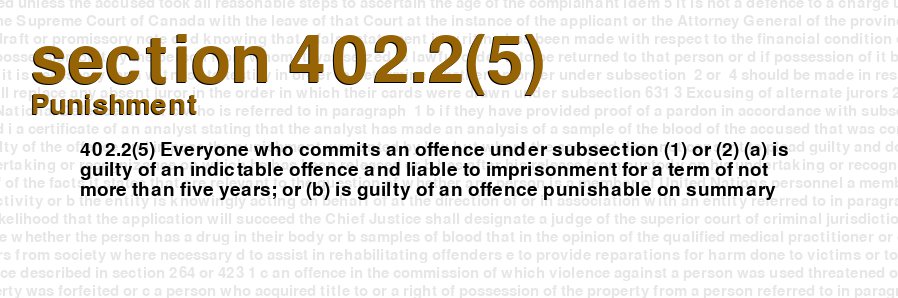
This section outlines the potential punishments for committing an offence under subsections (1) or (2) of section 402.2 of the Criminal Code of Canada.
Statutory Text
Explanation
Section 402.2(5) of the Criminal Code of Canada is related to the offense of participating in a criminal organization. The section states that anyone who commits an offense under subsection (1) or (2) is guilty of an indictable offense and can be imprisoned for a maximum of five years. The offense of participating in a criminal organization is one that is taken seriously in Canada, and this is reflected in the strict penalties outlined in this section.
Subsection (1) of section 402.2 defines the offense of participating in a criminal organization as anyone who knowingly participates in or contributes to any activity of a criminal organization for the purpose of enhancing the ability of the organization to facilitate or commit an indictable offense. Subsection (2) of the same section defines other activities that constitute an offense under this section. These include instructing or directing another person to carry out a criminal activity, engaging in activities that support the criminal activities of the organization, and aiding or abetting any person involved in the activities of the organization.
The maximum penalty for an offense under this section is five years, which can be imposed in cases where the offense is considered serious. In less severe cases, the offender can be charged with an offense that is punishable on summary conviction. This means that the offender can be fined or imprisoned for a maximum of two years, or both, at the discretion of the court.
In summary, section 402.2(5) of the Criminal Code of Canada is designed to deter individuals from participating in criminal organizations. The section outlines strict penalties that can be imposed for offenses under subsections (1) and (2), and these penalties are reflective of the seriousness of the offense. It is a powerful tool used by the Canadian government to combat organized crime and maintain a safe and just society.
Commentary
Section 402.2(5) of the Criminal Code of Canada is a provision that imposes stiff penalties for acts of mischief involving property. According to this section, anyone who commits an offence under subsection (1) or (2) will be charged under an indictable offence and may face imprisonment for a maximum of five years. Alternatively, offenders may be charged with an offence punishable on summary conviction.
The section enumerates the acts of mischief that are punishable under the law. Subsection (1) deals with the wilful destruction or damage of property that could endanger the life of an individual. Subsection (2) relates to other forms of mischief, such as interfering with, obstructing, interrupting, or disturbing the proper use of property, or interfering with any person in the lawful use, enjoyment, or operation of property.
The provision seeks to maintain public order and protect public property by criminalizing acts that could cause physical harm to individuals or damage to public property. The provision is a vital tool in ensuring that people think twice before they engage in such conduct. The punishment prescribed under section 402.2(5) is severe and acts as a deterrence to potential offenders.
The provision also serves to ensure that victims of acts of mischief are adequately compensated. Section 402.2(6) requires the offenders to compensate the victims for the damages suffered as a result of the offence. The compensation may include the costs of repairs or the loss of use of the property. By compelling offenders to provide compensation, the provision ensures that victims are adequately compensated for their loss.
Section 402.2(5) is consistent with the objectives of the Canadian Criminal Code, which seeks to maintain public order, protect the public, and promote the safety of individuals. By punishing acts of mischief, the provision acts as a deterrent to potential offenders, thereby reducing the number of incidents of property destruction and damage.
However, some argue that the provision may be too broad and could result in the punishment of individuals who may have engaged in similar conduct unintentionally or without a criminal intent. For example, an individual may accidentally damage public property while performing an activity, which may result in criminal charges. While section 402.2(5) applies to intentional conduct, there may be instances where it may be difficult to distinguish between intentional and unintentional conduct.
In conclusion, section 402.2(5) of the Criminal Code of Canada is a provision that imposes severe penalties for acts of mischief involving property. While it serves to maintain public order and protect public property, it may be overly broad and may result in the punishment of individuals who may have engaged in similar conduct unintentionally. There may be a need to review the provision to strike a balance between punishing offenders and protecting individuals from unintended consequences.
Strategy
Section 402.2(5) of the Criminal Code of Canada deals with the offence of participating in a criminal organization. This offence is considered a serious one and has significant legal and strategic implications for both the accused and the prosecution. In this article, we will explore some strategic considerations when dealing with this section of the Criminal Code of Canada and the strategies that could be employed to handle it effectively.
Strategic considerations
1. Evidence: Proving that the accused has participated in a criminal organization can be challenging. The prosecution must present compelling evidence that establishes the accused's membership, participation, or contribution to the criminal organization. The evidence must establish a clear link between the accused and the organization's criminal activities.
2. Witnesses: The testimony of witnesses can be critical in establishing the accused's involvement in a criminal organization. However, witnesses may be reluctant to testify due to fear of retaliation from the organization. Therefore, the prosecution must ensure that witnesses are adequately protected and encouraged to testify.
3. Sentencing: If convicted, the accused is liable to imprisonment for a term of not more than five years. The severity of the sentence can vary depending on the accused's level of involvement in the criminal organization. The prosecution must factor in the accused's criminal history, prior involvement, and the nature of the organization's activities while seeking an appropriate sentence.
4. Plea bargaining: The accused may be willing to plead guilty to a lesser charge to avoid a more severe penalty. The prosecution must consider the strength of their evidence and the possibility of a conviction before considering plea bargaining.
5. Co-accused: If multiple individuals are charged with participation in a criminal organization, their cases may be interconnected. The prosecution must consider the impact of each individual's case's outcome on the others' and manage the cases accordingly.
Strategies
1. Comprehensive investigation: A thorough investigation is crucial in building a strong case against the accused. The prosecution must identify the organization's structure, hierarchy, membership, and activities to establish a clear link between the accused and the organization.
2. Witness protection: Protecting witnesses is critical to obtaining their testimony. The prosecution must work closely with authorities to offer witness protection programs, safe houses, and other measures to ensure witnesses' safety.
3. Collaboration: Collaboration between different law enforcement agencies and departments can assist in gathering relevant information. This includes intelligence gathering and sharing, which can help build stronger cases against criminal organizations and their members.
4. Evidence preservation: Documenting and preserving evidence is essential in building a strong case against the accused. It is critical to have a clear chain of custody for the evidence presented to the court.
5. Collaborative sentencing: Sentencing is a crucial phase of the case. The prosecution must collaborate with other agencies and departments responsible for the accused's conviction and sentencing to ensure that an appropriate sentence is handed out.
In conclusion, participating in a criminal organization is a serious crime with severe implications for the accused. The prosecution must take into consideration several strategic factors to build a strong case against the accused. Gathering compelling evidence, protecting witnesses, and collaborating with different agencies are some strategies employed. Additionally, the sentencing phase is crucial and must be adequately managed to ensure an appropriate sentence is handed out. By employing these strategies and taking a comprehensive approach to the case, the prosecution can effectively manage this section of the Criminal Code of Canada.