Editorial Annotation
Evidence of property in timber
Introduction
This section states that a timber mark or boom chain brand registered under any Act proves ownership of lumber or lumbering equipment in legal proceedings.
Statutory Text
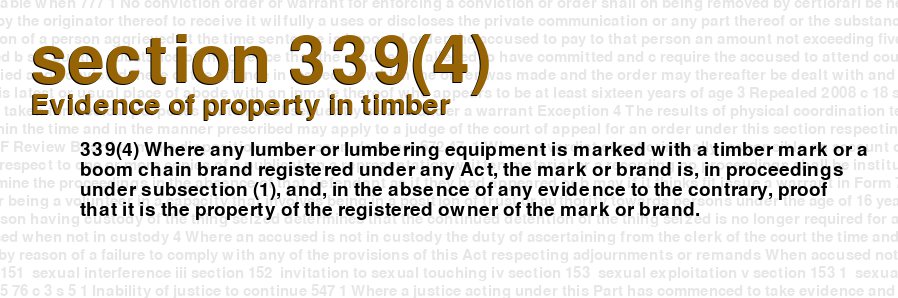
339(4) Where any lumber or lumbering equipment is marked with a timber mark or a boom chain brand registered under any Act, the mark or brand is, in proceedings under subsection (1), and, in the absence of any evidence to the contrary, proof that it is the property of the registered owner of the mark or brand.
Explanation
Section 339(4) of the Criminal Code of Canada is aimed at protecting the property rights of those involved in the lumber and lumbering equipment industry. Under this section, if any lumber or lumbering equipment is marked with a timber mark or a boom chain brand that is registered under any Act, it is presumed to be the property of the registered owner of the mark or brand, in the absence of any evidence to the contrary.
The purpose of this section is to provide a mechanism for identifying the rightful owner of the lumber or equipment. By requiring all those in the industry to register their timber marks or boom chain brands, it becomes easier to identify the owner of any specific piece of equipment or lumber.
This section is important in enforcing property rights in the industry. It ensures that if any lumber or equipment is stolen or misappropriated, the owner can quickly identify their property and take legal action to recover it.
Additionally, this section also serves as a deterrent to potential thieves or individuals looking to acquire equipment or lumber through fraudulent means. By making it clear that all marked items are the property of the registered owner, it becomes more difficult for individuals to steal or fraudulently acquire this property.
Overall, Section 339(4) is an essential tool for protecting property rights in the lumber and lumbering equipment industry. By establishing a clear legal framework for identifying and protecting property, it helps to promote a fair and just industry for all those involved.
Commentary
Section 339(4) of the Criminal Code of Canada is an important provision that serves to protect the rights of registered owners of timber marks or boom chain brands. This provision establishes a legal presumption that any lumber or lumbering equipment marked with a registered timber mark or boom chain brand is the property of the registered owner, unless there is evidence to the contrary.
The purpose of this provision is to deter theft of timber and lumbering equipment by making it easier for law enforcement authorities to enforce property rights. Timber marks and boom chain brands are registered trademarks that identify the owner of the timber or equipment. They are used to distinguish one owner's products from another and to track the movement of timber and lumbering equipment from the forest to the mill.
By creating a legal presumption that timber or lumbering equipment marked with a registered timber mark or boom chain brand belongs to the registered owner, the law provides a strong incentive for potential thieves to think twice before trying to steal such items. This is because they would be unable to sell the stolen timber or equipment without detection, and would likely face criminal charges if caught in possession of marked items.
Section 339(4) of the Criminal Code of Canada is an important provision for the forestry industry, as it helps to protect legitimate businesses from illegal competition. This is particularly important in resource-rich regions where illegal logging and theft of lumbering equipment can undermine the viability of legitimate forestry operations. By enforcing property rights, this provision helps to ensure that businesses that follow the rules are able to compete on a level playing field, without interference from criminals.
However, it is important to note that this provision is not without its limitations. In some cases, the evidence may suggest that the marked timber or equipment does not belong to the registered owner. For example, if a thief were to steal lumber marked with a registered timber mark and then modify the mark or rebrand it, there may be convincing evidence to suggest that the lumber does not belong to the registered owner. Similarly, if the registered owner has sold the timber or equipment and failed to remove the mark, there may be evidence to suggest that the current possessor is the rightful owner.
In such cases, the legal presumption established by Section 339(4) of the Criminal Code of Canada would be rebutted by the evidence, and the rightful ownership of the timber or equipment would have to be determined on a case-by-case basis. However, the legal presumption established by this provision still serves to provide a strong deterrent against theft and to protect the legitimate property rights of registered owners of timber marks and boom chain brands.
In conclusion, Section 339(4) of the Criminal Code of Canada is an important provision that helps to protect the property rights of registered owners of timber marks and boom chain brands. By creating a legal presumption in favor of registered owners, this provision serves as a strong deterrent against theft of timber and lumbering equipment and helps to ensure a level playing field for legitimate forestry businesses. While the provision is not without its limitations, it is a valuable tool for law enforcement authorities in their efforts to combat illegal logging and theft of lumbering equipment.
Strategy
Section 339(4) of the Criminal Code of Canada provides a powerful tool for owners of timber marks and boom chain brands to protect their property from theft. The provision creates a legal presumption that any lumber or lumbering equipment marked with a registered timber mark or boom chain brand is the property of the registered owner. However, to take full advantage of this provision, strategic considerations need to be taken into account.
One of the primary considerations is the need to register the timber mark or boom chain brand. Without proper registration, the legal presumption does not apply, and the burden of proof falls on the owner to demonstrate ownership. Therefore, registering the mark or brand with the appropriate authority is essential to ensure that the provision can be relied upon when needed.
Another consideration is enforcing the provision through careful monitoring of the market for stolen lumber and equipment. Theft of timber and lumbering equipment can be lucrative, especially if the theft is not detected and the stolen goods sold on the open market. Therefore, owners of registered timber marks and boom chain brands should collaborate with law enforcement agencies, logging industry associations, and other stakeholders to keep a close eye on the market and identify and recover stolen goods.
In addition, owners can employ various strategies to deter theft, such as using tracking devices, conducting regular audits of inventory, and employing security measures such as fencing and surveillance cameras. Investing in these preventive measures can help minimize the risk of theft, which ultimately reduces the need to rely on the legal presumption of ownership under section 339(4).
Finally, owners should also be mindful of their legal obligations when dealing with stolen goods. For instance, owning stolen property is a criminal offense, and therefore, owners who unwittingly purchase stolen goods run the risk of criminal liability. Moreover, it is a crime to provide false information on ownership of lumber or lumbering equipment, which, if proven, can result in penalties, including fines and jail time. Therefore, owners must handle stolen goods only through appropriate legal channels and document their ownership and transfer of ownership carefully.
In conclusion, section 339(4) of the Criminal Code of Canada provides owners of registered timber marks and boom chain brands with a powerful tool to protect their property from theft. However, taking full advantage of the provision requires careful strategic considerations, such as registering the mark or brand, monitoring the market, implementing preventive measures, and complying with legal obligations when dealing with stolen goods. By employing these strategies, owners can effectively deter theft and preserve their legal rights under the Criminal Code.