Editorial Annotation
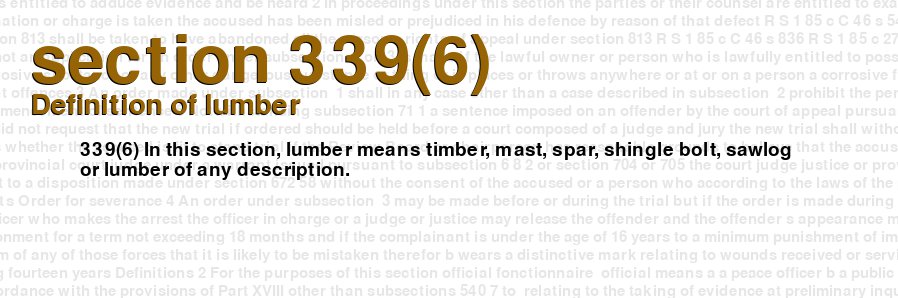
Definition of lumber
Introduction
This section defines lumber for the purposes of the criminal offense of theft.
Statutory Text
Explanation
Section 339(6) of the Criminal Code of Canada is an important provision that defines the term lumber" in the context of the criminal law. The section aims to clarify the meaning of lumber in criminal offences related to timber or forestry, and provides a comprehensive definition of the term to ensure consistent interpretation and application of the law.
The definition includes various types of timber such as mast, spar, shingle bolt, sawlog, and lumber of any description. This broad definition is important as it covers a wide range of activities and materials related to the production, processing, and transportation of timber. The definition also recognizes that lumber can be of many different types and sizes and can be used for a variety of purposes.
One of the key areas in which this definition is important is in relation to offences related to the theft or illegal harvesting of timber or lumber. The definition of lumber" in this context ensures that all forms of timber and lumber are covered by the law, and that offenders cannot escape liability by claiming that they were dealing with a different type or form of wood.
Overall, section 339(6) is an important provision that helps to ensure clarity and consistency in the interpretation and application of criminal law related to timber and forestry. By providing a clear definition of lumber", the section provides legal certainty and helps to ensure that offenders are held accountable for their actions.
Commentary
Section 339(6) of the Criminal Code of Canada is a definition section that provides clarity about the term lumber" as used in Section 339 of the code. Lumber entails timber, mast, spar, shingle bolt, sawlog, or any type of lumber in general. This legal provision helps to establish the scope and detail of the term lumber and sets it apart from other species of trees. To better understand the relevance of this section, it is essential to review some of the terms in the definition.
Firstly, timber is a product obtained from the cutting of trees, and it is often used for construction purposes. Secondly, a mast and spar are long poles that are mainly used in sailing ships to support sails. Thirdly, a shingle bolt is a rectangular piece of wood that is used to make roof shingles. Lastly, sawlog refers to the trunk of a tree that is cut into planks or boards at a sawmill. By being defined in this section, these terms are separated from other types of trees or vegetation that would not typically fall under the jurisdiction of this part of the Criminal Code.
The significance of this definition is that under Section 339 of the Criminal Code, a person commits an offense by stealing lumber or claiming interest or title in it. This section covers timber or lumber on both the public and private land. Therefore, by setting the scope and identifying specific types of lumber, the Criminal Code makes it easier to establish what kinds of activities are prohibited under this section.
In addition to this, this section ensures that any person accused of committing an offense relating to lumber is judged within the same set of parameters. Defining the term lumber" ensures that the prosecutor and the defense are aware of the parameters and the type of activity that is being considered. The clarity provided by this definition supports consistency and accuracy in legal proceedings, and it enables fairer judgement.
Furthermore, the definition of lumber also helps the enforcement officers and investigators working on these cases in identifying the scene of the crime. By being defined in the Criminal Code, investigators are able to identify lumber from other kinds of vegetation that may be growing in the environment. This definition also helps in distinguishing different grades and types of wood, which is essential in the prosecution of forestry crimes.
In conclusion, Section 339(6) plays a crucial role in providing clarity and consistency in legal proceedings and enforcement of the law. This definition ensures that the activities identified under this section of the Criminal Code are specific and that the accused person is understood to be committing an offense relating to lumber. Additionally, the definition ensures that investigators and law enforcement officials can identify specific lumber types. Therefore, it is essential for legal practitioners and investigators to understand the implications and importance of this definition in achieving justice in forestry crimes.
Strategy
Section 339(6) is a relevant provision for those who are engaged in the lumber industry in Canada. The section outlines the definition of lumber and the offenses that can be committed in relation to it. Businesses involved in the lumber trade need to be aware of the provisions of this section and develop strategies to ensure that they comply with the law and avoid any criminal liability.
One strategy to consider is ensuring that the business is well-informed about the definition of lumber as outlined in the provision. This is important as any activities that do not fall under the definition of lumber can lead to criminal charges. For instance, a company selling illegally harvested or poached timber may be found to be in breach of the law.
Another important strategy is to ensure that the business is compliant with all relevant regulatory frameworks related to the lumber trade. This includes obtaining necessary permits and licenses that are required for the sale and transportation of lumber. A company that operates without proper authorization is at risk of being charged under section 339(6) of the Criminal Code.
It is also essential to supervise the actions of employees and third-party contractors involved in the trade of lumber. This includes implementing policies and procedures that ensure that all parties are aware of the regulations and guidelines that must be followed. Training sessions and ongoing supervision are also necessary to ensure that employees remain compliant and vigilant.
Additionally, businesses should be proactive in identifying potential risks related to the trade of lumber. This may include conducting regular risk assessments and implementing mitigation strategies to minimize the risks. For example, a company that operates in an area that is prone to illegal logging may adopt measures such as installing security cameras or hiring security personnel to prevent unauthorized access to their property.
Finally, it is essential to maintain accurate records of all transactions related to the lumber trade. This includes information such as the source of the lumber, the quantity sold and transported and the recipient of the product. Keeping detailed records can help defend against any potential charges of violating section 339(6) of the Criminal Code.
In conclusion, businesses that deal with lumber must follow several strategies to ensure that they comply with the regulations and guidelines established by the Criminal Code of Canada. These include understanding the definition of lumber, obtaining the necessary permits and licenses, supervising employees, identifying potential risks, and keeping accurate records. By doing so, businesses can avoid criminal liability and maintain the integrity of their operations.