Editorial Annotation
Exception
Introduction
The results of physical coordination tests and evaluations may be disclosed for research purposes if they are made anonymous.
Statutory Text
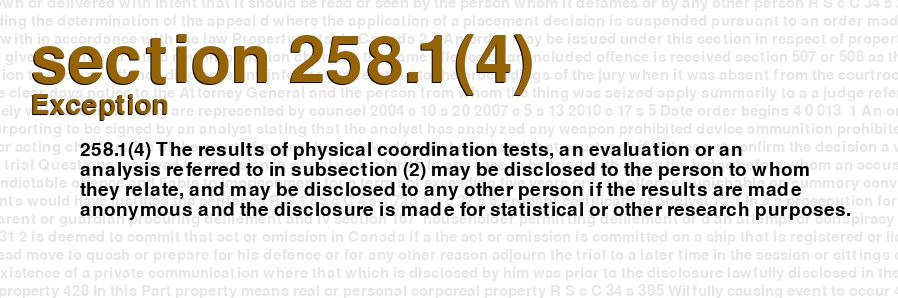
258.1(4) The results of physical coordination tests, an evaluation or an analysis referred to in subsection (2) may be disclosed to the person to whom they relate, and may be disclosed to any other person if the results are made anonymous and the disclosure is made for statistical or other research purposes.
Explanation
Section 258.1(4) of the Criminal Code of Canada allows for the disclosure of the results of physical coordination tests, evaluations, or analyses to individuals and for research purposes. These tests are commonly used in cases of impaired driving to determine if an individual is under the influence of drugs or alcohol.
The section permits the results to be shared with the person to whom the tests were administered if they ask for them. Additionally, the results may be made available to anyone else if they are made anonymous and the disclosure is meant for statistical or research purposes. This allows researchers to use the information gathered from these evaluations to better understand impaired driving and its effects on individuals.
Importantly, the disclosure of these results must be done in a way that protects the privacy of the individual who is being evaluated. This is in accordance with Canada's privacy laws, which protect individuals' personal information from being shared without their consent.
In summary, Section 258.1(4) of the Criminal Code of Canada permits the disclosure of physical coordination test results for research purposes and to the individuals who took the tests. However, the results must be anonymized to protect the privacy of the person being evaluated. This provision facilitates the study of impaired driving, and allows legal proceedings to be conducted with more accurate evidence.
Commentary
Section 258.1(4) of the Criminal Code of Canada is a provision that pertains to the disclosure of results related to physical coordination tests, evaluations or analyses conducted under subsection (2). The section permits such results to be disclosed to the person to whom they relate, and furthermore allows the information to be disclosed to third parties if the results are made anonymous and the disclosure is being made for statistical or research purposes.
This provision is a way to protect the privacy and rights of individuals who have undergone testing related to impaired driving. The section ensures that any results from such tests are kept confidential and are only released to the individual or third-party entities if they pose no harm to the privacy or rights of the individual.
Given that physical coordination tests and evaluations are vital tools used in determining the sobriety of drivers, Section 258.1(4) acknowledges the importance of respecting an individual's privacy and rights. If these results were to be disclosed to a third-party without consent, it could lead to negative consequences such as discrimination, stigmatization, or other forms of prejudice.
Section 258.1(4) also recognizes the importance of research. Providing researchers with data from physical coordination tests, evaluations, or analyses conducted under subsection (2) can be beneficial to advancing scientific knowledge and possibly informing policy decisions related to impaired driving. The results are provided on an anonymized basis, ensuring that the privacy of individuals is thoroughly protected.
The provision, as it pertains to the disclosure of results to individuals, is an essential aspect of providing them access to information critical to their defense. Impaired driving is a criminal offense that could result in fines, license suspension or even incarceration, thus making it necessary for individuals to have access to the results of their tests and evaluations.
Additionally, releasing information for statistical or research purposes is essential in improving policies related to impaired driving and potentially reducing the incidence of this criminal offense. With this information, researchers can better understand the factors contributing to impaired driving, the effectiveness of testing procedures, and provide recommendations for better testing standards.
In conclusion, Section 258.1(4) is an essential provision in the Criminal Code of Canada that protects the privacy and rights of individuals who have undergone tests related to impaired driving and helps advance scientific knowledge to combat this criminal offense. Its inclusion in the code highlights Canada's commitment to protecting individual's rights and ensuring they are treated fairly in the criminal justice system.
Strategy
Section 258.1(4) of the Criminal Code of Canada is an essential legal provision that provides for the handling and disclosure of results from physical coordination tests, evaluations, and analyses carried out in relation to drug and alcohol impaired driving offenses. This section is critical for ensuring that all involved parties are treated fairly and that their confidential information is handled appropriately. When dealing with this section of the Criminal Code of Canada, there are several strategic considerations that need to be taken into account.
One strategic consideration when dealing with section 258.1(4) of the Criminal Code of Canada is to ensure that all parties involved fully understand the provisions of the section, including their rights and responsibilities. This may involve providing education and training for law enforcement officers, prosecutors, and defense lawyers on the proper handling of physical coordination tests, evaluations, and analyses. This will ensure that all involved parties comply with the relevant laws, regulations, and procedures.
Another strategic consideration when dealing with section 258.1(4) of the Criminal Code of Canada is to ensure that the information provided in these tests, evaluations, or analyses is accurate and reliable. To this end, it is critical to have qualified and experienced professionals carry out these tests and evaluations, with proper equipment and testing procedures. Additionally, it is essential to have reliable and comprehensive data analysis methods to ensure that the information obtained meets the rigorous standards required by law.
A third strategic consideration is to ensure that the confidentiality of any personal information obtained through these tests, evaluations, or analyses is protected. This requires strict adherence to privacy and data protection laws throughout the testing and evaluation process. Measures such as storing confidential information in secure systems and limiting access to authorized personnel only should be put in place. The disclosure of this information must also be carefully controlled to avoid any inappropriate or unauthorized access to this information.
A fourth strategic consideration is to ensure that any statistical or research purposes for which the information is released are appropriate and in line with legal requirements. This means that any research must be conducted with the appropriate ethical and legal guidelines, and all research data must be anonymized to prevent the identification of any individual. The research must also be relevant and contribute to the improvement of the justice system or public policy, with the goal of fostering accountability, transparency, and fairness.
Several strategies could be employed when dealing with section 258.1(4) of the Criminal Code of Canada. For example, training and education programs for law enforcement officers, prosecutors, and defense lawyers could help to improve their understanding of their roles and responsibilities in carrying out these tests, evaluations, and analyses. Also, investing in better equipment and testing procedures could lead to more reliable and accurate results. Employing professionals with relevant expertise to conduct these tests could also enhance the accuracy and reliability of the testing and evaluation process.
In conclusion, section 258.1(4) of the Criminal Code of Canada is a crucial legal provision that plays a critical role in ensuring the fair and appropriate handling of physical coordination tests, evaluations, and analyses. When dealing with this section, it is critical to consider several strategic factors, including ensuring that all parties involved understand the relevant laws, regulations, and procedures. Additionally, it is vital to ensure that confidentiality and privacy measures are in place, and that any statistical or research purposes are in line with legal requirements. The use of appropriate strategies such as training and education programs, investing in equipment, and employing professionals can all lead to the more reliable and accurate handling of this critical information.