Editorial Annotation
Conditional discharge
Introduction
Allows for an order of discharge instead of a conviction for individuals in need of curative treatment for alcohol or drug consumption.
Statutory Text
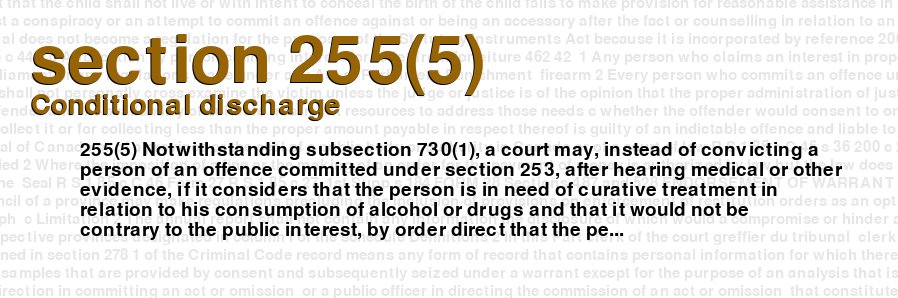
255*(5) Notwithstanding subsection 730(1), a court may, instead of convicting a person of an offence committed under section 253, after hearing medical or other evidence, if it considers that the person is in need of curative treatment in relation to his consumption of alcohol or drugs and that it would not be contrary to the public interest, by order direct that the person be discharged under section 730 on the conditions prescribed in a probation order, including a condition respecting the person�s attendance for curative treatment in relation to that consumption of alcohol or drugs. *[Note: In force in the Provinces of Nova Scotia, New Brunswick, Manitoba, Prince Edward Island, Saskatchewan and Alberta and in the Yukon Territory and the Northwest Territories, see SI/85-211 and SI/88-24.]
Explanation
Section 255(5) of the Criminal Code of Canada allows a court, instead of convicting a person of an offence under section 253 (impaired driving), to order that the person be discharged under section 730 if the court believes that the person is in need of curative treatment in relation to their consumption of drugs or alcohol. This section is only applicable in certain Canadian provinces and territories, as listed in the note.
Under this section, the court must hear medical or other evidence to determine whether the individual requires curative treatment and whether it is in the public interest to order the discharge. If the court decides to order the discharge, the individual will be subject to a probation order with conditions, including a condition that they attend curative treatment for their drug or alcohol consumption.
This section recognizes the potential for individuals who have committed impaired driving offences to require treatment for their substance abuse issues, rather than being punished through a conviction and sentence. It is a recognition that addressing the underlying issue of addiction may be a more effective means of preventing impaired driving and protecting public safety.
Commentary
Section 255(5) of the Criminal Code of Canada allows for a court to order a person to attend curative treatment for alcohol or drug consumption instead of convicting them of an offense under section 253. This provision is aimed at promoting rehabilitation and addressing addiction in a compassionate manner.
The language used in this section of the Criminal Code is particularly important. Firstly, it refers to curative" treatment, rather than punitive measures. This choice of language shows the intention of the law to address addiction as a medical issue, rather than solely as a criminal act.
Furthermore, the provision refers to medical or other evidence" which means that the court must base its decision on scientific data and professional medical opinion rather than just on the discretion of the judge.
Another important aspect of this provision is the requirement that the court must make the determination that the person is genuinely in need of curative treatment. This decision is based on medical or other evidence presented to the court. Therefore, the decision is not arbitrary but based on professional opinion.
In cases where the court orders curative treatment, the person is then discharged under section 730 on prescribed conditions including attending curative treatment. These conditions are outlined in a probation order, and it is essential to follow them. The failure to comply with the terms of the order may result in more severe consequences.
The provision explicitly outlines that the decision to order curative treatment should not be contrary to the public interest. This means the decision should be in the best interest of the person and general public. Courts have to balance the rights of the person to receive the best treatment with the interests of the public safety.
Section 255(5) serves two main purposes. Firstly, it acknowledges that addiction is a health issue, not just a criminal one, and promotes rehabilitation rather than punishment. Secondly, it recognizes that mandatory rehabilitation is sometimes necessary to break the cycle of addiction and protect society from the dangers of alcohol or drug addiction.
This provision has been widely used across Canada in various cases. It has proved to be useful as it helps those suffering from addiction to access help and treatment they need. The provision also provides a chance for people who have made one-off mistakes to access rehabilitation services rather than prison.
While this provision is beneficial for many, there have also been criticisms. Some have argued that the provision is too broad and gives courts too much power to order people into treatment. Others argue that curative treatment is not always effective and that mandatory rehabilitation can feel like a burden.
In conclusion, section 255(5) of the Criminal Code of Canada is an essential provision that recognizes the importance of rehabilitation in cases where addiction may be the root cause of an offense. The provision provides a pathway to recovery for those who need help and reduces the number of people in correctional facilities due to addiction and alcoholism. It is important that courts use this power only in cases where it is appropriate and that the rehabilitation procedures put in place are effective.
Strategy
Section 255(5) of the Criminal Code of Canada allows courts to order individuals who are in need of curative treatment in relation to their consumption of alcohol or drugs to attend such treatment as a condition of their probation. This provision offers a strategic approach to addressing addiction issues and reducing the risk of reoffending for those who have been charged with impaired driving offenses. In this essay, we will discuss some strategic considerations when dealing with Section 255(5) and some strategies that could be employed to ensure the best outcomes for all parties involved.
Strategic Considerations
1. Public Interest: The court must consider the public interest when making a decision under Section 255(5). The objective of this provision is to address the underlying causes of addiction and to reduce the likelihood of reoffending. In determining whether the public interest will be served by a treatment order, the court must consider the severity of the offense, the offender's prior criminal record, and the likelihood of future reoffending.
2. Medical Evidence: The court must hear medical or other evidence to determine whether the individual is in need of curative treatment in relation to their consumption of alcohol or drugs. The court may order a pre-sentence report or other assessments to gather this evidence. It is crucial to have reliable and comprehensive evidence to support the decision to order treatment.
3. Probation Conditions: The court may impose conditions on the individual's probation, including attendance for curative treatment relating to the consumption of alcohol or drugs. The conditions of probation may also include abstaining from consuming alcohol or drugs, driving with a breathalyzer ignition interlock device, and attending counseling or treatment programs. It is important to ensure that the conditions imposed are relevant and necessary to address the offender's addiction issues and that they are clearly communicated to the individual.
Strategies
1. Collaborative Approach: A collaborative approach involving multiple stakeholders, such as the court, treatment providers, and probation officers, can help to ensure that the individual receives appropriate and effective treatment. This approach may involve regular communication and coordination between stakeholders to monitor the individual's progress and adjust treatment as necessary.
2. Accessible Treatment: Access to treatment can be a significant barrier for many individuals. Ensuring that treatment is accessible, affordable, and appropriate for the individual's needs can improve outcomes and reduce the risk of reoffending. This may involve working with community organizations and healthcare providers to expand treatment options and reduce wait times.
3. Educational Programs: Education programs and initiatives targeted at addressing impaired driving and addiction issues can help to raise awareness and reduce the prevalence of these issues. These programs may include public education campaigns, training for healthcare professionals and educators, and community outreach initiatives.
Conclusion
Section 255(5) of the Criminal Code of Canada offers a strategic approach to addressing addiction issues and reducing the likelihood of reoffending for individuals charged with impaired driving offenses. To ensure the best outcomes for all parties involved, it is important to consider the public interest, gather comprehensive medical evidence, and impose relevant and necessary probation conditions. Strategies such as a collaborative approach, accessible treatment, and education programs can also help to support the effective implementation of Section 255(5) and promote positive outcomes for individuals struggling with addiction.