Editorial Annotation
Exception
Introduction
This section states that occupants of a motor vehicle who attempt or actually leave the vehicle upon discovering a prohibited weapon or ammunition are exempt from prosecution.
Statutory Text
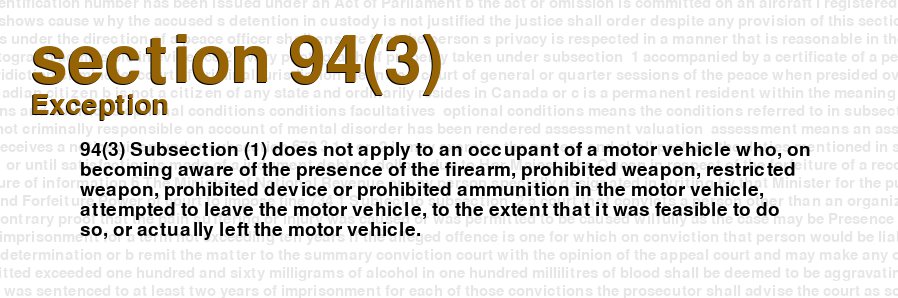
94(3) Subsection (1) does not apply to an occupant of a motor vehicle who, on becoming aware of the presence of the firearm, prohibited weapon, restricted weapon, prohibited device or prohibited ammunition in the motor vehicle, attempted to leave the motor vehicle, to the extent that it was feasible to do so, or actually left the motor vehicle.
Explanation
Section 94(3) of the Criminal Code of Canada provides an exemption for occupants of motor vehicles who become aware of the presence of a firearm, prohibited weapon, restricted weapon, prohibited device or prohibited ammunition in the vehicle. This section essentially allows a person who is not aware of the presence of these prohibited items to avoid legal punishment if they make a reasonable attempt to leave the vehicle when they become aware of them.
The subsection (1) referenced in section 94(3) relates to punishment for possessing prohibited weapons or items. So, if a person possesses a prohibited firearm or weapon without a license, they could face significant legal consequences. However, section 94(3) creates an exception for individuals who are occupants in a motor vehicle and only become aware of the presence of the prohibited item after the fact.
This provision is intended to protect individuals who may have unknowingly found themselves in a potentially dangerous situation involving a firearm or other prohibited item. It incentivizes individuals to take appropriate action when they realize that such items are present, such as immediately exiting the vehicle, rather than continuing to stay in a vehicle with these dangerous items.
Overall, section 94(3) aims to strike a balance between punishment for the possession of prohibited items and ensuring that individuals are not unfairly punished for being in situations outside of their control. It provides a level of protection for individuals who may have been unknowingly put in harm's way, while still ensuring the safety of the general public by prohibiting the possession of certain dangerous items.
Commentary
Section 94(3) of the Criminal Code of Canada provides an exception to the offence of possessing a prohibited or restricted weapon in a motor vehicle. The exception applies to an occupant of the motor vehicle who becomes aware of the presence of a prohibited weapon, restricted weapon, prohibited device, or prohibited ammunition in the vehicle. The occupant must attempt to leave the motor vehicle to the extent that it is feasible to do so or actually leave the motor vehicle.
In other words, an occupant who is unaware of the presence of a prohibited or restricted weapon in the vehicle cannot rely on this exception. It only applies to occupants who become aware of the weapon's presence while inside the vehicle. The exception is designed to address situations in which a person unwittingly finds themselves travelling in a vehicle containing a prohibited or restricted weapon.
The purpose of the provision is to encourage situational awareness and responsible behaviour among occupants of a motor vehicle. In cases where the occupant did not initially know about the weapon, they have the opportunity to extract themselves from a potentially dangerous situation and avoid criminal liability. Additionally, by requiring occupants to attempt to leave the vehicle to the extent possible, the exception incentivizes individuals to exercise a higher degree of vigilance and avoid being in situations where they could become aware of the presence of prohibited or restricted weapons.
It is important to note that the exception does not absolve the individual of all criminal responsibility. If the occupant does not attempt to leave the vehicle to the extent possible or simply remains in the vehicle despite knowing about the prohibited or restricted weapon, they will be guilty of the offence of possession. It is essential that individuals who become aware of the presence of such a weapon in a motor vehicle act promptly to remove themselves from the vehicle and report the incident to the authorities.
This section of the Criminal Code is a useful tool for ensuring responsible behaviour among occupants of a motor vehicle. By providing immunity from liability for individuals who take appropriate action, it incentivizes people to be vigilant about their surroundings, and it helps to prevent accidents that could be caused by the handling of prohibited or restricted weapons. The section also acts as a deterrent to those who may be considering transporting prohibited or restricted weapons in a motor vehicle, as it creates a greater risk of detection and prosecution.
In conclusion, the exception provided by Section 94(3) of the Criminal Code of Canada is an effective way to encourage responsible behaviour among occupants of a motor vehicle and prevent accidents or crimes involving prohibited or restricted weapons. It underscores the importance of situational awareness and vigilance and ensures that those who take the appropriate action in response to such situations are not subject to criminal liability.
Strategy
Section 94(3) of the Criminal Code of Canada provides an exemption to occupants of a motor vehicle who become aware that a firearm, prohibited weapon, restricted weapon, prohibited device or prohibited ammunition is present in the vehicle and attempt to leave or do leave the vehicle. There are several strategic considerations that individuals and legal practitioners must consider in relation to this section of the Criminal Code of Canada.
The first strategic consideration is the credibility of the individual claiming exemption from liability. It is essential to assess whether the individual's actions were genuine attempts to distance themselves from the firearm, prohibited weapon, restricted weapon, prohibited device or prohibited ammunition present in the vehicle at the time. Their actions must be considered from the perspective of a reasonable person in their position. Factors such as the speed at which the vehicle was moving, availability of a safe place to pull over, and potential risks to the occupant's safety must be assessed.
The second strategic consideration is the duty of care owed by the occupants of the vehicle. If it is determined that the occupants were aware of the presence of a firearm, prohibited weapon, restricted weapon, prohibited device or prohibited ammunition in the vehicle, they may be deemed to have a duty of care to ensure the safety of the occupants of the vehicle and other individuals. While Section 94(3) may provide an exemption from liability, it may not necessarily absolve individuals from facing other criminal charges such as those related to negligence or reckless endangerment.
The third strategic consideration is the specifics of the case under investigation. The circumstances surrounding the discovery of the firearm, prohibited weapon, restricted weapon, prohibited device or prohibited ammunition in the vehicle must be evaluated. If it is found that the occupants of the vehicle were actively engaged in using the firearm, prohibited weapon, restricted weapon, prohibited device or prohibited ammunition, they may be liable under other provisions of the Criminal Code regardless of whether they attempted to distance themselves from the weapon.
In terms of strategies that could be employed when dealing with Section 94(3) of the Criminal Code, individuals and legal practitioners must be proactive. One strategy could be to implement measures to prevent the presence of firearms, prohibited weapons, restricted weapons, prohibited devices, or prohibited ammunition in vehicles. Steps could include conducting regular inspections of vehicles used for transportation, providing training to drivers and occupants on safe weapon handling, and instituting strict policies prohibiting the transport of weapons in vehicles.
Another effective strategy could be to emphasize the importance of self-reporting in situations where an individual becomes aware of the presence of firearms, prohibited weapons, restricted weapons, prohibited devices, or prohibited ammunition in a vehicle. By self-reporting, individuals demonstrate a willingness to comply with the law and potentially avoid criminal charges. Law enforcement agencies could implement awareness campaigns aimed at encouraging self-reporting and providing clear guidelines on how to do so safely and responsibly.
In conclusion, Section 94(3) of the Criminal Code of Canada provides an exemption to occupants of motor vehicles who attempt to leave or do leave the vehicle upon becoming aware of the presence of firearms, prohibited weapons, restricted weapons, prohibited devices or prohibited ammunition. Legal practitioners and individuals must consider several strategic considerations when dealing with this section of the Criminal Code, including the credibility of the individuals claiming exemption, the duty of care owed to other individuals, and the specifics of the case under investigation. Strategies such as implementing measures to prevent the presence of weapons in vehicles and promoting self-reporting can assist in preventing criminal charges related to the possession of firearms, prohibited weapons, restricted weapons, prohibited devices or prohibited ammunition.