Editorial Annotation
Enforcement by justice
Introduction
Statutory Text
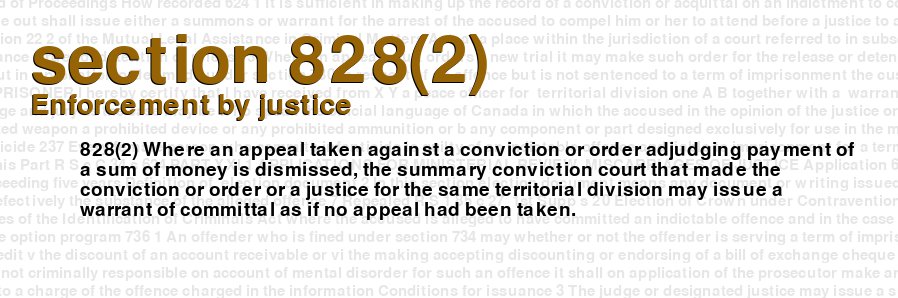
828(2) Where an appeal taken against a conviction or order adjudging payment of a sum of money is dismissed, the summary conviction court that made the conviction or order or a justice for the same territorial division may issue a warrant of committal as if no appeal had been taken.
Explanation
Section 828(2) of the Criminal Code of Canada outlines the process for issuing a warrant of committal in cases where an appeal against a conviction or order adjudging payment of a sum of money has been dismissed. Essentially, this section allows the summary conviction court, or a justice for the same territorial division, to issue a warrant of committal if an appeal is dismissed, regardless of whether or not the accused has paid the amount in question.
The purpose of this section is to ensure that individuals who have been convicted of a crime or ordered to pay a sum of money cannot simply avoid the consequences of their actions by filing an appeal. If an appeal is dismissed, this section allows for swift enforcement of the original conviction or order, as the court can issue a warrant of committal and place the accused in custody until they have satisfied their obligation.
Overall, Section 828(2) serves as an important tool for ensuring that justice is served in cases where individuals have been convicted of a crime or ordered to pay a sum of money. By allowing for the enforcement of such convictions and orders, even if an appeal is dismissed, this section helps to maintain the integrity of the Canadian justice system and ensure that those who break the law are held accountable for their actions.
Commentary
Section 828(2) of the Criminal Code of Canada provides a framework for enforcing legal orders issued by summary conviction courts in Canada. It states that if an appeal taken against a conviction or an order adjudging the payment of a sum of money is dismissed, then the summary conviction court that made the conviction or order, or a justice for the same territorial division, may issue a warrant of committal as if no appeal had been taken.
The purpose of this section of the Criminal Code is to ensure compliance with orders issued in criminal proceedings. It recognizes that appeals can be necessary in the pursuit of justice, but also recognizes that orders issued by the courts must be respected and followed until they are overturned by a higher authority. Thus, if an appeal is dismissed, then the original decision of the court stands, and the order must be enforced.
A warrant of committal is a legal order which authorizes authorities to arrest and detain an individual for failing to comply with a court order. It is a powerful tool that is used when other means of enforcement have failed. Section 828(2) allows for warrants of committal to be issued in cases where an appeal has been dismissed. This provision ensures that defendants cannot evade the consequences of their actions by simply lodging an appeal, but also ensures that individuals who have been wrongfully convicted have adequate rights to appeal.
The use of warrants of committal is a serious matter that should not be taken lightly. It represents a significant infringement on an individual's liberty and should only be used in cases where all other means of enforcement have failed. Judges and justices should carefully consider the circumstances of each case before issuing warrants of committal.
In conclusion, section 828(2) of the Criminal Code of Canada plays an important role in ensuring the effective enforcement of legal orders issued by summary conviction courts. It balances the need for justice with the need to protect the rights of individuals who have been wrongfully convicted. The provision serves as a reminder that justice must be both fair and effective, and that ensuring compliance with legal orders is a necessary part of the criminal justice system.
Strategy
Section 828(2) of the Criminal Code of Canada empowers courts to issue a warrant of committal where an appeal taken against a conviction or an order for payment of a sum of money is dismissed. This provision raises some strategic considerations for litigants, especially those who may face conviction or an order for payment of a sum of money.
One of the strategic considerations for litigants is the possibility of appealing the conviction or order. Section 828(2) suggests that appeals may not always be successful, and therefore, litigants may need to weigh the cost and benefits of the appeal. For instance, defendants may consider the strength of their legal defenses and the chances of success before filing an appeal. Additionally, defendants may also consider the potential cost of a failed appeal, as a warrant of committal may be issued against them if the appeal is dismissed.
Another strategic consideration for litigants is communication with their legal representatives. Defendants who face conviction or an order for payment of a sum of money may need to work closely with their legal representatives to develop effective legal defenses. Defendants may also need to keep their legal representatives up to date with their financial status, as the potential order for payment of a sum of money may have implications on their financial situation. Moreover, defendants may also need to seek their legal representatives' advice on the timing and viability of an appeal.
A third strategic consideration for litigants is the possibility of negotiating with the prosecution. Defendants may need to explore the possibility of plea bargaining or other forms of negotiation with the prosecution to reduce the charges or a potential order for payment of a sum of money. Negotiating with the prosecution may save defendants from the cost and uncertainty of a trial, and may also result in a more favorable outcome. However, defendants need to weigh the benefits of negotiation against the potential consequences of a plea bargain, such as losing the opportunity for an appeal.
In light of these strategic considerations, litigants may employ various strategies to manage the risks associated with section 828(2) of the Criminal Code of Canada. For instance, some defendants may decide to prioritize their defense strategy rather than filing an appeal. This means focusing on building a strong defense to avoid a conviction or an order for payment of a sum of money in the first place. Additionally, some defendants may explore alternative approaches, such as restorative justice programs, to resolve the charges without going through the criminal justice system.
Another strategy that litigants may employ is engaging with other stakeholders, such as community groups or advocacy organizations. By connecting with these groups, defendants may gain support and resources that can help them navigate the legal system and protect their rights. Moreover, community groups and advocacy organizations may help defendants reduce the social stigma associated with being charged or convicted of a crime.
In conclusion, section 828(2) of the Criminal Code of Canada presents strategic considerations for litigants who face conviction or an order for payment of a sum of money. Litigants may need to weigh the cost and benefits of an appeal, communicate effectively with their legal representatives, negotiate with the prosecution, and employ alternative approaches where applicable. Employing these strategies can increase the chances of a positive outcome and mitigate the risks associated with this provision.