Editorial Annotation
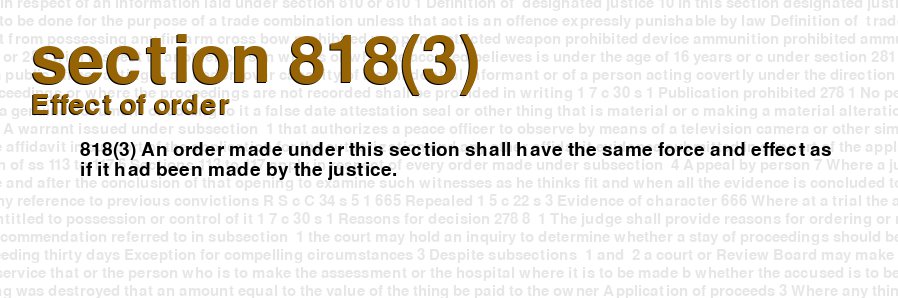
Effect of order
Introduction
Statutory Text
Explanation
Section 818(3) of the Criminal Code of Canada is related to the powers of a court to make an order that maintains and enforces the peace and security of the public. This section deals with the issuance of conditional release orders and undertakings, which are often given to accused persons who are released from custody pending trial or sentencing.
The subsection states that any order made under this section shall have the same force and effect as if it had been made by the justice. In other words, this provision confers a judicial power to the court to issue valid and legally binding orders that must be complied with by the recipient of the order.
When granting a conditional release order, either by the court or a justice, several conditions may be imposed to ensure that the accused complies with certain rules and regulations while awaiting trial and sentencing. These conditions can restrict the movements of the accused person and may require them to stay away from certain locations or individuals, or refrain from certain activities.
Section 818(3) therefore ensures that the orders made under this section are legally valid and enforceable, which means that non-compliance with these orders could result in an arrest and additional charges against the accused. This provision helps courts uphold the rule of law and protect the community from any potential harm or danger posed by the accused.
Commentary
Section 818(3) of the Criminal Code of Canada is an important provision that outlines the authority and effect of orders made by the court under this specific section. This provision governs the orders made by a justice of the peace or a judge, pursuant to section 817 and 810.01 of the Criminal Code, which allow for the imposition of conditions on a person's release from custody or detention to prevent the commission of a criminal offence.
An order made under section 818(3) has the same force and effect as if it had been made by a justice of the peace or a judge. This means that these orders are binding on the person subject to them and failure to comply could result in serious consequences. Such orders are made to reduce the risk of reoffending and to ensure the safety of the community while the person is out on bail. An order made under this section can include conditions such as where the person can live, who they can speak to, how often they must report to the authorities, and other limits on their behavior.
The significance of this provision is that it ensures that the orders made by the court are taken seriously and are not seen as a mere suggestion or recommendation. The orders made under section 818(3) are intended to protect the community, and they serve as a tool to hold offenders accountable for their behavior and prevent further harm. The inclusion of this provision in the Criminal Code of Canada reinforces the authority of the court in protecting the community and the rights of everyone involved in a criminal case.
It is worth noting, however, that the use of this provision should be proportional to the risk posed by the accused. The imposition of strict or onerous conditions on a person who does not pose a significant risk to the community can have serious consequences, including the loss of employment and the inability to care for one's family. Therefore, the use of section 818(3) must be guided by a clear understanding of the risk posed by the accused and the potential effects of the order on them and their family.
Furthermore, while orders made under section 818(3) are essential in ensuring public safety, they should not be seen as a substitute for effective rehabilitation and support for offenders. The criminal justice system, when coupled with access to rehabilitation programs and community supports can work towards reintegrating an individual back into society as a responsible and law-abiding citizen.
In conclusion, section 818(3) of the Criminal Code of Canada is a vital provision that affirms the authority of the court in enforcing orders that are intended to protect the community and prevent further harm. Nevertheless, the use of this provision should be guided by a balanced and pragmatic approach that takes into account the risks posed by the accused and potential consequences. Ultimately, this provision supports the greater goal of ensuring public safety while upholding the fundamental principles of justice.
Strategy
Section 818(3) of the Criminal Code of Canada grants courts the power to issue orders that have the same force and effect as if they had been made by a justice. This provision is an essential tool in the administration of justice, as it permits judges to issue orders that can keep accused persons and witnesses in a particular location or prevent them from communicating with others. However, several strategic considerations must be taken under advisement when dealing with this section of the Criminal Code of Canada.
One strategic consideration is the provision's constitutional validity. In several cases, accused persons have challenged the constitutionality of orders made under section 818(3), arguing that they violate their rights under section 7 (the right to liberty) and section 11 (the right to a fair trial) of the Canadian Charter of Rights and Freedoms. Thus, one strategy that could be employed is to ensure that the order issued under this provision is narrowly tailored to the specific circumstances of the case and does not infringe upon the accused person's Charter rights.
Another strategic consideration is the question of whether the order issued under section 818(3) is necessary in the specific case. Courts must weigh the interests of the accused person against society's interests in preserving the administration of justice and preventing potential harm to the public. Therefore, one strategy that could be employed is to demonstrate that the order is justified, necessary, and proportionate to the objective.
Moreover, courts have the discretion to impose conditions on orders issued under section 818(3). For example, an order may require the accused person to remain in a specific geographic location or communicate with only certain people. Thus, another strategic consideration that could be made is to negotiate the terms of the order with the Crown or the defence, such that it balances the needs of the administration of justice and the rights of the accused person.
In addition, courts must have the evidence to support the order issued under section 818(3). In several instances, failure to present sufficient evidence has led to orders being set aside on appeal. Therefore, one strategy that could be employed is to ensure that the evidence supports the need for the order and that the order is issued in the strictest sense of necessity.
Furthermore, courts must provide reasons for issuing orders under section 818(3). The reasons should indicate why the order was necessary in the specific case and should clearly demonstrate the court's decision-making process. Accordingly, one strategy that could be employed is to ensure that the court's reasons are sufficient, clear, and concise such that they can be comprehended by a layperson.
Finally, the Crown must be diligent in enforcing the order if it was made under section 818(3). Officers who fail to comply with court orders may be liable for contempt of court or other sanctions. One strategic consideration, therefore, is to ensure that any order is enforced adequately, such that its intended purpose is accomplished.
In conclusion, section 818(3) of the Criminal Code of Canada is an essential provision empowering courts to issue orders that maintain the administration of justice and protect public safety. However, several strategic considerations must be sensitive to when dealing with this provision, including its constitutional validity, necessity, and proportionality. The evidence must support its issuance, and extensive reasoning must be provided. As a result, strategies such as narrow tailoring of orders, negotiating their terms, and adequate enforcement should be employed to ensure that the administration of justice is achieved, and Charter rights are preserved.