Editorial Annotation
British Columbia
Introduction
Statutory Text
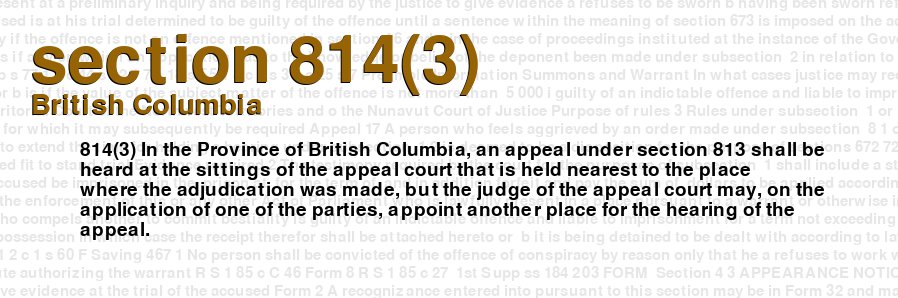
814(3) In the Province of British Columbia, an appeal under section 813 shall be heard at the sittings of the appeal court that is held nearest to the place where the adjudication was made, but the judge of the appeal court may, on the application of one of the parties, appoint another place for the hearing of the appeal.
Explanation
Section 814(3) of the Criminal Code of Canada pertains to the appeals process in the Province of British Columbia for adjudications made under section 813. This section deals with appeals against an order made by a judge or justice imposing conditions or requirements on a person in relation to a recognizance, or against a decision confirming, varying or terminating such an order.
Under this section, any appeal of an adjudication made in British Columbia must be heard at the sittings of the appeal court nearest to the place where the original adjudication was made. However, the judge of the appeal court has the power to appoint another place for the hearing of the appeal upon the request of one of the parties involved in the case.
The purpose of this section is to ensure that appeals are heard in a timely and efficient manner, and that they are accessible to all parties involved. By requiring appeals to be heard at the appeal court nearest to the place where the original order was made, the section reduces the burden on parties to travel long distances to attend hearings. However, the flexibility of allowing the judge to appoint another place for the hearing gives parties the opportunity to request a location that is more convenient for them.
Overall, section 814(3) is an important provision of the Criminal Code of Canada that gives parties involved in adjudications made under section 813 a fair and accessible appeals process.
Commentary
Section 814(3) of the Criminal Code of Canada deals with where appeals can be heard in the Province of British Columbia. It states that an appeal under section 813, which relates to the revocation or variation of a recognizance, shall be heard at the sittings of the appeal court that is held nearest to the place where the adjudication was made. However, it also provides for the judge of the appeal court to appoint another place for the hearing of the appeal on the application of one of the parties.
The purpose of this section is to ensure that appeals are heard as conveniently as possible for those involved. It recognizes that individuals who are appealing a decision may have limited resources and may not be able to travel long distances to attend an appeal hearing. By having the appeal court situated near the place where the adjudication was made, it ensures that the appellant can attend easily and without undue hardship.
At the same time, the provision also recognizes that there may be situations where it is not convenient or practical to have the hearing at the nearest appeal court. For example, if one of the parties is based in another part of the province or if there are logistical issues in having the hearing in the nearest court. In such cases, the provision allows for the judge of the appeal court to appoint another place for the hearing of the appeal, which may be more convenient for the parties involved.
Overall, section 814(3) is a useful provision that balances the need for convenience and accessibility for appellants with the practical considerations involved in arranging an appeal hearing. In addition to providing guidance on where an appeal should be heard, it also allows for flexibility in cases where the nearest court is not the best option.
However, it should be noted that this provision only applies to appeals under section 813 of the Criminal Code. Other types of appeals may have different requirements and procedures for where they are heard. As such, parties appealing decisions should be sure to familiarize themselves with the relevant provisions of the Criminal Code and any other applicable laws or regulations to ensure that their appeal is heard in the proper venue.
Strategy
Section 814(3) of the Criminal Code of Canada outlines the procedure for appeals under section 813 in the province of British Columbia. It states that the appeal shall be heard at the sittings of the appeal court that is held nearest to the place where the adjudication was made. However, the judge of the appeal court may appoint another place for the hearing of the appeal on the application of one of the parties.
Strategic considerations when dealing with this section of the Criminal Code of Canada would depend on the specific circumstances of the case. However, some general strategies that could be employed are as follows:
1. Timing of the application: The Criminal Code of Canada does not provide a specific time within which the application for a change of venue must be made. However, it is advisable to make the application at the earliest possible time. This is because if the application is made at a later stage, it may cause delay in the proceedings and may not be granted unless there are compelling reasons.
2. Grounds for the application: The parties must have valid grounds for the application in order for the judge to grant it. Examples of valid grounds are convenience to witnesses, the location of the relevant evidence, and expenses of the parties. The grounds should be clearly stated in the application and supported by evidence.
3. Compliance with court procedures: The parties must comply with court procedures when making the application. This includes filing the application with the court, serving it on the other party, and providing the necessary evidence to support the application.
4. Cooperation with the other party: It is important to cooperate with the other party when making the application. This includes providing them with notice of the application and the evidence supporting it. It also includes working with the other party to identify the most appropriate venue for the hearing.
5. Importance of the hearing: The importance of the hearing may be a relevant factor in determining whether a change of venue should be granted. If it is a high-stakes case, the judge may be more inclined to grant the application if there are valid grounds.
Overall, when dealing with section 814(3) of the Criminal Code of Canada, parties must carefully consider their options. They must assess the grounds for the application and comply with court procedures. Cooperation with the other party and consideration of the importance of the hearing may also be important factors. By carefully considering these factors, parties can develop effective strategies to obtain a change of venue if necessary.