Editorial Annotation
Duration extended
Introduction
A provincial court judge may order a defendant convicted of an offense to enter into a recognizance for a maximum of two years if they have a previous conviction for a similar offense.
Statutory Text
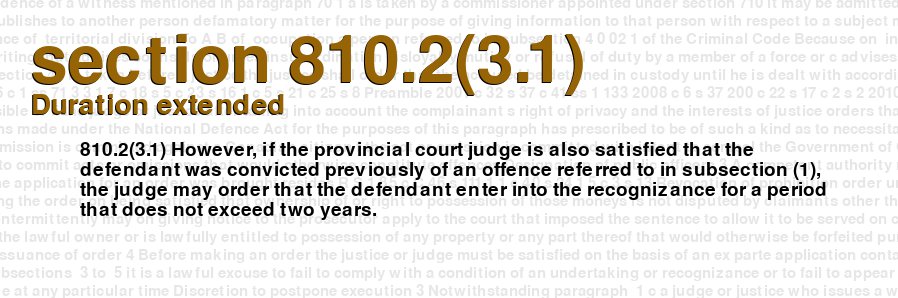
810.2(3.1) However, if the provincial court judge is also satisfied that the defendant was convicted previously of an offence referred to in subsection (1), the judge may order that the defendant enter into the recognizance for a period that does not exceed two years.
Explanation
Section 810.2(3.1) of the Criminal Code of Canada pertains to recognizance orders that are issued to individuals who are perceived to be a risk to public safety or afraid of committing an offence. Recognizance is a form of court order that compels individuals to comply with certain conditions as part of their release from court custody. This section provides permission for provincial court judges to order an individual to enter into a recognizance if the defendant was convicted previously of an offence referred to in subsection (1) that made them a risk to public safety.
The purpose of this section is to provide judges with a means to protect the public from individuals deemed to be dangerous. Recognizance, in this context, is a preventive measure imposed on individuals whose actions pose a risk to the community. The judge may order the defendant to enter into the recognizance for a period up to two years. The conditions of the recognizance may include, for example, remaining within a designated geographical area, submitting to electronic monitoring, or refraining from communicating with specific individuals or groups.
Overall, Section 810.2(3.1) of the Criminal Code serves as a statutory tool to reduce the risk of violence or harm to the community by requiring individuals with previous convictions to comply with a recognizance order. The section is particularly relevant for cases that involve violent crimes or sexual offences, where there is a risk of recidivism. The utilization of this section by judges may help reduce the incidence of future offences and, thus, promote the safety of the community.
Commentary
Section 810.2(3.1) of the Criminal Code of Canada is a provision that addresses the issues of potential harm and risk posed to victims of certain offences. This section enables a provincial court judge to order an offender to enter into a recognizance with specific conditions for up to two years in cases where the judge is satisfied that the offender has been previously convicted of an offense listed under subsection (1). This provision is aimed at protecting potential victims from harm or any other risk posed by the offender.
The purpose of the provision is to provide a legal mechanism that ensures public safety, especially in situations where it is deemed necessary to impose restrictions and conditions to prevent an offender from causing harm to the public or any potential victims. The provision is particularly relevant in situations where a person has been convicted of certain offenses such as sexual assault, stalking, or uttering threats. In such situations, the risk posed by the offender to the victim is considered to be high, and preventive measures are necessary to ensure the safety of the victim.
The provision recognizes that some offenders may pose a risk to public safety even after serving their sentences, and therefore, it is necessary to take action to mitigate the risk. If the provincial court judge is convinced that the offender is likely to commit an offense again and pose a risk to the victim, a recognizance can be issued to impose conditions aimed at preventing the offender from causing any harm. For instance, an offender may be prohibited from contacting the victim, or may be required to stay away from certain places or people or report to the police on a regular basis.
Generally, the purpose of the recognizance order is to ensure that the offender does not breach the peace, commit any criminal offenses, or interfere with the victim. The judge can also order the offender to attend counseling or treatment programs aimed at addressing any underlying issues that may contribute to their offending. The provision recognizes that the criminal justice system should not only punish offenders but should also assist them to change their behavior to prevent future offences.
While the provision is aimed at protecting potential victims from harm, it is important to note that it does not impose criminal culpability on the offender. Instead, the recognizance order is designed to prevent the offender from offending further and contributing to public safety.
In conclusion, section 810.2(3.1) of the Criminal Code of Canada is an important legal provision aimed at protecting potential victims from harm. The provision recognizes that some offenders may pose a risk to the public even after serving their sentences and therefore provides a legal mechanism for imposing conditions aimed at preventing further harm. The provision recognizes that the criminal justice system should not only punish offenders but should also assist them to change their behavior to prevent future offences.
Strategy
Section 810.2(3.1) of the Criminal Code of Canada allows for the issuance of peace bonds, which require a defendant to enter into a recognizance with conditions prescribed by a judge to prevent harassment or harm to another person. In cases where the defendant has a previous conviction for a listed offence under subsection (1), the judge may order the defendant to enter into a recognizance for a period not exceeding two years. This provision is an important tool for protecting victims of violence, particularly in cases where an individual has already exhibited violent or harassing behaviour. However, there are several strategic considerations that must be taken into account when dealing with this section of the Criminal Code.
The first consideration is whether to seek a peace bond in the first place. This decision will depend on a number of factors, including the seriousness of the threat posed by the defendant, the victim's safety concerns, the nature and frequency of previous incidents, and the likelihood that the defendant will abide by the conditions of the recognizance. It is also important to note that a peace bond is not a guarantee of protection, and victims may continue to face risk even after a defendant has entered into a recognizance.
Assuming that a peace bond is sought, the next strategic consideration is the content of the bond itself. The types of conditions that may be included in a peace bond are wide-ranging and can include prohibitions on contact with the victim, requirements to stay away from certain locations, and requirements to attend counselling or other treatment programs. The specific conditions that are included will depend on the circumstances of the case and the judge's discretion. It is important for those seeking a peace bond to be clear about the types of conditions they believe are necessary to ensure the victim's safety and to be prepared to provide evidence to support those conditions.
Another strategic consideration is whether to pursue a longer or shorter period of time for the peace bond. While the maximum period for a peace bond under section 810.2(3.1) is two years, it is not always necessary or desirable to seek the full two years. For example, if the defendant has a history of compliance with court orders or has shown remorse for their actions, a shorter period may be appropriate. Conversely, if the defendant remains a significant threat to the victim, a longer period may be more appropriate. The decision about the length of the peace bond should be based on a thorough assessment of the risks and benefits in each case.
Finally, it is important to consider the broader context in which the peace bond is sought. For example, it may be necessary to consider whether there are other legal remedies available, such as obtaining a restraining order, or whether criminal charges should be pursued. It may also be essential to address social and economic factors that contribute to violence, such as poverty, housing instability, and lack of access to mental health services. Ultimately, the decision to seek a peace bond is just one part of a larger strategy to prevent violence and protect victims.
In terms of strategies that can be employed, one important approach is to work closely with the victim to understand their needs and concerns and to ensure that their safety is at the forefront of all decisions. It may also be beneficial to consult with experts in areas such as risk assessment, domestic violence, and trauma-informed practice to inform the development of effective interventions. It is also important to be prepared to provide evidence to support the case for a peace bond and to ensure that the legal process is accessible and understandable for all parties involved.
In conclusion, section 810.2(3.1) of the Criminal Code of Canada provides an important tool for protecting victims of violence and preventing further harm. However, strategic considerations are needed when dealing with this section of the Criminal Code, including decisions about whether to seek a peace bond, the content of the bond itself, the length of the bond, and the broader context in which the peace bond is sought. Effective strategies that prioritize victim safety and include input from experts in relevant fields can help ensure that the peace bond is an effective intervention in preventing violence.