Editorial Annotation
Definition of Attorney General
Introduction
This section defines the term Attorney General for the purposes of sections 771 and 773 of the Criminal Code of Canada.
Statutory Text
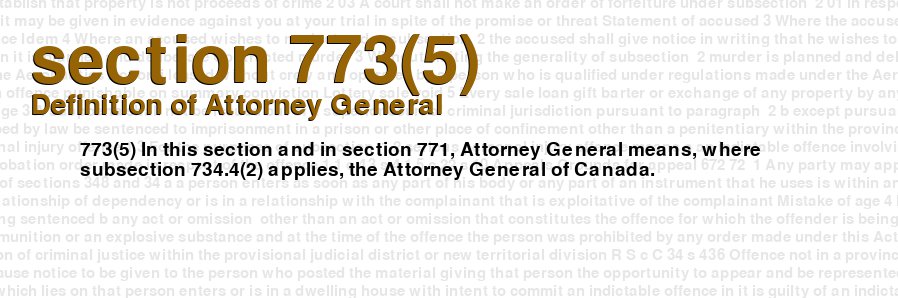
773(5) In this section and in section 771, "Attorney General" means, where subsection 734.4(2) applies, the Attorney General of Canada.
Explanation
Section 773(5) of the Criminal Code of Canada is a definition section that provides a contextual meaning for the term "Attorney General" in the broader context of Sections 771 and 773. This section is important because it helps to clarify the role of the Attorney General in criminal proceedings.
Specifically, this section defines the term "Attorney General" to mean the Attorney General of Canada in cases where subsection 734.4(2) applies. This subsection refers to cases where a person is convicted of an offense and has been fined but is unable to pay that fine. In these cases, the Attorney General has the authority to waive the payment of the fine or to allow the offender to pay the fine in installments.
By providing a clear definition of the term "Attorney General" in this context, Section 773(5) helps to ensure that there is clarity and consistency in the way that these proceedings are handled. It also establishes the authority of the Attorney General in these cases, which is important for maintaining the integrity and fairness of the criminal justice system.
In summary, while Section 773(5) may seem like a small and technical provision, it is an important part of the Criminal Code of Canada that helps to ensure that the Attorney General has the proper authority to administer justice in cases where fines are involved.
Commentary
Section 773(5) of the Criminal Code of Canada provides a definition for the term Attorney General" in the context of sections 771 and 773. This section is particularly significant because it clarifies the meaning of a critical term that is used throughout the criminal justice system in Canada.
The Attorney General is a key player in the criminal justice system, playing a vital role in both the prosecution of criminal offences and the administration of justice. The Attorney General is responsible for ensuring that the law is upheld and that justice is served in every case. This includes overseeing the work of prosecutors and ensuring that they have the resources they need to do their jobs effectively.
Section 773(5) of the Criminal Code of Canada is important because it defines the term Attorney General" in a very specific way. According to this section, the term refers to the Attorney General of Canada in cases where subsection 734.4(2) applies. This subsection relates to cases where a judge is considering whether to impose a fine on a corporation. In such cases, the Attorney General of Canada is the appropriate entity to consult with.
By defining the term in this way, section 773(5) ensures that there is clarity and consistency in the use of this term throughout the criminal justice system. This helps to prevent confusion and ensures that everyone involved in the system understands who the Attorney General is and what their role is. This is particularly important in cases where a corporation is involved, as there may be multiple levels of government and multiple attorneys general involved.
Furthermore, by specifying that the Attorney General referred to in this section is the Attorney General of Canada, section 773(5) helps to ensure that there is a clear chain of command and responsibility within the justice system. This is important because it helps to ensure that decisions are made in a consistent and fair manner, and that there is accountability for those decisions.
Overall, section 773(5) of the Criminal Code of Canada is an important provision that helps to ensure clarity and consistency in the use of the term Attorney General" in the context of criminal proceedings. By defining the term in a very specific way, this section helps to ensure that all participants in the criminal justice system understand who the Attorney General is and what their role is. This, in turn, helps to ensure that justice is served in a fair and consistent manner, and that all parties involved in the legal process are held accountable for their actions.
Strategy
Section 773(5) of the Criminal Code of Canada is an important provision when it comes to plea bargaining. It defines the role and authority of the Attorney General in the context of plea agreements, which are negotiated agreements between the Crown and the accused to resolve criminal charges without going to trial. Plea bargaining is a common practice in Canada, and can be a useful tool for both the prosecution and the defense to resolve cases quickly, efficiently, and with the best interests of justice in mind.
When dealing with this section of the Criminal Code, one of the most important strategic considerations is the potential impact of the Attorney General's involvement in the plea bargaining process. Specifically, subsection 734.4(2) of the Criminal Code allows the Attorney General to issue directives to prosecutors regarding how and when to enter into plea agreements. This provision gives the Attorney General a significant degree of control over the plea bargaining process, and can limit the autonomy of individual prosecutors when it comes to negotiating and finalizing agreements with the defense.
Another important consideration is the potential impact of the Crown's decision-making process on the accused's ability to negotiate a favorable plea agreement. For example, if the Crown is particularly aggressive or insistent in pursuing certain charges or sentencing options, this can make it more difficult for the defense to negotiate a plea agreement that meets their client's needs. Similarly, if the Crown is willing to be more flexible or open-minded in their approach, this can create opportunities for the defense to negotiate a more favorable outcome.
Strategies that could be employed when dealing with this section of the Criminal Code will depend on the specific circumstances of the case, as well as the interests and objectives of the parties involved. However, some general strategies that could be useful in many contexts include:
1. Building a strong case: Before entering into plea negotiations, it is important for the defense to thoroughly investigate the case against their client and identify any weaknesses or inconsistencies in the Crown's evidence. Building a strong case can provide leverage in negotiations and increase the chances of securing a favorable plea agreement.
2. Assessing the strength of the Crown's case: Similarly, the defense should assess the strength of the Crown's case and determine whether it is in their client's best interests to accept a plea agreement or proceed to trial. If the evidentiary case against the defendant is weak, this may provide an opportunity to negotiate for more favorable terms.
3. Understanding the Crown's objectives: To negotiate effectively, it is important to understand the Crown's objectives and priorities. For example, if the Crown is primarily interested in securing a conviction and is willing to accept a reduced sentence, the defense may be able to negotiate for a less severe sentence in exchange for a guilty plea.
4. Leveraging the role of the Attorney General: If the Attorney General is involved in the plea bargaining process, it may be useful to leverage their authority to nudge the negotiations in a certain direction. For example, if the Attorney General has issued a directive emphasizing the importance of reducing the number of cases going to trial, this may provide an opportunity to negotiate for a more lenient sentence in exchange for a guilty plea.
Overall, navigating the complexities of plea bargaining in the Canadian criminal justice system requires careful attention to strategic considerations and a deep understanding of the legal context in which negotiations are taking place. By leveraging opportunities and avoiding pitfalls, attorneys can help their clients achieve the best possible outcome in the plea bargaining process.