Editorial Annotation
Exception
Introduction
Statutory Text
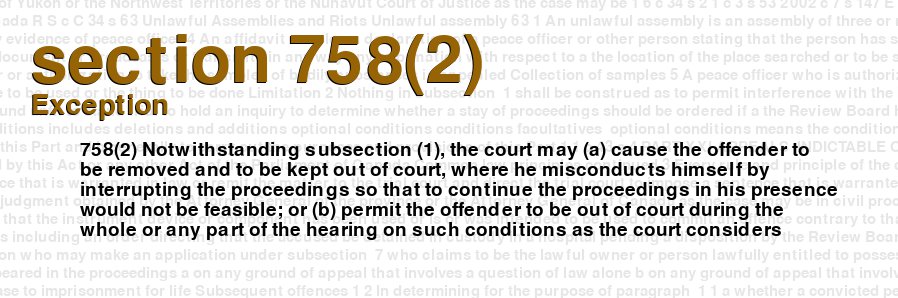
758(2) Notwithstanding subsection (1), the court may (a) cause the offender to be removed and to be kept out of court, where he misconducts himself by interrupting the proceedings so that to continue the proceedings in his presence would not be feasible; or (b) permit the offender to be out of court during the whole or any part of the hearing on such conditions as the court considers proper.
Explanation
Section 758(2) of the Criminal Code of Canada provides the court with the power to remove or permit an offender to be out of court during criminal proceedings. This section is useful for situations where an offender is disrupting the proceedings, making it impossible to continue with the offender present. In such a scenario, the court may choose to remove the offender and keep them out of the court for the remainder of the proceedings.
The court may also permit an offender to be out of court during any part or the whole of the hearing, under certain conditions. This provision could be utilized if the offender can demonstrate an inability to physically attend the session, or for other reasons that the court deems appropriate.
The decision to remove an offender is not made lightly and only occurs when the court is of the opinion that the offender's continued presence poses a risk to the proceedings. Additionally, should the court choose to permit an offender to be out of court, they would need to ensure that the conditions set do not negatively impact upon the effectiveness or integrity of the trial.
Overall, Section 758(2) exists to ensure that criminal proceedings are conducted fairly, and that the offender's behaviour during the proceedings does not impede the process of justice. By giving the court the power to remove or permit an offender to be out of court, this section acts as an important provision within the Criminal Code of Canada.
Commentary
Section 758(2) of the Criminal Code of Canada outlines the various measures a court may take to control the behavior of an offender during a judicial proceeding. The primary purpose of this section is to ensure that legal proceedings are conducted in a fair, orderly, and speedy manner. This section also serves as a safeguard for the accused individual's rights and liberties, as it allows the court to control their disruptive behavior in a measured and proportionate manner.
Subsection (1) of this section outlines the general rule that an accused person must be present in court for their trial, except in certain specified circumstances. However, subsection (2) provides exceptions to this general rule, giving the court the discretion to order the accused to leave the courtroom or permit them to stay out of court entirely.
One of the situations where the court may order the offender to be removed and kept out of court is if they are disrupting the proceedings through their behavior. This particular scenario is most likely to occur when the offender is not represented by legal counsel. In such cases, individuals may represent themselves and find it difficult to control their emotions, leading to outbursts or interruptions during proceedings. In these circumstances, the court may order the offender to be removed to ensure that the proceedings continue in a fair and efficient manner.
The other situation where an accused person may be permitted to stay out of court is if the court believes it is appropriate to do so. There is no exhaustive list of reasons why this may occur, and the decision is left to the court's discretion. For instance, the court may decide to permit the accused to leave the courtroom if they are of poor health or suffer from a disability. This provision may also apply if the presence of the defendant may pose a risk to the security of the court or witnesses.
When the court orders the accused to leave the courtroom or permits them to stay out of it, the accused may be subject to certain conditions. These conditions are intended to prevent the accused from interfering with the proceedings or from absconding. For instance, the court may require the accused to remain within a particular area or to report a specific number of times to the court. If the accused fails to comply with these conditions, it could result in a warrant being issued for their arrest.
Overall, Section 758(2) serves as an important tool for preserving the integrity of the judicial process and for ensuring that legal proceedings are conducted in a fair and orderly manner. By giving the court discretion to remove the accused or permit them to leave the courtroom, the provision strikes a balance between the rights of the accused and the interests of justice. While the provision is a necessary one, it's essential to ensure that it does not infringe on the rights of the accused. Therefore, any decisions made under this provision should be made with careful consideration of the circumstances of the case and the rights of the accused.
Strategy
Section 758(2) of the Criminal Code of Canada provides the court with the power to remove an offender from the courtroom if the individual disrupts the proceedings in such a way that continuing the proceedings in their presence is not feasible. Additionally, the court may permit the defendant to be absent from the hearing entirely, under certain restrictions. The implementation of this section requires strategic consideration on part of the defense counsel. The following are some strategies that could be employed to navigate this section of the Criminal Code of Canada.
1. Maintaining Calmness and Control - It is imperative for the defense counsel to maintain calmness and control during the proceedings. Any kind of outburst from their client will not be taken lightly by the court and could result in the removal of the defendant from the courtroom. Defense counsel should prepare their clients for the possibility of removal by the judge. It is essential that the defendant understands the importance of remaining calm and well-behaved during the proceedings.
2. Be Prepared - Successful implementation of Section 758(2) of the Criminal Code of Canada requires proper preparation. Defense counsel should be well-prepared for any scenario that may arise during the proceedings. They must have a solid understanding of the law and the facts of the case to ensure that they can make informed decisions quickly.
3. Ensure Proper Communication - Proper communication between defense counsel and their clients is crucial. They should educate their clients on the seriousness of their behavior in the courtroom and how it can negatively impact their case. Defense counsel should always explain the potential consequences of a client's behavior in the courtroom.
4. Know the Judge - Familiarizing oneself with the judge and their court is an essential strategy for defense counsel. Knowing the judge's tendencies and quirks can provide insight into how they are likely to respond to particular actions in court. This information can be invaluable when determining whether to ask the judge for permission to have the defendant removed or to instead permit the defendant to be out of court during the proceedings.
5. Use Section 758(2) to your Advantage - Defense counsel may use Section 758(2) to their advantage by requesting that the judge remove disruptive individuals from the courtroom or that the defendant be permitted to leave the courtroom. If a defendant is removed from the courtroom, they will have to remain in a holding cell or in a secure area in the courthouse until they are able to return to the hearing. If the defendant is permitted to be absent from the hearing entirely, they will be prohibited from communicating with anyone about the proceedings until they have returned to court.
In conclusion, successful implementation of Section 758(2) of the Criminal Code of Canada requires careful preparation and strategic thinking. Defense counsel should communicate properly with their clients, remain calm and well-prepared, know the judge and their court, and use this section of the Criminal Code to their advantage. Understanding the possible outcomes and consequences of any decisions made during proceedings is essential to a successful defense strategy.