Editorial Annotation
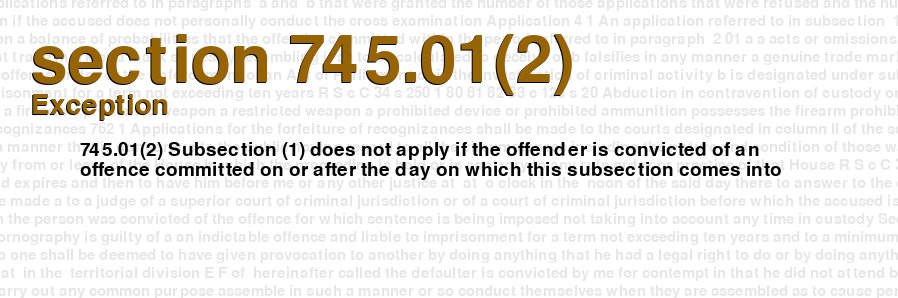
Exception
Introduction
This section excludes certain offenders from being eligible for a sentence reduction if their offence was committed on or after a specific date.
Statutory Text
Explanation
Section 745.01 of the Criminal Code of Canada outlines rules around the possibility of being released on parole after being convicted of murder. Specifically, it allows for those convicted of first-degree murder to apply for parole after serving at least 25 years of their sentence, and those convicted of second-degree murder to apply after serving at least 10 years of their sentence.
However, subsection (2) of Section 745.01 states that these rules do not apply if the offender is convicted of a murder committed on or after the day on which this subsection comes into force. Essentially, this means that anyone convicted of a murder on or after the date this subsection was enacted is not eligible for parole under Section 745.01.
The purpose of this clause is likely to discourage potential murderers by removing the potential for early release from their sentence. It also serves as a deterrent for those who may have committed a murder with the expectation of being released on parole after serving a certain amount of time.
While some may argue that this clause is harsh, it is important to remember that murder is a serious crime with severe implications for victims and their families. By removing the possibility of parole for those convicted of murder after the enactment of this subsection, the Canadian justice system is sending a message that such crimes will not be taken lightly.
Commentary
Section 745.01(2) of the Criminal Code of Canada is an important provision in the Canadian criminal justice system. It limits the possibility for offenders who committed serious offences before the coming into force of section 745.01(1) to apply for early parole.
Before the enactment of section 745.01(1), offenders sentenced to life imprisonment had to serve a minimum of 25 years before they could apply for parole. However, section 745.01(1) reduced that period to 15 years for some offenders who had committed murder or high treason, and who met certain criteria. This provision sought to address concerns about the lengthy periods of incarceration faced by some offenders, and the lack of incentive for them to engage in rehabilitation and change.
However, section 745.01(2) ensures that offenders who committed offences before the coming into force of section 745.01(1) are not eligible for the reduced parole period. This means that for some offenders, they will still have to wait 25 years before they are eligible for parole, even if they meet the criteria set out in section 745.01(1).
The purpose of section 745.01(2) is to recognize that there is a public interest in ensuring that offenders who commit serious crimes are held accountable for their actions. Offenders who committed serious crimes before the enactment of section 745.01(1) may have been sentenced with the understanding that they would not be eligible for early parole, and it would be unfair to retroactively apply the new provisions to them. Additionally, the families and loved ones of victims may feel that offenders who committed crimes before section 745.01(1) should not have the same rights to early parole as those who committed crimes after that provision came into force.
It is worth noting that section 745.01(2) does not apply to all offenders who committed serious crimes before the coming into force of section 745.01(1). Rather, it only applies if the offender is convicted of an offence committed on or after the day on which section 745.01(2) comes into force. This means that if an offender committed a serious crime before section 745.01(1) came into force, but was not convicted until after section 745.01(2) came into force, they would not be eligible for early parole under section 745.01(1).
In summary, section 745.01(2) of the Criminal Code of Canada ensures that offenders who committed serious crimes before the coming into force of section 745.01(1) are not eligible for the reduced parole period. This provision recognizes the public interest in ensuring that offenders who commit serious crimes are held accountable for their actions, and maintains fairness in the criminal justice system.
Strategy
Section 745.01(2) of the Criminal Code of Canada states that the sentence reduction provisions of section 745.01(1) will not apply if the offender is convicted of an offence committed on or after the day this subsection comes into force. This provision was introduced in 2011 to restrict the application of section 745.01(1) that allows offenders convicted of murder to seek early parole after serving 15 years of their life sentence. This provision was introduced to address concerns about public safety and to ensure that those who commit the most heinous crimes spend longer in prison.
When dealing with section 745.01(2) of the Criminal Code of Canada, there are several strategic considerations that must be taken into account. Firstly, defence lawyers must be aware that this provision restricts their ability to seek early parole for offenders convicted of murder. This means that they must prepare their case accordingly and focus on mitigating factors that may lead to a reduced sentence, such as mental illness, remorse, and cooperation with the authorities.
Secondly, prosecutors need to be aware that section 745.01(2) removes a crucial bargaining tool from their arsenal. Going to trial and securing a conviction will no longer necessarily mean that the offender will remain in prison for life. Therefore, prosecutors must be more aggressive in seeking long sentences for murderers and make a strong case for why early parole should not be granted.
Thirdly, judges need to be aware that section 745.01(2) means that they will have less discretion in sentencing murderers. They must ensure that the sentence they impose reflects not only the gravity of the offence but also the risk to public safety. They must take into account aggravating factors such as the brutality of the crime, the harm caused to the victim's family, and the fact that the offender has shown no remorse.
There are several strategies that could be employed to address the implications of section 745.01(2) of the Criminal Code of Canada. Firstly, defence lawyers could focus on seeking a plea bargain that would allow the offender to plead guilty to a lesser offence and thus avoid the restrictions of section 745.01(2). Secondly, prosecutors could seek to introduce evidence that would mitigate the severity of the crime and demonstrate that the offender remains a threat to public safety. This could include evidence of the offender's prior criminal record, their behaviour in prison, and their potential for reoffending.
Finally, judges could seek to impose longer sentences that would address the concerns of public safety that led to the introduction of section 745.01(2) in the first place. They could take into account the offender's prospects for rehabilitation, the impact of the crime on the victim's family, and the need to send a message about the severity of the offence.
In conclusion, section 745.01(2) of the Criminal Code of Canada has significant implications for how offenders convicted of murder are sentenced. All stakeholders - defence lawyers, prosecutors, and judges - must be aware of the implications of this provision and adopt strategies that reflect the need to ensure public safety while also upholding the rule of law.