Editorial Annotation
Hearing
Introduction
Offenders or prosecutors may request a hearing to consider proposed changes to a sentence within seven days of notification.
Statutory Text
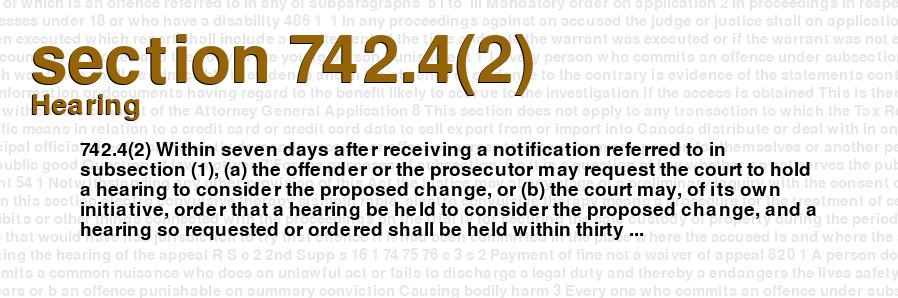
742.4(2) Within seven days after receiving a notification referred to in subsection (1), (a) the offender or the prosecutor may request the court to hold a hearing to consider the proposed change, or (b) the court may, of its own initiative, order that a hearing be held to consider the proposed change, and a hearing so requested or ordered shall be held within thirty days after the receipt by the court of the notification referred to in subsection (1).
Explanation
Section 742.4(2) of the Criminal Code of Canada outlines the procedure for requesting a hearing to consider proposed changes to an offender's release conditions. When an offender is released from custody on certain conditions, such as a curfew or a prohibition from contacting certain individuals, the offender must comply with these conditions or face further legal consequences. If the offender wishes to change any of these conditions, or if the prosecutor wishes to propose new conditions, they must notify the court of their intentions.
Upon receiving this notification, the offender or prosecutor may request a hearing to consider the proposed changes. Alternatively, the court may initiate a hearing of its own accord. If a hearing is requested or ordered, it must be held within 30 days of the court's receipt of the notification.
This section is intended to provide a fair and efficient process for considering proposed changes to an offender's release conditions. It ensures that both the offender and the prosecution have an opportunity to present their arguments for or against the proposed changes in a timely manner. It also allows the court to make an informed decision based on all relevant information provided at the hearing, which is important for maintaining the integrity of the criminal justice system. Overall, section 742.4(2) is an important tool for ensuring that release conditions are appropriate, reasonable, and effective for both the offender and the community at large.
Commentary
Section 742.4(2) of the Criminal Code of Canada stipulates that in the event of a proposed change to the conditions of an offender's conditional release, such as a change in residency or employment, both the offender and the prosecutor have the right to request a hearing to consider the proposed change. Additionally, the court may also order a hearing to be held of its own initiative if deemed necessary. The law requires that any hearing requested or ordered should be held within thirty days of the notice being received by the court.
The purpose of this section is to ensure that offenders on conditional release are not subjected to arbitrary changes to their conditions of release. It seeks to balance the need to protect society from potential risks posed by the offender against the offender's right to procedural fairness. By providing for a hearing, the offender is given an opportunity to make representations to the court regarding why the proposed change to their release conditions may be inappropriate or unwarranted.
Section 742.4(2) is a critical tool in ensuring that the criminal justice system remains fair and just. Offenders who have been released under conditional release have usually served their sentence, and it is essential to ensure that any changes to their release conditions do not unfairly impact their lives. These offenders are deemed to have paid their dues to society and deserve the opportunity to reintegrate back into their communities positively. Any changes made to their release conditions should, therefore, be in line with the purpose of conditional release, which is to support the offender's successful reintegration into society.
The requirement that the hearing should be held within thirty days of the notice being received by the court indicates the importance of expediting the process. This enables the offender to quickly know whether the changes to their conditions of release will be implemented or not, which gives them an opportunity to plan their lives accordingly. Additionally, the time limit set for the hearing helps to ensure that changes to release conditions are not delayed unnecessarily, which could potentially put society at risk.
In conclusion, Section 742.4(2) of the Criminal Code of Canada is a crucial provision in ensuring the appropriate administration of justice. It helps to ensure that offenders on conditional release are not subjected to arbitrary changes to their conditions of release. The provision strikes a balance between protecting society and ensuring that offenders are given the opportunity to reintegrate back into their communities. The requirement for a hearing within thirty days of the notice being received by the court expedites the process and ensures that any changes to release conditions are made promptly.
Strategy
Section 742.4(2) of the Criminal Code of Canada has significant implications for both offenders and prosecutors. This section deals with the notification process for proposed changes to an offender's conditional sentence order (CSO) or probation order (PO). As such, it is important to carefully consider the strategic options available when dealing with this provision.
One consideration for prosecutors is whether to request a hearing on a proposed change to an offender's CSO or PO. Prosecutors might consider doing so if they believe that the change is necessary to protect public safety, or if they believe that the offender is not complying with the terms of their order. Alternatively, if the prosecutor believes that the proposed change is not warranted, they might choose not to request a hearing. In making this decision, prosecutors should carefully consider the evidence available to support their position, as the court will need to be convinced that the proposed change is necessary.
For offenders, the main consideration is whether to request a hearing to challenge the proposed change to their order. If an offender believes that the proposed change is unfair or unjustified, they may choose to contest it in court. In making this decision, they should consider the strength of their case, as well as the potential consequences of a hearing. If they are successful in challenging the proposed change, they may be able to continue with their CSO or PO as originally ordered. However, if they are unsuccessful, the court may impose additional conditions or even revoke their order altogether.
Strategic considerations for both prosecutors and offenders may also include timing and preparation. Requests for hearings must be made within seven days of receiving notification of the proposed change, and hearings must be held within thirty days of the court's receipt of the notification. This means that both parties must act quickly to gather evidence and prepare their arguments. Prosecutors may want to gather additional evidence to support their case, while offenders may want to obtain mitigating evidence or legal counsel to help challenge the proposed change.
Overall, there are a variety of strategic considerations that should be taken into account when dealing with section 742.4(2) of the Criminal Code. Whether you are a prosecutor or an offender, it is important to carefully evaluate the situation and consider the available options in order to achieve the best possible outcome.