Editorial Annotation
Changes to probation order
Introduction
This section allows a court to modify or cancel probation conditions and shorten the duration of a probation order upon application by the offender, probation officer, or prosecutor.
Statutory Text
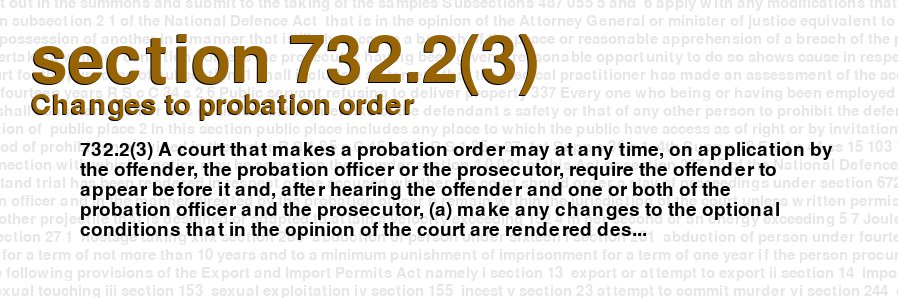
732.2(3) A court that makes a probation order may at any time, on application by the offender, the probation officer or the prosecutor, require the offender to appear before it and, after hearing the offender and one or both of the probation officer and the prosecutor, (a) make any changes to the optional conditions that in the opinion of the court are rendered desirable by a change in the circumstances since those conditions were prescribed, (b) relieve the offender, either absolutely or on such terms or for such period as the court deems desirable, of compliance with any optional condition, or (c) decrease the period for which the probation order is to remain in force, and the court shall thereupon endorse the probation order accordingly and, if it changes the optional conditions, inform the offender of its action and give the offender a copy of the order so endorsed.
Explanation
Section 732.2(3) of the Criminal Code of Canada deals with probation orders and how the court can modify them. Probation is a form of punishment or rehabilitation for offenders that allows them to stay in the community under certain terms and conditions.
Under the provisions of this section, a court that makes a probation order has the discretion to modify it if circumstances have changed. Such a change could involve things like the offender's behaviour during the period of probation, progress in rehabilitation, or unforeseen situations arising. An application can be made by the probation officer, the prosecutor, or the offender for changes to the probation order.
The court can make any changes to the optional conditions that are deemed desirable by the change in circumstances since the conditions were prescribed. Optional conditions may include things like curfews, community service, or substance abuse treatment. The court can also relieve an offender from complying with any optional condition either permanently or temporarily. Finally, the court can decrease the length of the probation order.
In making these changes, the court must hear from the offender and one or both of the probation officer and the prosecutor. Then, the court will advise the offender of its action, provide them with a copy of the amended order, and endorse it accordingly.
Overall, section 732.2(3) provides the court with the flexibility to modify probation orders if the original conditions are no longer appropriate or effective. This can help ensure that probation remains a valuable tool for managing the behaviour of offenders and promoting rehabilitation.
Commentary
Section 732.2(3) of the Criminal Code of Canada is a provision of the criminal justice system related to probation orders. Probation is a type of sentence in criminal cases that allows offenders to remain in the community while being monitored and following certain conditions set forth by the court. Probation is often used as an alternative to imprisonment and is meant to provide offenders with the opportunity to rehabilitate themselves and reintegrate back into society.
The purpose of Section 732.2(3) is to allow the court to make changes to the terms and conditions of the probation order based on changes in the offender's circumstances or other factors that may make certain aspects of the order unnecessary or undesirable. The provision allows for flexibility in application, recognizing that circumstances may change over the course of the probation order.
The section empowers the court to make any changes to optional conditions of the probation order, relieve the offender from compliance with any optional condition, or decrease the period for which the probation order remains in effect. The application for change can be made by the offender, probation officer, or prosecutor. The the court is required to conduct a hearing where the offender and either the probation officer or prosecutor (or both) can make representations about why the changes are necessary or desirable.
The court must exercise discretion and determine whether the changes are desirable based on the given circumstances. The changes can only be made when the court is satisfied that changing the conditions of the probation order is warranted. The discretion is important since every probation order must be tailored to meet the specific needs of the offender and the circumstances of their case. The court must always keep in mind that the main goal of probation is to promote rehabilitation and reintegrate the offender into society as a law-abiding citizen, so adjustments should be made with this objective in mind.
This provision ensures that the probation order remains relevant and effective throughout its duration, adapting to changes in the offender's situation. For example, if a condition in the probation order requires that the offender report to a specific probation officer every week, but the officer is no longer available, the court could change this condition to a new probation officer. Adjusting conditions to fit changing circumstances helps prevent probation orders from being unrealistic, unfair to the offender, or inconsistent with the goals of rehabilitation.
In conclusion, Section 732.2(3) of the Criminal Code of Canada is a vital provision that allows for flexibility in probation orders. It allows for adjustments to be made to the conditions of the order to better reflect the current circumstances of the offender. This flexibility helps ensure that the probation order remains relevant and effective throughout its duration, promoting the rehabilitation and successful reintegration of offenders back into society. The exercise of discretion by the court is crucial to ensure that changes are made in the best interests of the offender and with the goal of promoting long-term success.
Strategy
Section 732.2(3) of the Criminal Code of Canada provides a mechanism for offenders, probation officers, and prosecutors to apply to a court to modify the terms of a probation order. This flexibility allows for changes to be made to the conditions of the probation order to reflect changes in the circumstances of the offender.
Strategic considerations when dealing with this section of the Criminal Code of Canada depend on the individual circumstances of the case and the parties involved. For offenders, it may be beneficial to apply for a modification of the probation order if their situation has changed, and the current conditions are no longer appropriate. Similarly, probation officers may apply for a modification if they believe that changes to the conditions of the probation order would be in the best interest of the offender or the community.
For prosecutors, strategic considerations may include assessing the risk posed by the offender and balancing the need for modification against the risk of the offender reoffending. This may involve consulting with the victim, assessing the offender's compliance with the current probation order, and considering the impact of any proposed changes on public safety.
One potential strategy for offenders may be to work collaboratively with their probation officer to develop a plan for a modification of the probation order that addresses their changing circumstances and the concerns of the court and prosecutor. This may involve providing evidence to demonstrate that modifications are necessary and that they will reduce the risk of reoffending.
Another potential strategy may be for offenders to seek legal representation to help them navigate the process of applying for a modification of the probation order. Legal representation can help ensure that the offender's rights are protected and that they are able to advocate effectively for their interests.
For probation officers and prosecutors, strategic considerations may include conducting a thorough assessment of the offender's risk of reoffending, consulting with other professionals, and assessing the impact of any proposed modifications on public safety. They should also work collaboratively with the offender and their legal representative, where appropriate, to develop a plan that meets the needs of all parties involved.
In conclusion, Section 732.2(3) of the Criminal Code of Canada provides a mechanism for modifying the conditions of probation orders. Strategic considerations when dealing with this section of the Criminal Code of Canada will depend on the individual circumstances of the case and the parties involved. Work collaboratively and develop a plan that meets the needs of all parties involved with a focus on ensuring that public safety is not compromised.