Editorial Annotation
Presentation of statement
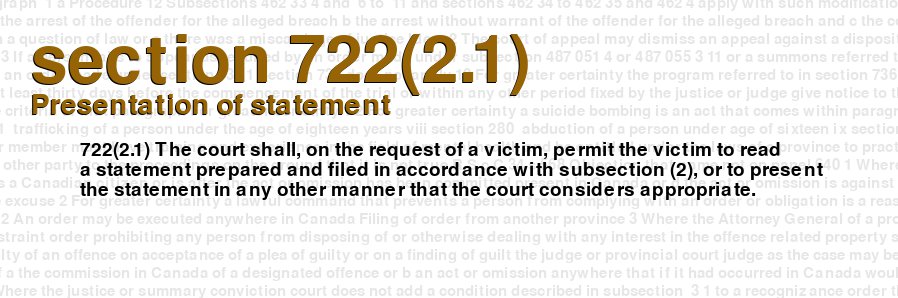
Introduction
Victims have the right to read or present a statement in court.
Statutory Text
Explanation
Section 722(2.1) of the Criminal Code of Canada is an important provision with regards to victim rights within the legal system. The section specifies that if a victim of a crime makes a request to the court, they must be permitted to read or present a statement that they have prepared and filed in accordance with subsection 2 of the same section. This statement is typically a victim impact statement, which details the harm that they have suffered as a result of the crime committed against them. This could include physical or emotional harm, financial losses, and any other relevant impact that has been experienced.
The purpose of allowing victims to read or present these statements is to give them a voice in the court proceedings and to ensure that their experiences are considered by the sentencing judge. Victims often feel that their voices are not heard or that their experiences are undervalued by the legal system. By allowing them to present their own statements, the legal system is acknowledging the importance of their role in the process and helping to ensure that justice is served.
This provision is an important step towards recognizing and valuing the rights of victims in Canada's legal system. It is important that victims have an opportunity to speak in court and that they are empowered to share their experiences. This provision helps to ensure that their voices are heard and that justice is served in a way that recognizes the harm caused to victims by crime.
Commentary
Section 722(2.1) of the Criminal Code of Canada is a provision that empowers victims to make a statement in court, either by reading from a written statement or presenting the statement in another manner. It is a notable development in Canada's criminal justice system, as it recognizes the importance of giving victims a voice and allows them to have an active role in the proceedings.
The right of victims to participate in criminal proceedings is a fundamental principle of justice, and it is recognized by various international human rights instruments. In addition, it is now also recognized by Canadian law as an integral part of the justice system. Giving victims an opportunity to make a statement in court is a significant step in this direction, as it acknowledges their experiences and the impact that the crime has had on their lives.
The manner in which the victim makes the statement is flexible and depends on the court's discretion. This allows for individual variations, taking into account the victim's needs and circumstances. It may be in written form or delivered verbally by the victim or an advocate. The statement is usually made during the sentencing phase of the trial, where a judge hears the victim's statement before handing down a sentence.
The statement may include the victim's emotions, their physical, emotional, and financial costs as a result of the crime, and how the crime has affected their family. The victim also has the chance to express what they would like to see as a fitting punishment for the offender. By allowing victims to participate in the sentencing process, the criminal justice system acknowledges that the victim has a stake in the outcome, and that justice must not only be seen to be done but must also be felt by the victim.
Therefore, this provision also serves to promote the rehabilitation of the accused, as it helps to make them aware of the impact of their actions on others. It can also serve as a deterrent effect, as it is evidence to the offender that their actions have severe and long-lasting impacts on others.
However, it should be kept in mind that when victims are allowed to make a statement, they may be re-traumatized, and it can have a severe emotional impact on them. Therefore, it is crucial that they receive support from victim services programs, advocacy services, as well as mental health experts, making sure that they are not further victimized in the process.
In conclusion, section 722(2.1) of the Criminal Code of Canada is an essential provision for promoting the rights of victims in the criminal justice system. It allows them to make a statement in court and have their voice heard by ensuring they feel a sense of empowerment and recognition. This provision can serve as a step towards restoring trust in the justice system, as it acknowledges the victim's experience and allows them to play an active role in the sentencing process. But it must also be implemented with greater discretion and attention to avoid further harm to victims.
Strategy
Section 722(2.1) of the Criminal Code of Canada is a provision that allows victims to read or present a statement in court. This statement is called a victim impact statement, and its purpose is to provide information about the harm that the victim has suffered as a result of the crime. The purpose of this provision is to give victims a voice in the criminal justice system.
There are several strategic considerations that need to be taken into account when dealing with this section of the Criminal Code. These considerations include:
1. Timing: The timing of the submission of a victim impact statement is critical. It is important to submit the statement at the appropriate time in the proceedings to ensure that it has the maximum impact. Generally, the statement should be provided before the sentencing hearing.
2. Content: The content of the victim impact statement is also critical. It should provide a detailed account of the harm that has been suffered by the victim. It should include information about the physical, emotional, and financial impact of the crime. The statement should also include information about any ongoing effects that the crime has had on the victim, such as ongoing medical or psychological treatment.
3. Rehearsal: Rehearsing the delivery of the statement is also important. The victim should practice delivering the statement in front of a trusted individual or professional to ensure that it is delivered effectively and without any emotional outbursts.
4. Professional Assistance: Seeking assistance from a professional, such as a victim services worker or a counsellor, can also be beneficial. This assistance can help the victim prepare emotionally for the statement and provide guidance on the content of the statement.
There are several strategies that can be employed when dealing with this provision. These strategies include:
1. Engagement: Engaging with the prosecutor and the court is imperative. Victims should ensure that they are aware of their rights and are actively involved in the proceedings. This involvement can include attending court hearings, communicating with the prosecutor, and seeking out victim services.
2. Collaboration: Collaboration with other victims can also be beneficial. Victims can share their experiences with one another and provide support to each other.
3. Empowerment: Empowering the victim is also important. When preparing the victim impact statement, the victim should be encouraged to take ownership of the process and to communicate their experiences effectively.
4. High-Quality Statement: Preparing a high-quality victim impact statement is one of the most important strategies that can be employed. This statement should be well-organized, clear, and concise. It should provide a detailed account of the harm that has been suffered and clearly communicate this harm to the court.
In conclusion, Section 722(2.1) of the Criminal Code of Canada provides victims with an important opportunity to have their voices heard in the criminal justice system. To ensure that this opportunity is maximized, strategic considerations need to be taken into account. These considerations include timing, content, rehearsal, and seeking assistance from a professional. Strategies that can be employed include engagement, collaboration, empowerment, and preparing a high-quality victim impact statement. By taking these considerations and strategies into account, victims can effectively use Section 722(2.1) to have their voices heard in court.