Editorial Annotation
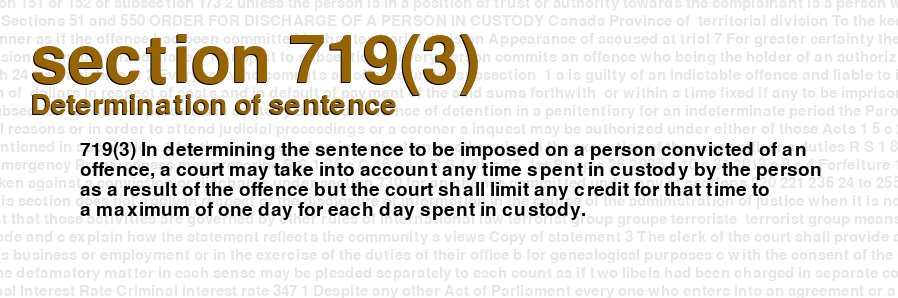
Determination of sentence
Introduction
Statutory Text
Explanation
Section 719(3) of the Criminal Code of Canada is an important provision that deals with the sentencing of individuals convicted of criminal offences who have spent time in custody. In essence, this section allows the court to consider the time already served by the person in custody when determining the sentence to be imposed.
The purpose of this section is to prevent individuals from being punished twice for the same offence, that is, by both being placed in custody and then being sentenced to additional time in jail. In other words, if a person has already served time in custody for the offence they have been convicted of, it would be inappropriate and unfair to punish them by imposing a lengthy jail sentence.
However, it is important to note that Section 719(3) also creates a limit on the amount of credit that can be given for time spent in custody. The court is limited to giving credit for a maximum of one day for each day spent in custody, which is a common practice in many criminal justice systems around the world.
Overall, Section 719(3) is an important provision that helps to ensure that the sentencing process is fair and just. It recognizes that individuals who have already spent time in custody have suffered a form of punishment and should not be subjected to further punishment through excessively long jail sentences. At the same time, it provides guidelines for how this credit should be applied to ensure that individuals are not treated unfairly or unequally in the sentencing process.
Commentary
Section 719(3) of the Criminal Code of Canada is a provision that allows courts to take into account the time spent in custody by a person convicted of an offence when determining the appropriate sentence. This provision is designed to ensure that individuals are not punished twice for the same offence, by taking into account the time spent in custody prior to sentencing.
However, this provision also includes a limitation on the credit that can be given for time spent in custody. The court may only credit one day for each day spent in custody, meaning that the maximum amount of credit a person can receive is the total number of days that they have already spent in custody. This limitation has been criticized by some legal experts for several reasons.
One of the main criticisms is that the one-to-one credit system fails to take into account the harsh realities of pre-trial custody. People who are in custody before trial often experience harsher conditions and a loss of freedom that goes beyond the punishment that would be imposed if they were convicted. Additionally, pre-trial detention can cause disruptions in a person's life, such as loss of employment or separation from family, which can serve as punishment in itself.
Another criticism of the one-to-one credit system is that it can create an incentive for individuals to plead guilty, even if they are not actually guilty of the crime. This is because individuals who plead guilty are often able to negotiate a more favorable sentence, which could include a reduced sentence due to time already spent in custody. This can lead to individuals pleading guilty simply to minimize their punishment, rather than because they are actually guilty.
Despite these criticisms, the one-to-one credit system has been upheld by Canadian courts as being consistent with the principles of sentencing. It is argued that the limitation on credit for time spent in custody helps to ensure that individuals do not receive a sentence that is disproportionate to the severity of the offence committed. Additionally, it is argued that the system provides an incentive for individuals to avoid committing offences in the first place, as they may be more likely to end up spending time in custody.
In conclusion, Section 719(3) of the Criminal Code of Canada is a provision that allows courts to take into account the time spent in custody by a person convicted of an offence when determining an appropriate sentence. While the one-to-one credit system has been criticized by some legal experts, it remains an integral part of Canadian sentencing principles and is designed to ensure that individuals do not receive a sentence that is disproportionate to the severity of the offence committed. As such, it continues to be an important aspect of Canada's criminal justice system.
Strategy
Section 719(3) of the Criminal Code of Canada is an important section that allows courts to take into account the time spent in custody by an offender while awaiting trial or sentencing. This provision offers some relief to individuals who have been incarcerated for a certain period of time, and it can have a significant impact on the final sentence imposed. However, like any provision, there are strategic considerations that must be taken into account when dealing with it.
One of the most important strategic considerations is to ensure that the court is aware of the amount of time the offender has spent in custody before trial or sentencing. This information can be presented in various ways, such as through the offender's criminal record or through testimony from the offender or their lawyer. It is important to provide accurate and complete information to the court, as any errors or omissions can result in a reduced credit being awarded.
Another strategic consideration is the timing of the request for credit for time served. While the court is required to limit the credit to one day for each day spent in custody, there may be situations where it is beneficial to delay the request for credit until a later stage in the process. For example, if an offender is facing both federal and provincial charges, it may be advantageous to wait until the federal charges are resolved before requesting credit for time served. This can result in a greater credit being awarded, as the maximum credit is based on the total time spent in custody, regardless of the nature of the charges.
A third strategic consideration is the impact that credit for time served may have on the overall sentence imposed. While the provision can offer some relief, it is important to recognize that the credit will only apply to the period of time spent in custody before trial or sentencing. If an offender is facing a lengthy sentence, the credit may have a relatively minor impact on the final outcome. For this reason, it may be beneficial to focus on other factors, such as mitigating factors or proposals for rehabilitation, in order to achieve a more favorable sentence.
Finally, it is important to recognize that credit for time served is not automatic, and it is not a right. Rather, it is a discretionary provision that the court can consider in its determination of an appropriate sentence. As such, it is important to present a strong case for why credit should be awarded, and to provide evidence to support this request.
In order to maximize the benefit of Section 719(3), it may be useful to employ several strategies. These might include:
- Ensuring that accurate and complete information about time spent in custody is presented to the court
- Timing the request for credit to maximize its potential impact
- Focusing on other factors that may influence the sentence, such as mitigating factors or rehabilitation proposals
- Providing evidence to support the request for credit
By carefully considering these factors and employing these strategies, individuals facing criminal charges can work to ensure that they receive the maximum benefit of Section 719(3) of the Criminal Code of Canada.