Editorial Annotation
Discretion respecting punishment
Introduction
Courts have discretion in imposing punishment for an offence, subject to limitations in the enactment and no punishment is a minimum unless declared as such.
Statutory Text
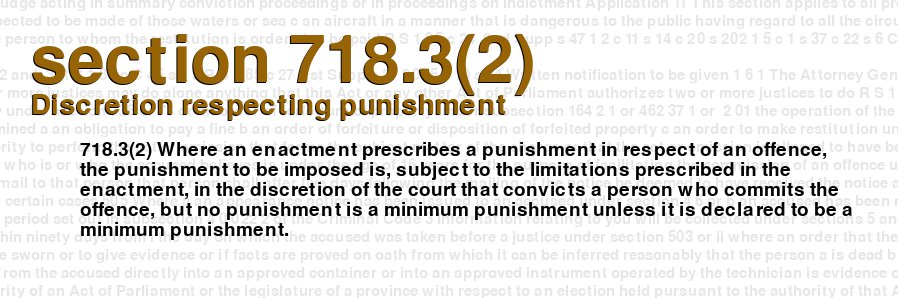
718.3(2) Where an enactment prescribes a punishment in respect of an offence, the punishment to be imposed is, subject to the limitations prescribed in the enactment, in the discretion of the court that convicts a person who commits the offence, but no punishment is a minimum punishment unless it is declared to be a minimum punishment.
Explanation
Section 718.3(2) of the Criminal Code of Canada outlines the general principles surrounding the punishment for criminal offences, indicating that judges have discretion to impose an appropriate sentence. This means that judges are not bound to impose a specific punishment for a particular offence. Rather, they must consider the specific circumstances of the case, the offender's criminal history, and the interests of society, in order to determine a just sentence.
This section also highlights that any punishment prescribed for an offence is subject to limitations set by the relevant legislation. For instance, some crimes may have a mandatory minimum sentence, which means that judges cannot impose a sentence that is less than the specified minimum. However, this section makes it clear that no punishment can be considered a minimum punishment unless it is explicitly declared to be so in the legislation. This ensures that judges have the flexibility to impose a sentence that is appropriate to the crime committed, rather than being constrained by mandatory minimums that may not take into account the unique circumstances of the case.
Overall, Section 718.3(2) reflects the Canadian criminal justice system's emphasis on judicial discretion, which allows judges to tailor sentences to individual cases, rather than relying on a one-size-fits-all approach. This principle helps ensure that justice is served in a fair and equitable manner, while also reflecting the need to address the harm caused by criminal conduct and maintain public safety.
Commentary
Section 718.3(2) of the Criminal Code of Canada is a critical provision that guides the sentencing process in criminal trials in Canada. The provision gives discretion to the court to determine the appropriate punishment to be imposed on an offender found guilty of committing a criminal offence in line with the limitations prescribed by the enactment. The section is inherently significant since it is designed to ensure that punishments handed down in criminal cases are fair, proportionate, and justifiable.
The provision furthers the concept of proportionality, which is a core principle of sentencing in Canada. The principle of proportionality essentially means that the punishment should fit the crime, and the severity of the punishment should be proportionate to the harm caused by the offender. Thus, the discretion provided to the court in section 718.3(2) of the Criminal Code is grounded on the principle of proportionality.
The discretion given to the court to impose a prescribed punishment as long as it is within the limitations of the enactment acknowledges the need for consistency in sentencing. Consistency in sentencing implies that an offender who commits a similar offence should receive a similar punishment to another offender who committed the same offence. This consistency in sentencing contributes to public trust and confidence in the criminal justice system.
Moreover, the provision also abolishes minimum mandatory sentences, except when it is expressly declared to be a minimum punishment. This position is an essential part of the principle of proportionality, which posits that every case should be judged on its merit and the unique circumstances surrounding it. It is believed that minimum mandatory sentences do not account for the specific facts surrounding the crime, and they may lead to an over-reliance on imprisonment without considering alternatives or evidence-based approaches that may be more effective in reducing recidivism rates.
However, the provision has also been controversial. Some people have argued that it gives too much discretion to the judges, which may result in inconsistent sentencing. There are concerns that judges may consider different factors and lead to significant discrepancies over similar crimes, resulting in unwarranted disparity. Others believe that this discretion is necessary for individualized justice and offers flexibility to the judiciary to cater to the unique circumstances of each case and each offender.
Despite the controversy surrounding section 718.3(2), it remains a critical provision in the Canadian justice system. It is a reflection of the Canadian criminal justice system's commitment to proportionality and consistency in sentencing. The provision acknowledges the need for judges to have discretion but provides guardrails to ensure that sentencing decisions are rational, principled, and predictable. The provision also upholds the concept of individualized justice, which is crucial in the context of Canada's diverse cultural landscape.
Strategy
Section 718.3(2) of the Criminal Code of Canada gives considerable discretionary power to the judges in imposing punishment on convicted offenders. This section has been subject to criticism, as it was seen to be leading to inequality in the sentences imposed on similar offenses. Moreover, there is no comprehensive guideline for judges regarding the sentencing, which results in arbitrary punishments. Hence, it is essential to take some strategic considerations when dealing with this section of the Criminal Code of Canada.
The primary strategy that a lawyer may use is to show the mitigating circumstances in the offense. Judges must consider the circumstances in which the crime is committed, such as the offender's age, mental state, and socio-economic background, among other factors. Highlighting these mitigating factors may lead to a reduced sentence or punishment that is more tailored to the offender's situation. A skilled defense lawyer can bring in a lot of evidence that can be beneficial for their client.
Another strategy is to show how the punishment that the prosecution is asking for is disproportionate to the offense. This can be done by drawing comparisons with other similar cases. Judges do not like to create precedents, so if a prosecutor is arguing that a particular punishment be imposed despite the fact that it is out of the norm for similar cases, the defense lawyer can use such instances to make a case for a lesser punishment.
A further strategy that a lawyer may use is to emphasize the offender's potential for rehabilitation. This emphasis can lead to a more lenient sentence, such as probation, community service, or other alternatives to imprisonment. Rehabilitation, when done correctly, can have a lasting impact on the offender's life, which may prevent them from reoffending in the future.
Moreover, it is essential to take into consideration the range of punishment for a particular offense as provided in the enactment, as the judge must always follow the legal framework set out in the Criminal Code. A lawyer may argue that a lighter sentence be given if the punishment prescribed in the enactment is too harsh under the given circumstances. On the other hand, if the punishment prescribed in the enactment is too lenient, a lawyer may argue for a more substantial sentence.
Finally, it is necessary to remember that judges are humans, and they are subject to institutional and individual biases. A lawyer may use this fact to their advantage by building a rapport with the judge, creating a personal connection with the judge, and utilizing their knowledge of the judge's inclinations. By understanding the judge's personal biases and working with them, the lawyer can anticipate the judge's reaction to the case and build an argument that would be well-received.
In summary, Section 718.3(2) of the Criminal Code of Canada gives judges considerable discretionary power when imposing punishment. A skilled defense lawyer must use strategic considerations to ensure that their client receives a fair sentence. Some of the strategies that can be used include highlighting mitigating circumstances, showing proportional punishment, emphasizing rehabilitation, considering the range of punishment for a particular offense, and understanding the judge's personal biases and working with them. In this way, a skilled defense lawyer can minimize the consequences for their client.