Editorial Annotation
Evidence
Introduction
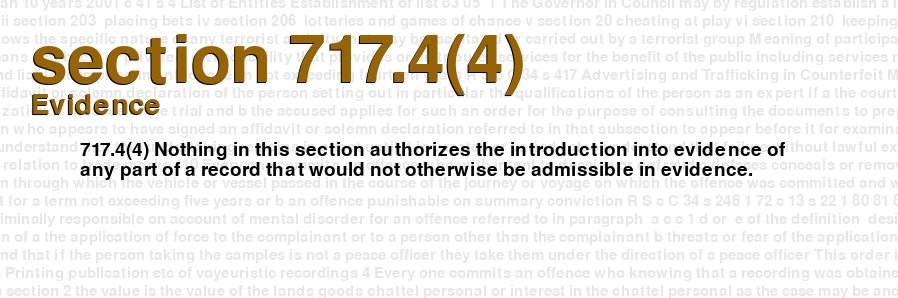
This section states that nothing in this section allows the use of any part of a record that would not otherwise be admissible in evidence.
Statutory Text
Explanation
Section 717.4(4) of the Criminal Code of Canada is a provision that clarifies the extent to which evidence can be admissible in court. Its purpose is to prohibit the introduction of any part of a record that would not be admissible in evidence, despite the provisions laid out in this section.
The section refers to the introduction of any part of a record, indicating that the provision is applicable in situations where documents or records are used as evidence in court proceedings. This provision must be read in the broader context of the Criminal Code of Canada as a whole, which outlines the rules of evidence and procedure for criminal proceedings.
For example, if the evidence sought to be introduced is hearsay, it would be inadmissible despite the provisions in this section. Similarly, if the evidence is prejudicial, irrelevant, or unreliable, it would not be admissible. The section thus serves to reinforce the principle of fairness and ensure that only reliable and relevant evidence is used to convict an accused in a criminal case.
In conclusion, section 717.4(4) of the Criminal Code of Canada is a crucial provision that limits the scope of admissible evidence in criminal proceedings. It ensures that only reliable and relevant evidence is used to prosecute an accused, thereby upholding the principles of fairness and justice in the Canadian legal system.
Commentary
Section 717.4(4) of the Criminal Code of Canada (CCC") is a provision that outlines the parameters under which certain types of evidence may be introduced in court proceedings. The provision is designed to limit the admissibility of certain records that may contain evidence that could be prejudicial or otherwise inadmissible under the normal rules of evidence. To understand the application of this provision, it is necessary to explore its wording and interpretation in detail.
The first key point to note about section 717.4(4) is that it states explicitly that nothing in this section authorizes the introduction into evidence of any part of a record that would not otherwise be admissible in evidence. This wording is important because it highlights the fact that section 717.4(4) does not create any new rules or exceptions to the usual legal standards for admitting evidence. Rather, it is simply a clarification of how existing rules should be applied in certain specific circumstances.
The second important aspect of section 717.4(4) is that it refers specifically to records". This term can encompass a wide variety of sources of evidence, including written documents, audio or video recordings, photographs, and other types of physical or electronic media. However, it is clear that this provision applies only to records that are being introduced as evidence in a legal proceeding.
The final key point to consider when analyzing section 717.4(4) is its overall purpose. As noted earlier, this section is designed to limit the admissibility of certain types of record-based evidence that might otherwise be prejudicial or legally problematic in some other way. By making clear that such records cannot be introduced under the authority of this provision alone, the CCC helps ensure that legal proceedings are conducted in a fair and just manner.
In practice, section 717.4(4) may come up in a variety of different types of cases. For example, it might be used to prevent the introduction of certain kinds of hearsay evidence, or to limit the use of illegally obtained recordings or documents. It might also be invoked to prevent the use of records that are irrelevant to the case at hand, or that are being introduced solely for purposes of harassment or intimidation.
Overall, section 717.4(4) of the Criminal Code of Canada is an important provision that helps ensure that legal proceedings are conducted in a fair and just manner. By limiting the admissibility of certain types of record-based evidence, this provision helps safeguard the integrity of the legal process and protect the rights of individuals who are involved in criminal or civil litigation. As such, it is an essential component of Canada's legal system, and one that should be carefully considered and upheld in all appropriate cases.
Strategy
Section 717.4(4) of the Criminal Code of Canada is an important section to consider when dealing with evidence in criminal proceedings. It states that nothing in the section authorizes the introduction of any part of a record that is not admissible in evidence. This means that any evidence presented must meet the admissibility requirements set out in the law.
There are several strategic considerations that lawyers and prosecutors must take into account when dealing with this section. First, they need to know the admissibility requirements for evidence in criminal proceedings. This includes understanding the rules of evidence, such as the hearsay rule, authentication, and the best evidence rule.
Second, lawyers and prosecutors must be prepared to challenge any evidence that does not meet the admissibility requirements. This may mean filing a motion to exclude evidence or making objections during trial. They can also use cross-examination to challenge the reliability and credibility of witnesses and evidence.
Third, lawyers and prosecutors must be careful not to introduce evidence that is inadmissible. This can lead to a mistrial or appeal, which can cost a lot of time and money. They must always do their due diligence and make sure that any evidence they present is reliable and admissible.
There are several strategies that can be employed when dealing with this section of the Criminal Code. One strategy is to make sure that all evidence is properly authenticated. This means that there must be evidence to prove that the evidence is what it claims to be. For example, if the evidence is a document, there must be evidence to prove that the document is genuine and has not been tampered with.
Another strategy is to use the best evidence rule. This rule requires that the original document or recording be presented as evidence, rather than a copy. This ensures that the evidence is reliable and has not been altered in any way.
Lawyers and prosecutors can also challenge the reliability and credibility of witnesses and evidence. This can be done through cross-examination or by presenting evidence that contradicts the witness or evidence.
Overall, Section 717.4(4) of the Criminal Code of Canada is an important section to consider when dealing with evidence in criminal proceedings. Lawyers and prosecutors must be aware of the admissibility requirements and use strategies to ensure that all evidence presented meets those requirements. By doing so, they can ensure that justice is served and that the accused receives a fair trial.