Editorial Annotation
Exception
Introduction
Statutory Text
Explanation
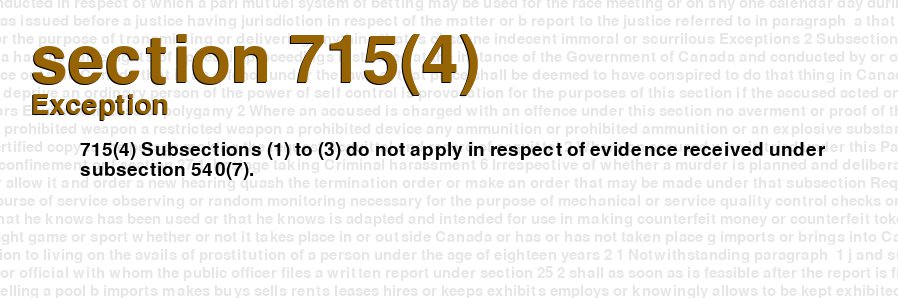
Section 715(4) of the Criminal Code of Canada pertains to the admissibility of certain types of evidence in a criminal trial. This section states that subsections (1) to (3) of the same section do not apply to evidence received under subsection 540(7).
Subsections (1) to (3) of section 715 pertain to the admissibility of evidence obtained through a search or seizure conducted in violation of Charter rights or evidence obtained through a confession given under duress. These subsections set out a process whereby the court must evaluate whether the evidence was obtained in a manner that violated the accused's rights. If the court determines that the evidence was obtained in this way, it may be excluded from consideration in the trial.
However, subsection 540(7) allows for the admission of "any evidence that, in the opinion of the justice or judge, is credible or trustworthy, whatever its source". This section permits the admission of evidence that might otherwise be excluded under subsections (1) to (3) due to a Charter violation.
Section 715(4) clarifies that the exclusionary rule established under subsections (1) to (3) of the section does not apply to evidence received under subsection 540(7). Therefore, if evidence is deemed credible or trustworthy by the justice or judge, it will be admissible in the trial, even if it was obtained in violation of the accused's rights.
Overall, section 715(4) ensures that evidence obtained in a manner that might otherwise be inadmissible due to Charter rights violations can still be considered in a criminal trial if it is deemed credible or trustworthy by the judge or justice.
Commentary
Section 715(4) of the Criminal Code of Canada is an important provision that governs the admissibility of evidence in criminal trials. Specifically, this provision limits the applicability of subsections (1) to (3) of section 715, which deal with the admissibility of previously excluded evidence. In essence, section 715(4) allows for the admission of evidence that was previously excluded under subsection 540(7) of the Criminal Code.
To fully understand the significance of section 715(4), it is important to examine both subsections 540(7) and sections 715(1)-(3) of the Criminal Code. Subsection 540(7) allows for the admission of evidence that was obtained under a warrant that was later found to be invalid, or under a warrant that was not originally required but was later deemed necessary. The subsection states that such evidence may be admissible if it would not bring the administration of justice into disrepute and if its admission would not interfere with the accused's right to a fair trial. Essentially, this subsection allows for evidence that was improperly obtained to be admitted if certain criteria are met.
Sections 715(1)-(3), on the other hand, deal with the admissibility of previously excluded evidence. Section 715(1) provides that evidence that was excluded under certain grounds, such as a breach of the accused's Charter rights or the rules of evidence, may become admissible if the court is satisfied that its admission would not bring the administration of justice into disrepute. Section 715(2) provides that evidence that was excluded because it was obtained by an illegal or improper search or seizure may become admissible if the court is satisfied that it would not have been found but for the illegal or improper conduct. Finally, section 715(3) provides that evidence that was excluded because it was obtained through a confession that was later found to be involuntary may become admissible if the court is satisfied that its admission would not bring the administration of justice into disrepute.
Section 715(4) limits the applicability of sections 715(1)-(3) in cases where evidence was admitted under subsection 540(7). Essentially, it means that evidence that was previously excluded because of a Charter breach or other illegal or improper conduct may still be admissible if it was obtained under a warrant that was later found to be invalid or unnecessary. This is an important provision that allows the court to consider the admissibility of evidence in a more nuanced way, taking into account the specific circumstances under which the evidence was obtained.
However, it is important to note that section 715(4) does not mean that evidence obtained through illegal or improper means is always admissible. Rather, it simply allows for the court to consider the admissibility of such evidence on a case-by-case basis, taking into account the specific circumstances of each case. As such, section 715(4) is a valuable tool that can help ensure that justice is served in a fair and equitable manner.
In conclusion, section 715(4) of the Criminal Code of Canada is an important provision that helps govern the admissibility of evidence in criminal trials. By limiting the applicability of sections 715(1)-(3) in cases where evidence was admitted under subsection 540(7), this provision allows for a more nuanced approach to the admissibility of previously excluded evidence. This can help ensure that justice is served in a fair and equitable manner, while also upholding the principles of the rule of law.
Strategy
Section 715(4) of the Criminal Code of Canada is an important provision in the criminal justice system. It provides an exception to the general rules governing the admissibility of evidence at trial. Specifically, it states that subsections (1) to (3) of Section 715, which deal with the admissibility of evidence obtained through certain investigative techniques, do not apply to evidence received under subsection 540(7).
This provision has significant implications for criminal trials, as it allows for the admission of certain types of evidence that would otherwise be excluded. As such, there are several strategic considerations that lawyers and defendants should keep in mind when dealing with this provision.
First and foremost, it is important to understand what evidence may be admitted under subsection 540(7). This provision allows for the admission of hearsay evidence in certain circumstances, specifically where the statement was made by a person who is unavailable to testify at trial due to death, illness, or other reasons beyond their control. This can be a powerful tool for the Crown, as it allows them to introduce evidence that might otherwise be inadmissible.
However, there are still limits on the admissibility of hearsay evidence under subsection 540(7). For example, the statement must relate to a material fact in issue at trial, and the court must be satisfied that the statement is sufficiently reliable to be admitted. As such, defendants and their lawyers should be prepared to challenge the admissibility of any hearsay evidence introduced under this provision.
Another key strategic consideration is the timing of any objections to evidence introduced under subsection 540(7). While objections can be raised at any time during the trial, it may be more effective to raise them early on, before the jury has had a chance to hear the evidence. This can help to minimize any potential impact that the evidence may have on the jury's perception of the case.
Finally, it is worth considering the potential impact of subsection 715(4) on plea negotiations. If the Crown has compelling evidence that they believe will be admissible under this provision, they may be less inclined to offer a plea deal. As such, defendants and their lawyers should be prepared to weigh the risks and benefits of taking a case to trial versus accepting a plea deal.
Overall, Section 715(4) of the Criminal Code of Canada is an important provision that can have significant implications for criminal trials. In order to effectively navigate this provision, it is important to understand its limits and to be prepared to challenge any evidence introduced under it. Defendants and their lawyers should also be aware of the potential impact of this provision on plea negotiations, and be prepared to make strategic decisions accordingly.