Editorial Annotation
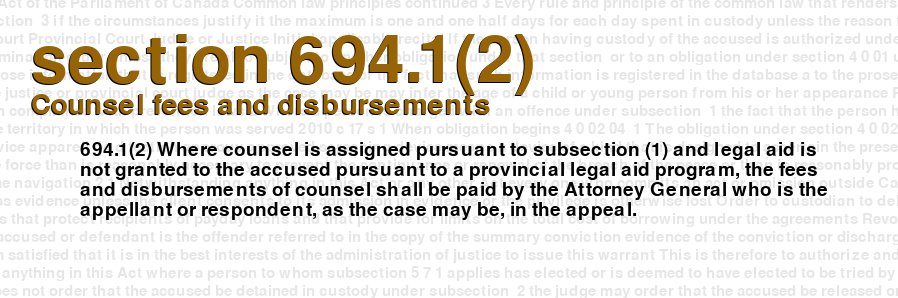
Counsel fees and disbursements
Introduction
The Attorney General must pay the fees and disbursements of assigned counsel in an appeal if legal aid is not granted.
Statutory Text
Explanation
Section 694.1(2) of the Criminal Code of Canada deals with the situation where an accused person appeals their conviction or sentence, and they are provided with legal counsel by the court, but they are not eligible for legal aid. In this scenario, the fees and expenses incurred by the assigned counsel must be paid by the Attorney General who is handling the appeal.
This provision is meant to ensure that individuals who are appealing a conviction or sentence have access to legal representation, regardless of their financial means. It recognizes that legal aid may not be available in all circumstances, but that it is still important to provide legal counsel to those who are seeking to challenge the decisions of the court.
The provision also establishes that the responsibility for payment of these fees and expenses lies with the Attorney General who is involved in the appeal. This ensures that there is a clear mechanism for payment, rather than leaving the matter to be resolved between the accused person and their assigned counsel.
Overall, section 694.1(2) is an important provision in the Criminal Code of Canada that helps to ensure access to justice for all individuals, regardless of their financial circumstances. By providing legal counsel to those who are appealing their conviction or sentence, it helps to ensure that the process is fair and transparent, and that everyone has an equal opportunity to have their case heard.
Commentary
Section 694.1(2) of the Criminal Code of Canada is a crucial provision of the Canadian legal system. This section ensures that accused persons, who are appealing their convictions, have access to legal representation, regardless of their financial situation.
Under the Canadian Charter of Rights and Freedoms, every person has the right to a fair and impartial trial. This includes the right to legal representation. However, not all accused persons have the financial resources to hire a lawyer. As a result, the Canadian government provides legal aid programs to ensure that those who cannot afford legal representation are not disadvantaged in the legal system.
However, even with legal aid programs, some accused persons may still not qualify for legal aid. In such cases, section 694.1(2) ensures that assigned counsel is available for those who cannot afford to pay a lawyer themselves. This means that the state will provide legal representation for an accused person who is appealing their conviction, and the fees and disbursements of that counsel will be paid for by the Attorney General.
The provision is crucial because it ensures that the right to a fair trial is not compromised by an accused person's financial situation. It recognizes that the appeal process is just as important as the trial process, and that access to legal representation is essential for a fair and just appeal. It also recognizes that those who cannot afford legal representation are not necessarily guilty of the crime they are accused of, and that providing legal aid is not only a fundamental aspect of the Canadian legal system, but also a moral obligation.
However, this provision does have its limitations. The fees and disbursements of counsel are often subject to a cap, which means that not all legal expenses may be covered. This can make it challenging for counsel to provide the best possible representation for their client, particularly in complex cases that require substantial resources.
Furthermore, the provision only applies to appeals. It does not cover representation for accused persons during the trial phase. Therefore, if an accused person cannot afford legal representation during their trial, they may be at a disadvantage, even if they are ultimately acquitted.
In conclusion, section 694.1(2) of the Criminal Code of Canada is a crucial provision that ensures that accused persons have access to legal representation, regardless of their financial situation. It recognizes that the right to a fair trial is fundamental and must be protected, and that access to legal representation is an essential component of that right. However, the limitations of this provision mean that some accused persons may still face challenges in accessing justice in the Canadian legal system.
Strategy
Section 694.1(2) of the Criminal Code of Canada presents several strategic considerations for both the appellant and respondent attorneys. The provision states that the fees and disbursements of counsel appointed under subsection (1) shall be paid by the Attorney General if the accused is not granted legal aid under a provincial legal aid program. In light of this, one of the primary strategic considerations that must be made is whether the attorney is appointed under subsection (1) and whether the accused person has access to legal aid.
If the attorney is appointed under subsection (1), they will most likely represent an accused person who has been denied legal aid by a provincial legal aid program. This means that regardless of whether the appellant or respondent attorney is the one seeking counsel fees, they must consider the financial situation of the defendant. If the defendant cannot afford legal representation, the appointed counsel will still need to be paid. In such a scenario, legal costs will be divided between the government and the opposing party.
One strategy that an attorney can employ in dealing with this section of the Criminal Code of Canada is to try to negotiate with the opposing party to share legal costs instead of incurring unnecessary expenses. This is especially true in situations where the defendant cannot afford legal representation. For example, a respondent attorney may decide to offer to pay a portion of the counsel fees with the government. By doing so, the respondent can secure an agreement with the appellant to ensure that their legal costs are not increased unnecessarily.
Another strategy that can be employed by an attorney is to apply to the court to allow the defendant to qualify for legal aid. Counsel can file a motion or application with the court, seeking to have the defendant declared in financial need and therefore qualified for legal aid. This can be a strategic move for the appellant or respondent attorney as they attempt to mitigate the cost burden of the accused person and limit their legal expenses.
Lastly, counsel can also consider exploring alternative forms of dispute resolution, such as mediation or arbitration. In such cases, the parties can negotiate a settlement or agree to a binding resolution outside of court. This approach can save the parties incurring litigation expenses, and ensure that the defendant can access legal representation without incurring significant financial difficulties.
In conclusion, section 694.1(2) of the Criminal Code of Canada presents significant strategic considerations for attorneys seeking legal counsel fees. To navigate this provision successfully, lawyers must carefully consider the financial situation of the accused and examine the possibility of sharing legal costs between parties, exploring alternative forms of dispute resolution, making applications to declare the defendant as having financial need, or a combination of any of these approaches. By doing so, they can ensure that their clients receive the legal representation needed without facing undue financial strain.