Editorial Annotation
Effect of suspension of disposition
Introduction
If the application of a disposition or placement decision is suspended, the previous order for the interim release or detention of the accused will remain in effect until the appeal is determined, subject to any new disposition made.
Statutory Text
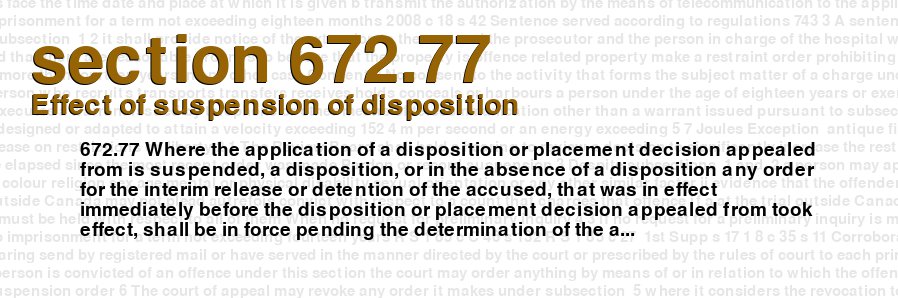
672.77 Where the application of a disposition or placement decision appealed from is suspended, a disposition, or in the absence of a disposition any order for the interim release or detention of the accused, that was in effect immediately before the disposition or placement decision appealed from took effect, shall be in force pending the determination of the appeal, subject to any disposition made under paragraph 672.76(2)(c).
Explanation
Section 672.77 of the Criminal Code of Canada relates to the suspension of a disposition or placement decision that has been appealed. Specifically, when a disposition or placement decision is appealed, and the court decides to suspend its application, this section sets out what will happen in terms of the accused's detention or release.
Under this section, if a disposition or placement decision is suspended, any order for interim release or detention of the accused that was in effect before the disposition or placement decision took effect will remain in place until the appeal is determined. This means that the accused will not be able to seek a new order for interim release or detention, as the previous order will continue to be in force until the appeal is resolved.
However, this continuation of the previous order is subject to any disposition that may be made under paragraph 672.76(2)(c), which allows the court to make an order for interim release or detention pending the appeal.
Overall, section 672.77 is intended to ensure that the accused's detention or release status remains consistent while an appeal of a disposition or placement decision is being considered. By maintaining the existing order for interim release or detention, the accused's rights are protected and they are not left in a legal limbo during the appeal process.
Commentary
Section 672.77 of the Criminal Code of Canada provides for the suspension of a disposition or placement decision appealed from. In such cases, the court orders that the disposition, or any order for interim release or detention of an accused, that was in effect before the disposition was made shall remain in force pending the determination of the appeal.
The section is primarily intended to ensure that a defendant is not unfairly detained or released pending the outcome of an appeal. It recognizes that a court's decision to detain or release an accused may be overturned on appeal, and in such cases, the defendant's liberty interests must be protected.
The section is particularly relevant in cases involving serious offences where the accused is not eligible for release on bail, and the court orders their detention pending trial. In such cases, the accused may appeal the decision to a higher court, and Section 672.77 ensures that they remain in detention until their appeal is heard and determined.
The section also applies to cases where the accused has been released on bail pending trial, and the court orders a change in the conditions of their release. For example, if the court orders that the accused must surrender their passport or report to a police station regularly, and the accused appeals this decision, Section 672.77 ensures that these conditions remain in force pending the outcome of the appeal.
Overall, Section 672.77 serves an important purpose in ensuring that the accused's liberty interests are protected pending the determination of an appeal. It recognizes that a court's decision may be overturned on appeal, and ensures that the accused is not unfairly detained or released pending the outcome of the appeal.
However, it is important to note that the section does not apply to cases where the accused is denied bail pending appeal. In such cases, the accused must apply directly to the higher court for release pending appeal, and the decision is made on a case-by-case basis.
Strategy
Section 672.77 of the Criminal Code of Canada provides important rights to individuals who appeal a disposition or placement decision. One of the key provisions of this section is the suspension of the application of a disposition or placement decision that has been appealed. This means that the accused person is entitled to remain in detention or release based on the earlier disposition or placement decision that was in effect before the appeal was filed until a new decision is made. This section is significant in safeguarding the rights of accused persons by ensuring that they are not left in limbo while their appeal is pending.
When dealing with Section 672.77, one of the key strategic considerations is the timing of making an appeal. If an accused person is dissatisfied with the disposition or placement decision, they should consider filing an appeal as soon as possible. This is because the earlier disposition or placement decision remains in effect until a new decision is made, and if the appeal is filed later, they could remain in detention longer than necessary. Therefore, a strategic approach would be to file the appeal promptly to ensure that the person is not left in detention longer than they need to be.
Another strategy that could be employed is to seek legal advice and support. An experienced criminal lawyer can provide valuable guidance and assistance in navigating the appeals process. The lawyer can help gather evidence and present strong arguments in favor of the accused person's release or a favorable disposition decision. Furthermore, when appealing a disposition or placement decision, the accused person should ensure that they have a strong case. This may involve presenting medical or other evidence to support their position that they are not a threat to the public and should be released on bail, for instance.
The accused person should also be prepared for the possibility that their appeal may not be successful. In this case, they may still remain in detention until a new decision is made. It is important to remain patient and keep working towards the best possible outcome in their case.
In conclusion, Section 672.77 of the Criminal Code of Canada provides crucial legal rights to accused persons who appeal a disposition or placement decision. Some strategic considerations when dealing with this section include filing an appeal promptly, seeking legal advice and support, presenting strong arguments in favor of the accused person's release or a favorable disposition decision, and being prepared for the possibility of an unsuccessful appeal.