Editorial Annotation
Evidence required
Introduction
This section outlines the required testimony from a medical practitioner regarding an accused persons fitness to stand trial and necessary psychiatric treatment.
Statutory Text
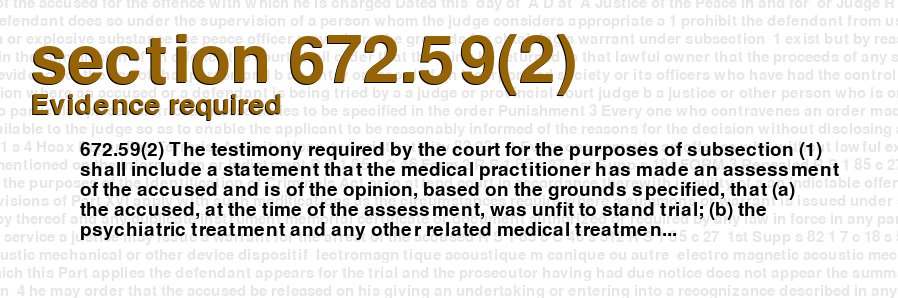
672.59(2) The testimony required by the court for the purposes of subsection (1) shall include a statement that the medical practitioner has made an assessment of the accused and is of the opinion, based on the grounds specified, that (a) the accused, at the time of the assessment, was unfit to stand trial; (b) the psychiatric treatment and any other related medical treatment specified by the medical practitioner will likely make the accused fit to stand trial within a period not exceeding sixty days and that without that treatment the accused is likely to remain unfit to stand trial; (c) the risk of harm to the accused from the psychiatric and other related medical treatment specified is not disproportionate to the benefit anticipated to be derived from it; and (d) the psychiatric and other related medical treatment specified is the least restrictive and least intrusive treatment that could, in the circumstances, be specified for the purpose referred to in subsection (1), considering the opinions referred to in paragraphs (b) and (c).
Explanation
Section 672.59(2) of the Criminal Code of Canada establishes the requirements for court testimony in cases where an accused person is considered unfit to stand trial due to mental illness. The section requires that a medical practitioner must make an assessment of the accused, and provide testimony to the court that addresses several specific factors.
Firstly, the medical practitioner must state that, based on specified grounds, the accused was unfit to stand trial at the time of the assessment. Secondly, the practitioner must determine that the psychiatric treatment and related medical treatment specified will make the accused fit to stand trial within 60 days. Additionally, the practitioner must demonstrate that the benefits of this treatment outweigh any risks of harm to the accused, and that the specified treatment is the least restrictive and intrusive option available.
This section of the Criminal Code aims to provide protections for accused individuals who may be unable to properly understand the legal proceedings against them due to a mental illness. By stipulating the requirements for medical assessments and treatment plans, the section aims to ensure that accused individuals receive the appropriate care they need while also allowing for justice to be carried out fairly within the criminal justice system.
Commentary
The Canadian Criminal Code of Canada is the collection of all federal criminal laws in Canada and it is regularly updated to reflect changes in legislation and societal norms. In the section 672.59(2), the code deals with the issue of an accused person being deemed unfit to stand trial. This section defines the role of medical practitioners in determining the fitness of an accused person to stand trial.
The subsection lays out the requirements for evidence that a court requires when considering an accused person's mental health at the time of the alleged offence. It states that a medical practitioner must provide an assessment based on a specific set of grounds for the court's purposes. The practitioner must be able to show that the accused was unfit to stand trial at the time of their assessment, that they are likely to become fit to stand trial with prescribed psychiatric treatment, and that the benefits of the treatment outweigh the risks.
The first condition that must be met before any assessment is made is that the medical practitioner must have thoroughly assessed an accused person's mental capacity to stand trial. The role of the medical practitioner is to provide the court with authoritative evidence with which to decide whether or not an accused person is mentally fit to stand trial. The courts rely on the expertise and impartiality of the medical practitioners who assess the accused person's mental health.
The second condition is related to the period in which an accused person is expected to become fit to stand trial under prescribed psychiatric treatment. The subsection stipulates that this treatment must not exceed a maximum of sixty days. This gives an accused person the best chance of being able to stand trial as soon as possible after their alleged offence.
The third condition requires the medical practitioner to weigh the benefits and risks of proposed psychiatric and other related medical treatments. This ensures that any treatment prescribed is balanced and based on evidence that it is likely to help the accused person to recover and become fit to stand trial.
Finally, the subsection requires that the proposed psychiatric treatment and related medical treatment be the least restrictive and least intrusive treatment reasonably available to the accused person. This is a vital safeguard against any unreasonable or arbitrary impositions of treatment that could have a negative effect on the accused person's mental health.
In conclusion, the subsection of section 672.59(2) of the Criminal Code of Canada provides a robust, legally sound, and ethical framework for determining the fitness of an accused person to stand trial. This subsection ensures that medical practitioners provide impartial evidence that is of the highest quality possible, which enables the courts to make informed decisions. This section ultimately serves to safeguard the defendant's rights, which is an essential aspect of Canada's justice system.
Strategy
When dealing with section 672.59(2) of the Criminal Code of Canada, there are several strategic considerations that should be taken into account. These include the need to ensure that the accused receives appropriate medical treatment, the need to protect their rights as a defendant, and the need to satisfy the court's criteria for fitness to stand trial.
One strategy that could be employed is to obtain an assessment of the accused's mental health as early as possible in the legal process. This can help to identify any potential issues that may affect their ability to stand trial and can allow for timely intervention and treatment if necessary. If the assessment determines that the accused is unfit to stand trial, steps can then be taken to ensure that they receive appropriate medical treatment in order to become fit to stand trial.
Another strategy that could be employed is to carefully review the medical practitioner's assessment of the accused's fitness to stand trial. This can help to identify any potential issues or concerns with the assessment and can allow for appropriate measures to be taken to address them. For example, if the assessment is incomplete or unclear, additional information may need to be requested or obtained in order to fully evaluate the accused's fitness to stand trial.
In addition, it is important to ensure that the accused's rights are protected throughout the legal process. This may include ensuring that they have access to legal counsel and that their rights to a fair trial are not compromised by their mental health status. Strategies that can be employed to protect the accused's rights may include requesting additional assessments or seeking legal representation for the accused to ensure that their interests are best represented.
Ultimately, the goal of section 672.59(2) is to ensure that the accused is given fair and appropriate treatment, while also upholding their rights as a defendant and protecting public safety. By carefully considering the factors outlined in the legislation and taking a strategic approach to managing the process, it is possible to achieve these goals and ensure that justice is served.