Editorial Annotation
Exception where disclosure unnecessary or prejudicial
Introduction
This section allows the court or Review Board to withhold information from parties other than the accused or Attorney General if it may be prejudicial to the accused.
Statutory Text
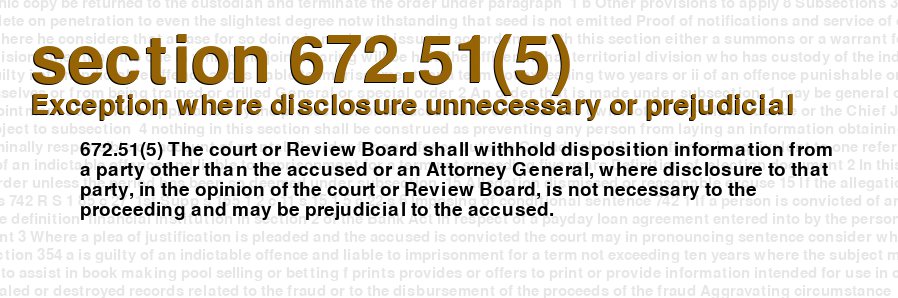
672.51(5) The court or Review Board shall withhold disposition information from a party other than the accused or an Attorney General, where disclosure to that party, in the opinion of the court or Review Board, is not necessary to the proceeding and may be prejudicial to the accused.
Explanation
Section 672.51(5) of the Criminal Code of Canada is an important provision that regulates the disclosure of information related to a criminal proceeding involving a mentally ill accused person. According to this section, the court or Review Board may withhold disposition information from a party other than the accused or an attorney general if the disclosure of such information to that party is not necessary for the proceeding and may be prejudicial to the accused.
Disposition information refers to information regarding the placement, release or other disposition of a mentally ill accused person following their trial. This information is vital to ensure that the accused receives appropriate care and treatment, and that the public safety is protected. However, in some cases, the disclosure of such information to a third party may lead to prejudice against the accused.
The purpose of this provision is to balance the need for information with the need to protect the rights of the accused. The court or Review Board must carefully consider whether withholding information is necessary and whether it may result in prejudice against the accused. In making this determination, the court or Review Board must consider several factors, such as the nature of the information, the potential harm to the accused and the public interest.
Overall, Section 672.51(5) reflects the important role of the court in balancing the needs of justice with the protection of individual rights. It ensures that information related to a criminal proceeding involving a mentally ill accused person is disclosed only when necessary and will not lead to prejudice against the accused.
Commentary
Section 672.51(5) of the Criminal Code of Canada is an important provision for protecting the rights of accused individuals. The provision empowers the court or Review Board to withhold disposition information from parties other than the accused or the Attorney General if disclosing such information may be prejudicial to the accused. In this commentary, I will discuss the importance of this provision and the various situations in which courts and Review Boards often use it.
The provision recognizes that accused individuals have the right to a fair trial and that disclosure of certain information may harm their right to fair trial. When information is disclosed to parties that are not necessary to the proceeding, such as witnesses or the media, there is a risk that this information may prejudice the accused. Therefore, the court or Review Board may withhold such information to ensure that the accused receives a fair trial.
One situation in which the court or Review Board may withhold disposition information is when the information is irrelevant to the proceeding. For example, if a witness wants to know the details of the accused's criminal records that are not relevant to the current charge, such information may be withheld. This ensures that the proceedings remain focused on the relevant facts of the case and that irrelevant information does not prejudice the accused.
Another situation in which the court or Review Board may withhold disposition information is when the information is likely to harm the accused's reputation or privacy rights. For example, if the accused has a prior conviction for a minor crime that has nothing to do with the current charge, disclosure of such information may harm their reputation and prejudice the case against them. In such cases, withholding such information may be necessary to ensure that the proceedings remain fair for the accused.
The provision also plays an important role in protecting sensitive information from disclosure. For instance, if the accused's medical or psychiatric records contain information that is not relevant to the current charge, the court or Review Board may withhold such information. This ensures that personal and sensitive information does not fall into the hands of people who may misuse it.
In conclusion, Section 672.51(5) of the Criminal Code of Canada is a crucial provision that is aimed at protecting the rights of accused individuals. It empowers the court or Review Board to withhold disposition information from parties other than the accused or the Attorney General if disclosing such information may be prejudicial to the accused. This provision enables fair trials, ensures that irrelevant information is not disclosed, protects sensitive information, and preserves the privacy and reputation rights of accused individuals. Thus, it is an essential tool for safeguarding the fairness and integrity of legal proceedings.
Strategy
Section 672.51(5) of the Criminal Code of Canada allows the court or the Review Board to withhold disposition information from a party other than the accused or an Attorney General, if the disclosure can be prejudicial to the accused or not necessary to the proceeding. This section poses a number of strategic considerations for parties in criminal proceedings, including the accused, prosecutors, defense counsel, and other parties to the case. Some strategies that could be employed by these parties are described below:
1. For the accused: If you are the accused in a case and the court or Review Board withholds disposition information from a party other than yourself or the Attorney General, you may want to request that the information be made available to your defense counsel. This can help your defense counsel to better prepare your defense by having access to all relevant information. Additionally, you can ask the court to re-consider the withholding of the information if you believe that it is necessary for the proceedings.
2. For the prosecutor: Prosecutors may want to argue for the withholding of disposition information from parties that are not the accused or the Attorney General. They may argue that the information is not necessary to the proceedings or that its disclosure may be prejudicial to the accused. This argument can be made if the prosecutor believes that the information may harm the accused's case or may put the accused's safety at risk. Prosecutors can also argue that withholding the information is necessary to protect the privacy and safety of the victim.
3. For the defense counsel: Defense counsel can use this section of the Criminal Code to request access to the disposition information that has been withheld from other parties in the case. This can be useful for building a stronger defense strategy and identifying possible weaknesses in the prosecution's case. Defense counsel can also use this section to argue for the withholding of certain information that may be prejudicial to the accused or not necessary to the proceedings.
4. For other parties: Parties other than the accused, the prosecutor, and the defense counsel may want to consider the impact of the withholding of disposition information on their role in the case. If they believe that the information is necessary for their involvement in the case, they can request that the court or Review Board reconsider the withholding of the information. If the information is withheld, parties can use other available resources to gather information about the case and prepare accordingly.
In conclusion, section 672.51(5) of the Criminal Code of Canada poses strategic considerations for all parties involved in criminal proceedings. Parties should carefully consider their options and develop strategies that can be employed based on their role in the case and their goals. By being aware of the section and the available strategies, parties can ensure that they are fully prepared to navigate the complexities of criminal proceedings in Canada.