Editorial Annotation
Disagreement of jury
Introduction
Statutory Text
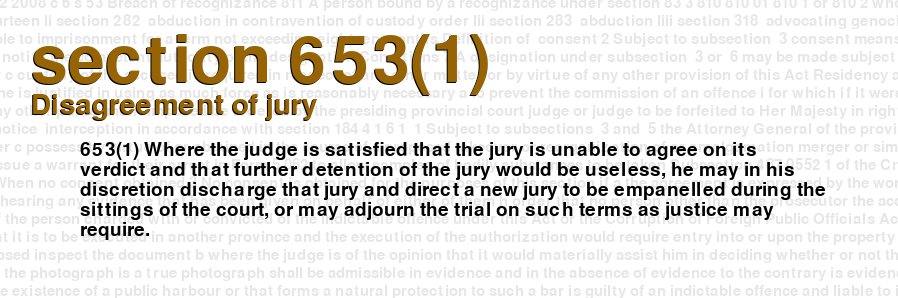
653(1) Where the judge is satisfied that the jury is unable to agree on its verdict and that further detention of the jury would be useless, he may in his discretion discharge that jury and direct a new jury to be empanelled during the sittings of the court, or may adjourn the trial on such terms as justice may require.
Explanation
Section 653(1) of the Criminal Code of Canada is a provision that deals with the discharge of a jury in a criminal trial. A jury is typically composed of 12 individuals who are responsible for assessing the evidence presented in a trial and determining the guilt or innocence of the accused. However, there may be cases where the jury is unable to reach a unanimous verdict.
In such situations, the judge has the discretion to discharge the jury and direct a new jury to be empaneled during the sittings of the court or may adjourn the trial on such terms as justice may require. This provision takes into account the fact that the jury may become deadlocked, and it provides for a mechanism to address this issue.
The discharge of a jury is not a decision that a judge takes lightly. The judge must be satisfied that the jury is unable to agree on its verdict, and that further detention of the jury would be useless. The judge must also consider the interests of justice in making the decision to discharge the jury and direct a new jury to be empaneled or to adjourn the trial.
Overall, section 653(1) ensures that the interests of justice are served in situations where a jury is unable to reach a unanimous verdict. It provides a mechanism to address deadlocked juries and ensures that trials can proceed fairly and efficiently.
Commentary
Section 653(1) of the Criminal Code of Canada outlines the circumstances under which a judge may discharge a jury in a criminal trial. It states that if a judge is satisfied that the jury is unable to reach a verdict, and that further attempts at deliberation would be useless, they may exercise discretion in discharging the jury and directing a new one to be empanelled, or alternatively, they may adjourn the trial on such terms as justice may require.
The purpose of this section is to ensure that justice is served, and that the trial process is fair and impartial. It recognizes that juries, while important components of the criminal justice system, are composed of human beings who are not infallible. If a jury is unable to reach a unanimous verdict, it is important that the judge has the authority to intervene and ensure that the trial does not result in an unjust outcome.
Discharging a jury is not a decision that is taken lightly. Judges must be satisfied that further attempts at deliberation would be useless, and that there is no reasonable prospect of the jury reaching a verdict. This is an objective standard, which means that the judge must evaluate the evidence and circumstances of the case to make an informed decision. They must take into account the length of the trial, the complexity of the issues, and any other factors that may be relevant to the jury's inability to reach a verdict.
If a judge decides to discharge a jury, they may direct a new jury to be empanelled during the sittings of the court, or they may adjourn the trial on such terms as justice may require. The decision as to which course of action to take will depend on the circumstances of the case. If the trial has been lengthy and complex, it may be appropriate to adjourn the trial to allow for a fresh start with a new jury. On the other hand, if the evidence is relatively straightforward and the trial has not been excessively long, it may be appropriate to empanel a new jury and continue with the trial.
One potential concern with this section of the Criminal Code is that it may lead to multiple trials for the same offense, which can be time-consuming and costly. However, it is important to remember that the primary focus of the criminal justice system is to ensure that justice is served. If a fair and impartial trial cannot be conducted with the current jury, then it is necessary to discharge them and begin again with a new jury.
In conclusion, Section 653(1) of the Criminal Code of Canada gives judges the discretion to discharge a jury if they are unable to agree on a verdict. This is an important safeguard to ensure that the trial process is fair and impartial, and that justice is served. While there may be some drawbacks to discharging a jury and beginning again, it is necessary to prioritize justice over efficiency. Overall, this section of the Criminal Code is an important component of the Canadian criminal justice system, and it helps to ensure that trials are conducted in a just and fair manner.
Strategy
Section 653(1) of the Criminal Code of Canada provides judges with an option where a jury is unable to reach a verdict. The provision allows the judge to discharge the jury and direct the empanelling of a new one or adjourn the trial on terms as may be reasonable in the circumstances. The judge's discretion is crucial in determining this outcome. In this article, we shall discuss some of the strategic considerations when dealing with this provision of the Criminal Code of Canada, and some strategies that parties can employ.
One of the strategic considerations when dealing with this provision is whether to seek a new trial immediately or adjourn the proceedings. A party may choose to seek an immediate retrial if they believe that the evidence presented thus far is strong, and they are likely to achieve a more favourable outcome with a new jury. On the other hand, they may opt to adjourn the trial if they believe that they require additional evidence or time to prepare adequately for the next trial.
Another strategic consideration is whether to introduce or exclude evidence during the subsequent trial. Under Section 653(1), parties are not prohibited from introducing new evidence in the subsequent trial. The defence may, therefore, opt to introduce evidence that was excluded in the previous trial, hoping that the new jury will consider it. Similarly, they may choose to exclude evidence that was presented at the previous trial if they believe that it hurt their case.
The choice of jury selection is an essential strategic consideration. This section of the Criminal Code of Canada allows for the selection of a new jury. As such, there are various considerations that parties should take into account when choosing the new jurors. For instance, if a party believes that the previous jury was biased against them, they may choose to select jurors who are more sympathetic to their case. On the other hand, they may opt to select jurors who are more neutral if they believe that previous jurors were swayed by emotional arguments.
The choice of legal representation is also important. If a party believes that their previous legal representation was inadequate in presenting their case, they may opt to engage new legal representation. The new legal representation may bring new perspectives and strategies to the case, increasing the likelihood of success in the subsequent trial.
In conclusion, section 653(1) of the Criminal Code of Canada is an important provision that allows the judge to discharge the jury in certain circumstances. There are several strategic considerations that parties should consider when dealing with this provision. These considerations include whether to seek a new trial immediately or adjourn the proceedings, introducing or excluding evidence, jury selection, and legal representation. Parties should consult with their legal counsel to determine which strategies to employ to ensure a successful outcome in subsequent trials.