Editorial Annotation
Effect of designation
Introduction
This section allows an accused person to be represented by designated counsel without being present for most of the criminal proceedings, but requires their presence for parts involving witness testimony, jury selection, and pleas/sentencing.
Statutory Text
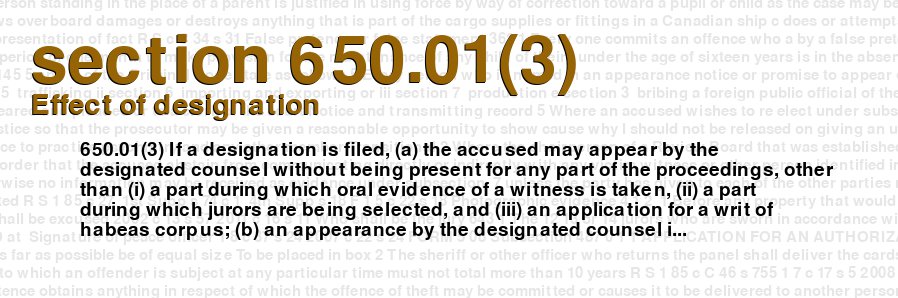
650.01(3) If a designation is filed, (a) the accused may appear by the designated counsel without being present for any part of the proceedings, other than (i) a part during which oral evidence of a witness is taken, (ii) a part during which jurors are being selected, and (iii) an application for a writ of habeas corpus; (b) an appearance by the designated counsel is equivalent to the accused�s being present, unless the court orders otherwise; and (c) a plea of guilty may be made, and a sentence may be pronounced, only if the accused is present, unless the court orders otherwise.
Explanation
Section 650.01(3) of the Criminal Code of Canada describes the option for an accused person to designate a lawyer to represent them in court. This means that instead of physically being present at all court proceedings, the accused can appoint a lawyer to attend on their behalf. However, there are a few limitations to this provision.
Firstly, the accused person can only use their designated counsel to attend court if they have filed the appropriate documentation with the court. Secondly, the designated counsel can only appear on behalf of the accused for certain parts of the proceeding, including during the selection of jurors, an application for habeas corpus, and when oral evidence of a witness is being taken.
It's important to note that while designated counsel can attend on behalf of the accused, their appearance is equivalent to the accused being present, unless the court orders otherwise. This means that the designated counsel has the same authority as the accused, but can only act within the limits set out in the Criminal Code.
Finally, it's important to note that if the accused wants to plead guilty or receive a sentence, they must be physically present in court unless the court orders otherwise. This ensures that the accused is aware of the consequences of their actions and has the opportunity to address the court directly.
Overall, section 650.01(3) of the Criminal Code of Canada gives the accused person an option to have a designated counsel attend court on their behalf, but also ensures that their presence may still be required for important parts of the proceeding.
Commentary
Section 650.01(3) of the Criminal Code of Canada is a critical legal provision that enshrines the right of an accused person to be represented by counsel of their choice; alternatively, they may select a lawyer to represent them in their absence in certain types of court proceedings. The provision recognizes that individuals charged with criminal offenses have the right to legal representation and that, in some cases, retaining counsel may be the most practical option.
In essence, the designation of counsel allows an accused person's representative to participate in criminal proceedings without the need for the accused person to be physically present in court. The provision acknowledges that there are certain types of court proceedings that would require the accused to be present, particularly for plea and sentencing hearings. While the provision allows for an accused person to waive their right to be present during certain portions of the trial, the provision also safeguards their right to be present during sentencing.
It is important to note that the provision refers only to designated counsel. The accused must still make an appearance in court to nominate their representative, and the court retains the right to deny a request for designated counsel if it believes that such representation would not be in the best interests of justice.
Section 650.01(3) is an essential part of the legal framework that ensures that individuals charged with criminal offenses receive a fair trial. The provision recognizes the importance of legal representation and acknowledges that some individuals may face practical barriers that prevent them from attending court hearings. By allowing designated counsel to participate in proceedings, the accused person's legal interests are still represented, which helps ensure that the trial remains fair.
Overall, Section 650.01(3) serves as an example of the importance of balancing the right to legal representation with the need for a fair trial. It recognizes the challenges faced by accused persons and seeks to provide a legal solution that best fits their specific circumstances. It is a critical legal provision that helps ensure that justice is accessible to all, regardless of their ability to physically attend court proceedings.
Strategy
Section 650.01(3) of the Criminal Code of Canada allows an accused person to designate a lawyer to appear for them in court. This provision raises several strategic considerations when dealing with criminal proceedings. The following are some strategies that could be employed when dealing with this section of the Criminal Code of Canada.
1. Choose the right counsel: Since the accused won't be physically present during the proceedings, their counsel must be competent and experienced enough to handle the case without any hiccups. The accused should choose a lawyer who understands their case well and has a proven track record of winning cases.
2. Assess the risks: The accused should assess the risks associated with appearing in court in person versus having their designated counsel appear. During the part of proceedings where oral evidence of a witness is being taken, jurors are being selected, or an application for a writ of habeas corpus is made, it may be beneficial to appear in person. In other situations, such as where the accused is hostile or may behave poorly in court, they may be better off having their designated lawyer appear without them. Also, if there are any potential misunderstandings or miscommunications between the accused and their designated counsel, it may be important for the accused to be present to clarify any misconceptions.
3. Determine the course of action: Once the risks have been assessed, the accused and their designated counsel should decide on the course of action to take. For example, if the accused decides to have their designated counsel appear without them, they should trust their lawyer to make strategic decisions on their behalf. If the accused decides to appear in court during the parts of the proceedings where they are required to be present, they should focus on presenting themselves well and following court etiquette.
4. Make a reasonable plea deal: If the accused decides to plead guilty, they must be present in court, unless the court orders otherwise. When making a plea deal, the designated counsel should ensure that the accused's rights are protected, and that the plea deal is reasonable and beneficial to the accused. If the plea deal is not reasonable or beneficial, it may be better to proceed with a trial.
5. Comply with any additional court orders: If the court orders the accused to be present during parts of the proceedings where they would normally be absent, they must comply. They should also ensure that they meet any other requirements such as attending counseling or mental health sessions.
In conclusion, section 650.01(3) of the Criminal Code of Canada raises various important strategic considerations when dealing with criminal proceedings. It is important that the accused make an informed decision regarding whether to designate their counsel and when to appear in court. The designated counsel should take the necessary steps to protect the accused's rights and interests throughout the proceedings. By employing the above strategies, the accused can increase their chances of achieving the best possible outcome in their case.