Editorial Annotation
Exception
Introduction
Statutory Text
Explanation
Section 631(3.1) of the Criminal Code of Canada pertains to the administration of justice in jury trials. Juries play an essential role in the justice system as they are responsible for determining the guilt or innocence of the accused based on the evidence presented. In order for the jury trial to be fair and impartial, it is necessary to minimize the risk of any extraneous influences that may affect the jurors' decision-making process.
One of the ways this can be achieved is through the use of a random selection process where names of potential jurors are drawn from a pool. Each individual is assigned a number, and the selections are made based on those numbers rather than the names. This helps to ensure that the selection of jurors is fair and unbiased.
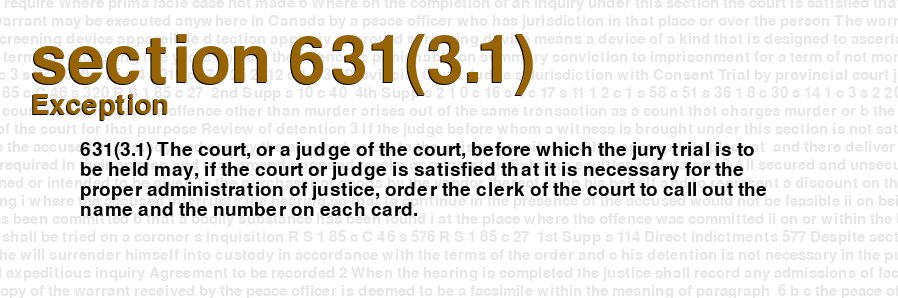
Section 631(3.1) allows for a further safeguarding measure. If the court or judge deems it necessary for the proper administration of justice, they may order that the clerk of the court call out the name and number on each card. This means that when the names are drawn from the pool to select the jury members, the names and numbers are called out loud for all to hear.
The purpose of this provision is to increase transparency and accountability in the jury selection process. It helps to ensure that the selection process is fair, and that the potential jurors are selected at random, without the possibility of any undue influence or bias affecting the decision.
In summary, Section 631(3.1) is an important provision in the Criminal Code of Canada that helps to safeguard the fairness and impartiality of jury trials. By requiring the clerk of the court to call out the name and number on each card during the selection process, the provision contributes to a transparent and fair administration of justice.
Commentary
Section 631(3.1) of the Criminal Code of Canada allows a judge or court to order the clerk of the court to call out the name and number on each jury summons card, before a jury trial is held, in the interest of the proper administration of justice. The section recognizes the importance of an impartial and fair jury in the administration of justice, and aims to reduce bias and prejudice against certain jurors.
The jury selection process is an essential part of the Canadian legal system. In a trial by jury, the selection of jurors is crucial, as they are responsible for deciding the guilt or innocence of an accused person. The selection process is expected to be fair and impartial, and to ensure that the jurors are representative of the community from which the trial is being held. Jurors are selected randomly from a pool of qualified individuals, and are expected to render their verdict based on the evidence presented in court and the instructions given by the presiding judge.
However, the jury selection process can also be influenced by factors such as personal biases, prejudices, and stereotypes. These biases can be based on a person's race, ethnicity, gender, religion, sexual orientation, or other personal characteristics. Such biases can lead to unfair treatment, and can compromise the impartiality and objectivity of the jury.
Section 631(3.1) of the Criminal Code recognizes that the random selection of jurors may not always be enough to ensure a fair and impartial jury. If a judge or court is satisfied that it is necessary for the proper administration of justice, they may order the clerk of the court to call out the name and number on each jury summons card. This requirement allows for an additional layer of scrutiny in the jury selection process, as potential jurors can be questioned about their biases and prejudices before being selected.
The section is intended to prevent challenges based on bias and prejudice in the jury selection process. It offers additional scrutiny to ensure that jurors are being selected fairly and impartially. This is in line with the principles of justice, fairness, and impartiality that the Canadian legal system is built on.
The requirement in section 631(3.1) also reflects the importance of transparency and openness in the justice system. By requiring the clerk of the court to call out the name and number on each jury summons card, the process is made visible to all those involved in the trial, and the public at large. This promotes accountability and trust in the justice system.
In conclusion, section 631(3.1) of the Criminal Code of Canada is a necessary provision that ensures the proper administration of justice in the Canadian legal system. It reinforces the importance of fairness and impartiality in the jury selection process, and reduces the risk of bias and prejudice in the trial process. It also promotes transparency and accountability in the justice system, and contributes to a stronger and more trusted legal system.
Strategy
Section 631(3.1) of the Criminal Code of Canada provides the court with the discretion to order the clerk of the court to call out the names and numbers on each card. This section could be strategically advantageous for both the Crown and the Defense. However, it is essential to carefully consider the circumstances of the case and the potential impact of calling out the name and number on each card before requesting this section to be employed.
One possible strategy for the Crown would be to use this section to ensure that there is a fair and impartial selection of jurors. For instance, if a member of the jury pool has a personal relationship with the accused or the victim or has expressed a bias or prejudice, they may be disqualified from serving as a juror. If the Crown decides to exercise this strategy, they must be careful not to reveal any information about the accused or the victim that could taint the jury pool. Therefore, it may be advantageous to request a publication ban.
Another strategy that the Crown could employ is to use this section to provide transparency and accountability in the jury selection process. The court may order the clerk of the court to call out the names and numbers on each card to give the parties an opportunity to confirm that the cards were drawn randomly. This strategy can be particularly useful in high-profile cases where the defense might argue that the jury selection process was biased or unfair.
Similarly, the Defense could use this section to challenge the power of the Crown and level the playing field. For instance, if the Crown has undue influence over the jury selection process, the Defense could use this section to ensure that the cards are drawn randomly and that the jury selection process is fair and impartial. The Defense could also use this strategy to point out any inconsistencies or irregularities in the jury selection process that could undermine the credibility of the Crown's case.
However, a potential drawback of using this section is that it could create unnecessary delay and add to the cost of the trial. Calling out the names and numbers on each card can be time-consuming and may require additional resources. Moreover, if one of the parties objects to the use of this section, it could lead to protracted litigation and delay the trial.
In conclusion, Section 631(3.1) of the Criminal Code of Canada can be a useful tool for both the Crown and the Defense in ensuring a fair and impartial jury selection process. The decision to employ this section must be carefully considered and weighed against the potential benefits and drawbacks. Factors such as the nature of the case, the fairness and impartiality of the jury pool, and the availability of resources must all be taken into account. By employing this section strategically, parties can increase the transparency and accountability of the jury selection process and ensure that justice is served.