Editorial Annotation
Conditions for accepting guilty plea
Introduction
This section specifies the conditions under which a plea of guilty may be accepted by a court in Canada.
Statutory Text
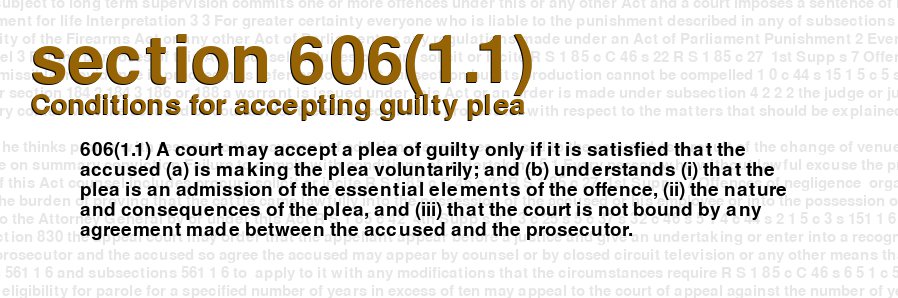
606(1.1) A court may accept a plea of guilty only if it is satisfied that the accused (a) is making the plea voluntarily; and (b) understands (i) that the plea is an admission of the essential elements of the offence, (ii) the nature and consequences of the plea, and (iii) that the court is not bound by any agreement made between the accused and the prosecutor.
Explanation
Section 606(1.1) of the Criminal Code of Canada sets out the requirements that must be met for a court to accept a plea of guilty from an accused individual. Under this section, a plea of guilty can only be accepted if the court is satisfied that the accused is making the plea voluntarily and that they fully understand the nature and consequences of the plea.
The first requirement, that the plea is made voluntarily, is important to ensure that the accused is not coerced or misled into entering a guilty plea. The second requirement, that the accused fully understands the nature and consequences of the plea, includes an understanding that the plea is an admission of the essential elements of the offence and that the court is not bound by any agreement made between the accused and the prosecutor.
This section is intended to protect the accused's rights and ensure that any guilty plea is made knowingly and voluntarily. It also ensures that the court has a full understanding of the accused's admission of guilt and that the plea is not the result of any agreement or negotiation that was made without full knowledge of the implications.
Overall, Section 606(1.1) is an important safeguard in the criminal justice system, ensuring that all guilty pleas are entered lawfully and that the rights of the accused are protected.
Commentary
Section 606(1.1) of the Criminal Code of Canada specifies the requirements that a court must satisfy in order to accept a plea of guilt. This section indicates that a court can accept a plea of guilt only if the defendant is making the plea voluntarily and understands the essential elements of the offense, the nature and consequences of the plea, and that the court is not bound by any agreement made between the defendant and prosecutor.
The purpose of this section of the Criminal Code of Canada is to ensure that any plea agreement entered into is voluntary and informed. This ensures that the defendant is not being coerced or pressured into pleading guilty and that they understand the consequences of their plea. It aims to prevent wrongful convictions, which can result from a plea being entered into without a full understanding of the implications of the plea.
The requirement that the plea be voluntary is crucial in ensuring that the plea agreement is fair and just. If a defendant is coerced or pressured into pleading guilty, it can be considered a violation of their rights and can undermine the integrity of the criminal justice system. This provision is in line with the principles of fundamental justice, which aim to protect individual rights and ensure that the legal system is fair and just.
The requirement that the defendant understands the essential elements of the offense, the nature and consequences of the plea, and that the court is not bound by any agreement made between the defendant and prosecutor ensures that the plea entered into is informed and made with knowledge of the implications. It is important that a defendant is aware of the implications associated with the plea, including the potential consequences of a conviction, such as imprisonment or a criminal record.
In addition, the provision that the court is not bound by any agreement made between the defendant and prosecutor ensures that the court maintains its independence and is not influenced by any prior agreement. This provision ensures that the court can independently assess the evidence and determine the appropriate sentence.
Overall, the requirements specified in Section 606(1.1) of the Criminal Code of Canada are important in ensuring that plea agreements are made voluntarily and with full knowledge of the implications. These provisions aim to prevent wrongful convictions and ensure that the criminal justice system operates in a fair and just manner.
Strategy
Section 606(1.1) of the Criminal Code of Canada lays out the criteria for accepting a plea of guilty in a criminal case, and it is essential for lawyers to be familiar with this provision in order to effectively represent their clients. When dealing with this section, there are several strategic considerations that lawyers should keep in mind, which can help them secure the best possible outcome for their clients.
One of the most important considerations when dealing with Section 606(1.1) is ensuring that the accused is making the plea voluntarily. It is crucial to ensure that the accused is not being coerced or pressured into making a guilty plea, as this can have serious consequences for both the accused and their legal team. For example, if the plea is not voluntary, it may be challenged on appeal, which can result in a new trial or potential acquittal. To avoid this, lawyers should take the time to build rapport with their clients and ensure that they have a full understanding of their legal options.
Another critical consideration is whether the accused understands the nature and consequences of the plea. This involves explaining the charges against them, the potential sentence they may face, and the consequences of a conviction. Lawyers should take the time to explain these concepts in plain language and ensure that their clients fully comprehend the risks involved in pleading guilty. This can help avoid misunderstandings down the road and ensure that the accused is making an informed decision.
Lawyers should also be aware that the court is not bound by any agreement made between the accused and the prosecutor. This means that even if a plea deal has been reached, the court may reject it if it is not satisfied that the accused fully understands the nature and consequences of the plea. To prevent this from happening, lawyers should prepare their clients thoroughly and ensure that they are fully prepared to make a persuasive case for accepting the plea.
Strategies that can be employed to address these considerations include conducting thorough interviews with the accused, including any potential witnesses or co-accused. This can help uncover any potential coercive tactics that may be used by the prosecution and allow lawyers to explain the risks and benefits of a guilty plea. Lawyers should also take the time to educate their clients about the legal system and the court process, and provide frequent updates throughout the case.
Another important strategy is negotiation with the prosecutor. This can involve reaching a plea agreement that takes into account the interests of both the accused and the prosecutor. This can help ensure that the accused understands the nature and consequences of the plea and is making an informed decision.
In conclusion, there are many strategic considerations when dealing with Section 606(1.1) of the Criminal Code of Canada. Lawyers should take the time to fully prepare their clients, conduct thorough interviews, and negotiate with the prosecutor as necessary. By doing so, they can help secure the best possible outcome for their clients while ensuring that they are fully invested in the legal process.