Editorial Annotation
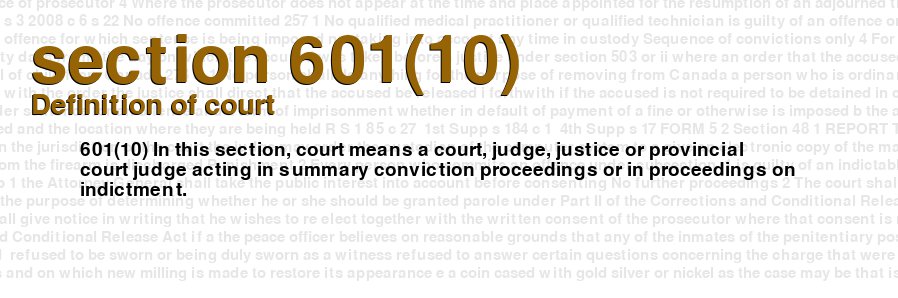
Definition of court
Introduction
Statutory Text
601(10) In this section, "court" means a court, judge, justice or provincial court judge acting in summary conviction proceedings or in proceedings on indictment.
Explanation
Section 601(10) of the Criminal Code of Canada is a provision that defines the term court" for the purposes of this particular section of the Criminal Code. This section is concerned with the power of a court to make an order for the forfeiture of property in certain circumstances. The word court" is used in this section, and it is therefore necessary to have a clear understanding of what this term means when interpreting this provision.
The term court" is defined broadly in section 601(10) of the Criminal Code. It encompasses a wide range of judicial officers, including a court, judge, justice, or provincial court judge acting in summary conviction proceedings or in proceedings on indictment. This means that any person or entity authorized by law to hear criminal cases falls within the definition of "court" for the purposes of this section.
In practice, this means that if the court determines that property has been obtained as a result of certain criminal activities, it may order that the property be forfeited to the Crown. Forfeiture is a form of punishment for the commission of an offense, and it is intended to prevent criminals from benefiting from their wrongdoing. Under the Criminal Code, the court may order forfeiture in situations such as drug offenses, fraud, and organized crime offenses--crimes that may result in significant financial gain for the offender.
Overall, the definition of the term "court" in section 601(10) of the Criminal Code is important for interpreting the power of the court to make forfeiture orders in criminal cases. The provision serves to clarify the meaning of "court," ensuring that any judicial officer empowered to hear criminal cases has the authority to make such an order if the statutory prerequisites are met.
Commentary
Section 601(10) of the Criminal Code of Canada is an important provision that defines the scope of the term court" in the context of summary conviction proceedings or proceedings on indictment. It recognizes that the term court can refer to a variety of judicial officials, including judges, justices, or provincial court judges, depending on the nature of the case.
This provision is important because it provides clarity and certainty to the criminal justice system in Canada. It ensures that all parties involved in a case, including the accused, the prosecution, and the judiciary, have a common understanding of the authority and jurisdiction of the court that is hearing the case.
Moreover, by defining the scope of the term court, section 601(10) of the Criminal Code helps to ensure that the procedures and rules of evidence that apply in a particular case are appropriate to the nature of the offence, the type of proceeding, and the judicial official who is hearing the case.
For example, if a case is being heard in summary conviction proceedings, the court will be a lower court that has limited jurisdiction and authority. The procedures and rules of evidence that apply in such proceedings are tailored to ensure that they are fair, efficient, and proportionate to the nature of the offence and the potential penalty that can be imposed.
On the other hand, if a case is being heard in proceedings on indictment, the court will be a higher court that has broader jurisdiction and authority. The procedures and rules of evidence that apply in such proceedings are more formal and complex, and are designed to ensure that the accused receives a fair trial and that justice is done.
In summary, section 601(10) of the Criminal Code of Canada plays an important role in ensuring clarity and consistency in the administration of justice in Canada. By defining the scope of the term court, this provision helps to ensure that the procedures and rules of evidence that apply in different types of proceedings are appropriate, fair, and just. It also helps to ensure that all parties involved in a case have a common understanding of the authority and jurisdiction of the court that is hearing the case.
Strategy
Section 601(10) of the Criminal Code of Canada specifies the definition of the term court" for the purpose of this section. This section deals with the forfeiture and destruction of things seized in relation to certain offences, including drug offences and firearm-related offences. This provision gives the court the power to order the forfeiture or destruction of these items in order to prevent their use in future offences.
When dealing with this section of the Criminal Code, there are several strategic considerations that lawyers and defendants need to take into account. The first consideration is the nature of the offence in question. This section applies only to certain offences, and a lawyer must be aware of whether the offence their client is charged with falls under this section or not. If the offence is not covered by this section, then this provision will not be applicable.
Another strategic consideration when dealing with this section is the possible impact of a forfeiture or destruction order on the defendant. For example, if a person is facing charges related to drug trafficking and their assets are seized, a forfeiture order could result in the loss of valuable assets. A lawyer must weigh the potential consequences of such an order against the possible benefits for their client, such as a reduced sentence or the dropping of some charges.
One possible strategy that could be employed when dealing with this section is to challenge the validity of the seizure itself. The seizure of property is subject to constitutional protections, including protections against unreasonable search and seizure. A lawyer may argue that the seizure was conducted unlawfully or without proper grounds, which could lead to the court ordering the return of the seized property and the quashing of the charges against the defendant.
Another strategy that could be employed is to negotiate with the prosecution to reach a plea agreement that avoids the need for a forfeiture or destruction order. This could involve the defendant agreeing to a reduced sentence or a different charge in exchange for the forfeiture or destruction of the seized property being dropped.
In conclusion, Section 601(10) of the Criminal Code of Canada is an important provision that allows for the forfeiture and destruction of things seized in relation to certain offences. When dealing with this section, lawyers and defendants must take into account the nature of the offence and the potential consequences of a forfeiture or destruction order. Strategies such as challenging the validity of the seizure and negotiating a plea agreement can be employed to achieve the best outcome for the defendant.