Editorial Annotation
Criminal information and bill of indictment
Introduction
No criminal charges can be laid or presented to a grand jury.
Statutory Text
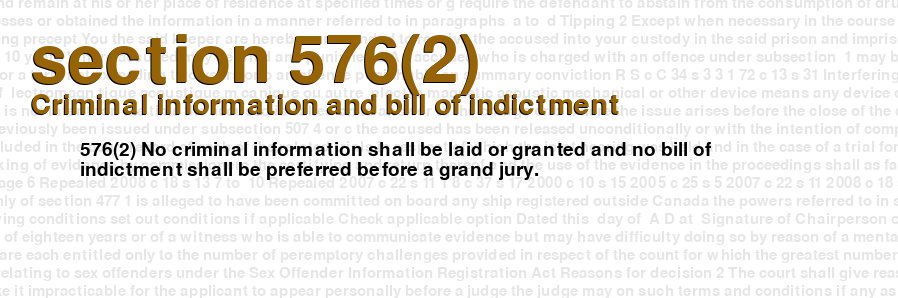
576(2) No criminal information shall be laid or granted and no bill of indictment shall be preferred before a grand jury.
Explanation
Section 576(2) of the Criminal Code of Canada prohibits the laying of criminal information, the granting of a complaint, and the preferring of a bill of indictment before a grand jury in criminal proceedings. Essentially, this means that prosecutors cannot proceed with criminal charges against an individual by presenting evidence to a grand jury.
Grand juries are not commonly used in the criminal justice system in Canada. They are typically used in the United States, where they have the power of subpoena and can compel witnesses to testify before them. In Canada, grand juries are used in exceptional cases and are only convened when necessary. They are typically used to investigate organized crime, corruption, and other complex cases.
The use of grand juries in criminal proceedings has been criticized by some legal experts who argue that they are outdated and unnecessary. Proponents of grand juries argue that they provide an additional layer of protection for defendants, as they give citizens the opportunity to grand jury members to review evidence before charges are laid.
Overall, section 576(2) of the Criminal Code of Canada serves to limit the use of grand juries in criminal proceedings, ensuring that prosecutors must rely on other methods for charging individuals with criminal offences. It serves as a safeguard against potential abuses of power and reinforces the principles of fairness and justice in Canada's criminal justice system.
Commentary
Section 576(2) of the Criminal Code of Canada is a provision that has been put in place to ensure that no criminal information shall be laid or granted, and no bill of indictment shall be preferred before a grand jury. In other words, it prevents the prosecution from laying any formal charges against an individual without first seeking permission from a judge.
This section of the Criminal Code is reflective of the Canadian legal system's commitment to the principles of due process and fair trial. It ensures that an individual is not being charged with a crime based on hearsay or allegations alone, without providing any evidence or justification for the charges. Instead, the prosecution is required to gather enough evidence to convince a judge that there is sufficient cause to grant an indictment. This guarantees that the accused is not being subjected to frivolous or malicious criminal proceedings.
The purpose of the grand jury is to act as a buffer between the prosecution and the accused. It is a panel of citizens that is tasked with reviewing the evidence presented by the prosecution and determining whether there is enough evidence to warrant a trial. The grand jury is supposed to act as a neutral party that ensures that the prosecution is not pursuing a case without just cause and that the accused is being provided with a fair trial.
However, this section of the Criminal Code has been criticized for its potential to be abused. It has been suggested that prosecutors sometimes use the grand jury process to intimidate or harass citizens. In some cases, the grand jury has been characterized as a rubber stamp, where the accused has no opportunity to challenge the evidence presented by the prosecution. Moreover, even if the grand jury decides not to indict, this does not prevent the prosecution from continuing with the charges; it simply means that the case has to proceed to a preliminary hearing.
In light of these concerns, some have called for the abolition of the grand jury system in Canada. They argue that it is an unnecessary and potentially abusive remnant of a bygone legal era. They contend that there are other legal mechanisms that can be employed to ensure that the prosecution is properly scrutinized and that the accused is given a fair trial.
Despite these concerns, it is clear that the grand jury system has been an important part of the Canadian legal landscape for many years. It has played a critical role in ensuring that the accused is not subjected to frivolous or malicious proceedings and that the prosecution is held accountable for its actions. As such, it is likely to remain an essential feature of Canada's legal system for the foreseeable future. However, it is important to continue to monitor its use and effectiveness in order to ensure that it remains an effective safeguard against prosecutorial overreach.
Strategy
Section 576(2) of the Criminal Code of Canada prohibits the laying of criminal information or the granting of a bill of indictment before a grand jury. This provision presents several strategic considerations for lawyers dealing with criminal cases. Lawyers must understand the implications of this section and develop strategies that will help them navigate around this prohibition.
One strategy that could be employed is to use an alternative procedure for laying a charge. For example, a lawyer could choose to lay an Information before a Justice of the Peace or a Provincial Court Judge. This process involves swearing an information, which essentially sets out the allegations against the accused. The JP or the judge then determines if there is sufficient evidence to warrant laying charges against the accused. If the JP or judge believes there is sufficient evidence, they will issue a summons for the accused, or an arrest warrant if the accused fails to comply with the summons.
Another strategy that could be employed is to pursue an indictment through the preferred indictment process. This process involves the Crown prosecutor sending a notice to the accused and their counsel indicating their intention to proceed by way of indictment. The Crown prosecutor then files the indictment at the appropriate court. The accused is then summonsed to appear before the court to enter a plea.
Lawyers also need to consider that the prohibition against a bill of indictment being preferred before a grand jury applies only to some criminal offences. For example, it does not apply to indictable offences that carry a maximum penalty of less than five years of imprisonment. Lawyers may consider pursuing those less serious offences by way of a bill of indictment before a grand jury. The strategic decision-making for this has to consider the potential downside of a longer sentence if the accused is found guilty.
Lawyers may also consider plea negotiations or plea bargaining as a strategy. When the Crown prosecutor avoids a grand jury procedure and bargains with the accused, they can save both time and resources. This strategy can also lead to a plea bargain, where the accused pleads guilty to a lesser charge in exchange for more leniency in sentencing.
Finally, lawyers must consider the impact that the appeal process or judicial reviews may have in avoiding the section 576(2) prohibition. Appeals or judicial reviews from similar cases may provide persuasive precedential support to argue that the policy considerations behind Section 576 are inapplicable in the case at issue.
In conclusion, lawyers dealing with criminal cases need to be aware of Section 576 of the Criminal Code of Canada and its implications. They must exercise strategic considerations and pursue options that comply with the prohibition and ensure an effective resolution for their clients. Different strategies, including alternative procedures and plea negotiations, can be employed to overcome the challenges presented by this provision and provide the best possible outcome for the accused.