Editorial Annotation
Endorsing charge
Introduction
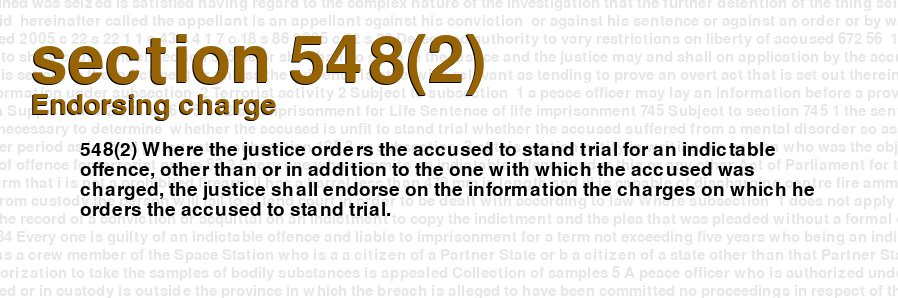
This section states that if a justice orders an accused person to stand trial for an indictable offense, they must endorse the charges on the information.
Statutory Text
Explanation
Section 548(2) of the Criminal Code of Canada is a provision that outlines a requirement for justices in Canada to specify the nature and scope of criminal charges when an accused is ordered to stand trial. This section applies to indictable offenses, which are serious crimes that are investigated and prosecuted by the government. Indictable offenses can include but are not limited to assault, murder, fraud, and drug trafficking.
The section mandates a judge, after taking evidence or hearing arguments, to rule on whether the accused should stand trial for an offense other than or in addition to the one with which they were initially charged. The judge conducts this decision-making process based on the evidence presented in court and whether or not it is prima facie - meaning, if it is enough evidence to establish a legally sufficient case.
If the judge determines that the accused should stand trial for other offenses beyond the initial charges, the provisions of section 548(2) apply. This requires the judge to enter the endorsed charges on the information document, which lays out what the accused is being charged with.
This section is important in ensuring that the accused knows precisely what charges they face, which is a fundamental aspect of the Canadian justice system. By specifying the charges the accused is facing, justice is done and the accused's right to a fair trial is upheld. This provision also helps ensure that evidence is not withheld or suppressed to support or discard particular charges. If endorsed charges are not included on the information document, then it is possible that charges could be added down the line, which would initiate a new court proceeding and require a new set of evidence.
All in all, this section upholds the principles of natural justice, ensures that accused persons understand the charges leveled against them, and enables a fair and transparent trial process in Canada.
Commentary
Section 548(2) of the Criminal Code of Canada provides guidance on the endorsement of charges on an information when a justice orders that an accused stand trial for an additional indictable offence. The section states that when the accused is charged with an offence, and the justice orders them to stand trial on an indictable offence that is not part of the original charge, the justice must endorse the charges on which the accused is to stand trial on the information.
The endorsement of charges on the information serves as a formal notice to the accused of the additional charges they are facing. It also ensures that the accused is properly informed of the charges they need to prepare for in their defense. This is an important step in the criminal justice process as it ensures that the accused is aware of the full extent of the charges against them and can prepare their case adequately.
Section 548(2) emphasizes the importance of transparency and fairness in the criminal justice system. Endorsing the charges on the information ensures that both the accused and the prosecution are fully aware of the charges being pursued. This helps prevent any surprises or misunderstandings during the trial, ensuring a fair and just trial for all involved.
Section 548(2) also highlights the role of a justice in the criminal justice system. Justices have the power to determine whether an accused should stand trial for an indictable offence. This power places a great responsibility on the justice to ensure that the accused receives a fair trial and is held accountable for their actions. Endorsing the charges on the information is just one small step in this process, but it is a critical one in ensuring that the justice system operates with transparency, fairness, and integrity.
In conclusion, Section 548(2) of the Criminal Code of Canada plays an important role in ensuring that the accused and the prosecution are aware of the charges being pursued. The endorsement of charges on the information helps prevent surprises or misunderstandings during trial and ensures that the accused can prepare their case adequately. This section of the Criminal Code highlights the role of a justice in the criminal justice system and emphasizes the importance of transparency, fairness, and integrity in the administration of justice. It is a critical component of the criminal justice process that helps maintain confidence in the justice system and ensures that justice is served.
Strategy
Section 548(2) of the Criminal Code of Canada requires the justice to endorse on the information the charges on which the accused is ordered to stand trial for an indictable offense. This section creates several strategic considerations for both the prosecution and defense lawyers.
One strategic consideration for the prosecution is to ensure that the endorsement is done correctly and promptly. The endorsement must include all the charges on which the accused is ordered to stand trial. If the endorsement is not done correctly, it may result in delay, confusion, or could lead to an appeal. The prosecution can ensure that the endorsement is done correctly by preparing an accurate and complete list of charges and requesting that the justice endorses them promptly. In doing so, the prosecution may avoid any unnecessary delays in the trial process and ensure that justice is served.
Another strategic consideration for the defense is to challenge the endorsement of the charges. The defense may argue that the endorsement was not done correctly or that the charges added were not supported by evidence. This challenge may result in the dismissal of charges or a reduced sentence, which may be more favorable to the accused. Defense counsel could use this strategy to limit the scope of the trial and ensure that their clients' rights are protected.
Strategic considerations may also arise in cases where the endorsement of charges gives rise to multiple offenses. A skilled defense counsel may look for a plea bargain with the prosecution, where the defendant pleads guilty to the endorsed charge in exchange for a reduced sentence. Alternatively, defense counsel may seek to argue that the multiple charges are the result of overcharging and seek to have some of the more serious charges dropped.
Another strategic consideration for both parties is timing. The prosecution may seek to add charges after the preliminary hearing or at the beginning of the trial, while the defense may seek to challenge the endorsement before the preliminary hearing. This timing can have a significant impact on the outcome of the case, and each party must carefully weigh the pros and cons of exercising their right to endorse or challenge charges.
In conclusion, Section 548(2) of the Criminal Code of Canada has significant implications for how charges are endorsed and how the trial proceeds. Prosecution and defense counsel must carefully consider the impact of endorsement and seek strategies that will best serve their clients' interests. These strategies may include challenging the endorsement of charges, seeking plea bargains, or timing endorsements to optimize outcomes. Ultimately, it is the responsibility of litigators to exercise sound judgment and deploy effective strategies that achieve just outcomes.