Editorial Annotation
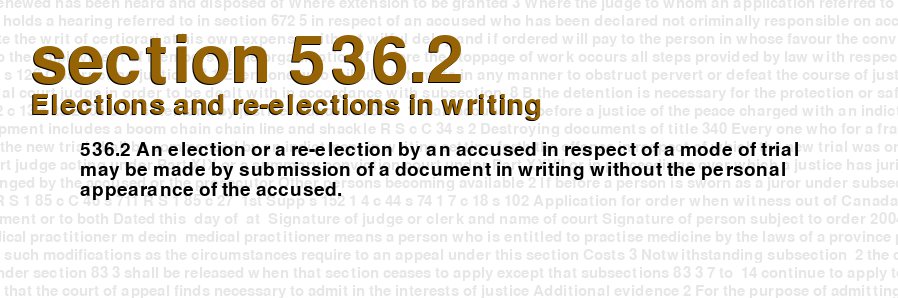
Elections and re-elections in writing
Introduction
Statutory Text
Explanation
Section 536.2 of the Criminal Code of Canada allows an accused person to elect a mode of trial without appearing in person before the court. The mode of trial refers to the process through which a criminal case is heard and decided. There are two main modes of trial in Canada: trial by judge alone and trial by judge and jury.
The accused person can elect a mode of trial by submitting a document in writing to the court. This means that the accused does not have to be present in court to make this decision. The document must be signed by the accused or their legal representative and should indicate which mode of trial is being elected.
This provision is important because it provides an accused person with flexibility and convenience in making their election. It also helps to streamline the court process by reducing the need for in-person appearances. However, the accused person must still ensure that they comply with all the necessary legal procedures and deadlines when making their election.
Overall, Section 536.2 of the Criminal Code of Canada is a useful provision that facilitates the smooth operation of the criminal justice system.
Commentary
Section 536.2 of the Criminal Code of Canada provides an accused person with the option of submitting a written document to make an election or re-election in respect of a mode of trial. In other words, an accused person has the choice to either have their trial in front of a judge alone (a judge sitting without a jury) or before a judge and a jury. This provision affords accused persons with the flexibility to make an informed decision regarding the mode of trial that they believe would best serve their interests.
This section is significant because it recognizes an accused person's right to a fair trial, which includes the right to choose the mode of trial that they believe will result in a just and fair outcome. It also acknowledges the fact that not all accused persons may be able to appear in person to make their election or re-election due to various reasons such as illness, physical disabilities, or impracticality of attending court in person, and therefore, provides for the submission of a written document instead.
However, it is important to note that the written election or re-election must still meet certain requirements stipulated under the Criminal Code. For instance, it must be in writing, signed and dated by the accused, and include a statement indicating the accused's choice of mode of trial. The document must also be filed with the appropriate court within the stipulated time frame.
Furthermore, it's noteworthy that an accused person's choice of mode of trial is an important decision that can have significant impacts on the outcome of their case. For example, a jury trial may be more suitable if the case involves complex legal issues or if there is strong public interest in the case. Still, a judge-alone trial may be preferred in cases involving sensitive or controversial issues where jurors may be swayed by emotions or preconceived biases.
In conclusion, section 536.2 of the Criminal Code of Canada provides for an accused person's right to choose the mode of trial that they believe is best suited for their case. It recognizes that an accused person may not always be able to appear in person to make their election or re-election and provides for the submission of a written document instead. This provision underscores the importance of an accused person's right to a fair trial, which necessarily includes the choice of mode of trial.
Strategy
Section 536.2 of the Criminal Code of Canada provides accused persons with the right to elect their preferred mode of trial by submitting a document in writing without the need for their personal appearance. This provision is intended to provide greater flexibility and convenience to accused persons while ensuring their fair and effective representation in the criminal trial process. However, it also raises various strategic considerations for both the accused person and their legal counsel.
One strategic consideration for the accused is the choice of mode of trial. Depending on the nature of the case, the accused may wish to elect a trial by judge alone, a trial by judge and jury, or a preliminary inquiry. A trial by judge alone may be preferred in cases where there are complex legal issues or where the accused may need to testify without the pressure of a jury. A trial by judge and jury may be preferred when the accused seeks a more sympathetic or diverse jury pool, or where a trial by jury may provide greater accountability and transparency. A preliminary inquiry may be preferred in cases where the accused seeks to challenge the evidence presented by the Crown.
Another strategic consideration is the timing of the election. Accused persons must make their election within 30 days of their first appearance in court or within such time as ordered by the court. Failure to elect within this time may result in a deemed election for trial by judge alone. Legal counsel must therefore be vigilant in ensuring that the accused is aware of their right to elect and that they make an informed decision within the required time frame.
A third strategic consideration is the content of the election document itself. The document must indicate the accused's choice of mode of trial and must be signed by the accused or their legal counsel. Legal counsel may wish to include additional information or arguments in support of the accused's choice of mode of trial, particularly if the accused wishes to challenge the Crown's evidence or if the case involves complex legal issues.
Finally, both the accused and their legal counsel must be aware of the potential consequences of their election. For example, a trial by judge and jury may result in longer trial delays and increased media attention, while a trial by judge alone may result in a less diverse and potentially less sympathetic adjudicator. Legal counsel must ensure that the accused understands these implications and makes an informed decision based on their individual circumstances and priorities.
In terms of strategies that could be employed, legal counsel may wish to engage in pre-trial negotiations with the Crown to explore the possibility of resolving the matter without going to trial. This may involve seeking a plea deal or negotiating a resolution agreement that avoids the need for a trial altogether. Alternatively, legal counsel may wish to engage in pre-trial motions that challenge the legality or constitutionality of the Crown's evidence or the fairness of the trial process. These strategies may influence the accused's decision regarding mode of trial and may ultimately enhance their chances of a successful outcome.
In conclusion, Section 536.2 of the Criminal Code of Canada provides accused persons with an important right to elect their preferred mode of trial without the need for their personal appearance. However, this provision also raises various strategic considerations for accused persons and their legal counsel, including the choice of mode of trial, the timing of the election, the content of the election document, and the potential consequences of the election. Legal counsel must be vigilant in ensuring that the accused understands and exercises their rights in accordance with their individual circumstances and legal objectives.