Editorial Annotation
Detention without application where consent
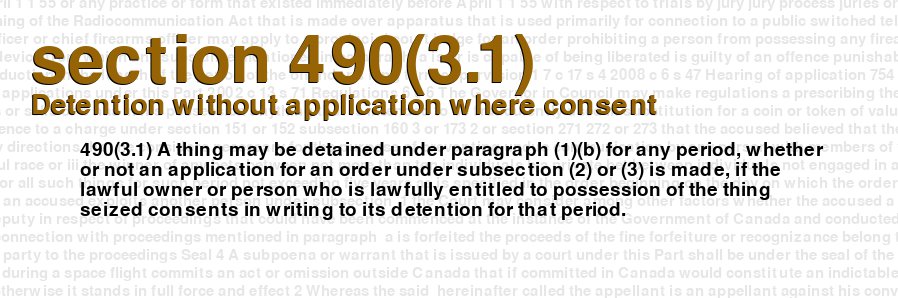
Introduction
Statutory Text
Explanation
Section 490(3.1) of the Criminal Code of Canada outlines the circumstances under which a thing seized by law enforcement can be detained for any length of time without the need for an order under subsection (2) or (3), provided that the lawful owner or person entitled to possession of the thing consents in writing to its detention.
This provision is significant in the context of the Criminal Code of Canada as it ensures that valuable items such as vehicles, weapons, or drugs are not released back into the possession of the accused individual or someone else who may misuse them or destroy evidence before the trial. In some cases, law enforcement may seize a valuable item during an investigation, but they may not have enough evidence to obtain a court order to retain the item until the trial is complete. In such cases, this provision allows the owner of the item to agree to its detention for any length of time, ensuring that there is no risk of losing valuable evidence.
It is crucial to note that this provision is dependent upon consent from the lawful owner or person who is entitled to possession of the item. Consent from someone who is not legally authorized to make such a decision may not be valid for the purposes of retaining the item, which may lead to confusion or legal disputes. Additionally, law enforcement officials must ensure that they comply with all other procedural requirements and ensure that the seizure and detention of the item are in line with the powers granted to them under the Criminal Code of Canada.
In summary, Section 490(3.1) of the Criminal Code of Canada plays a vital role in the retention of valuable evidence and property during a criminal investigation. It ensures that the lawful owner or person entitled to possession of the thing seized has the option to consent to its detention for any length of time, thus making it easier for law enforcement to secure and protect evidence until the trial is complete.
Commentary
Section 490(3.1) of the Criminal Code of Canada has to do with the detention of things that have been seized by law enforcement officers. This section provides that such a thing may be detained for any period if the lawful owner or person who is lawfully entitled to possession of the item consents in writing to its detention. This means that even if the officer does not apply for an order to keep the item detained, it can remain detained as long as the person who owns or is entitled to possession of the item gives their permission in writing.
This provision is significant because it allows for the lawful owner or possessor of a seized item to consent to its continued detention, even if there is no immediate need for law enforcement authorities to keep it. The provision recognizes that there may be circumstances where the owner or possessor of a seized item may want it to be detained for an extended period of time, even if there is no legal requirement for doing so.
This provision also recognizes the importance of the rights of lawful owners or possessors of seized items. By requiring written consent to be given before an item can be detained for an extended period of time, the provision ensures that owners and possessors are fully informed of their rights and have an opportunity to exercise them. This helps to prevent abuses of power by law enforcement officers and helps to safeguard the rights of individuals who are subject to seizures of property.
One potential issue with this provision is that it could be abused by law enforcement authorities if they pressure owners or possessors into giving their consent to the detention of seized items. This could happen, for example, if a person is unsure of their rights or is intimidated by law enforcement officers into giving their consent. If individuals feel pressured or compelled to give their consent, then they may not be making an informed decision and their rights may not be fully protected.
Another potential issue with this provision is that it could cause delays in the return of seized items to their lawful owners or possessors. If individuals consent to the continued detention of their seized items, then it could be held for a longer period than necessary, potentially causing inconvenience or hardship to the owner or possessor. This could be particularly problematic if the item is needed for work or personal reasons, or if it is a valuable item that is difficult or expensive to replace.
Overall, section 490(3.1) of the Criminal Code of Canada is an important provision that recognizes the rights of lawful owners and possessors of seized items. However, it is important to ensure that individuals are fully informed of their rights and are not pressured into consenting to the continued detention of their seized items. It is also important to ensure that items are not held for longer than necessary, to avoid causing undue hardship to the owner or possessor. By balancing the rights of individuals with the needs of law enforcement authorities, this provision can help to ensure that the law is applied fairly and justly.
Strategy
Section 490(3.1) of the Criminal Code of Canada allows for the detention of seized property for any period if the lawful owner or person with entitlement to possession consents in writing. This section is a strategic point for lawyers and their clients. It offers an opportunity to negotiate with law enforcement or prosecutors while protecting important assets, preventing them from being returned or destroyed.
One of the most important strategic considerations when dealing with Section 490(3.1) is timing. As soon as a person becomes aware that property has been seized, they should begin negotiating to have the property returned as soon as possible. This is particularly important if the seized property is essential for their business, or if further delay could cause significant harm or financial loss.
Attorneys should advise their clients to carefully consider the reasons for consenting to the detention of the seized property. The longer the property is detained, the more damage could be done to the owner's reputation and business. Consequently, lawyers must push for the quickest possible resolution to help prevent or mitigate such damages.
Another important aspect of dealing with Section 490(3.1) is effective communication. The process for getting property back can be lengthy and confusing, especially if lawyers are not involved in the negotiations. Clear communication with law enforcement or prosecutors is necessary to ensure that all documents are provided and to confirm that they have the client's consent for the property to be detained.
Moreover, attorneys should always consider other legal avenues in tandem with Section 490(3.1). Negotiating the return of seized property often forces law enforcement and prosecutors to disclose the evidence and information they have against their clients. If negotiating fails, an order for disclosure or a motion for release of the property can be filed in court while simultaneously pursuing the Section 490(3.1) process.
In conclusion, strategic considerations and planning are essential when negotiating the return of seized property under Section 490(3.1) of the Criminal Code of Canada. Timing, effective communication, and full disclosure of information can help create a strong negotiation strategy to help clients protect their assets and expedite the return of their property. With a well-thought-out plan in hand, attorneys can create the best outcome for their clients who experience property seizures.