Editorial Annotation
Exception
Introduction
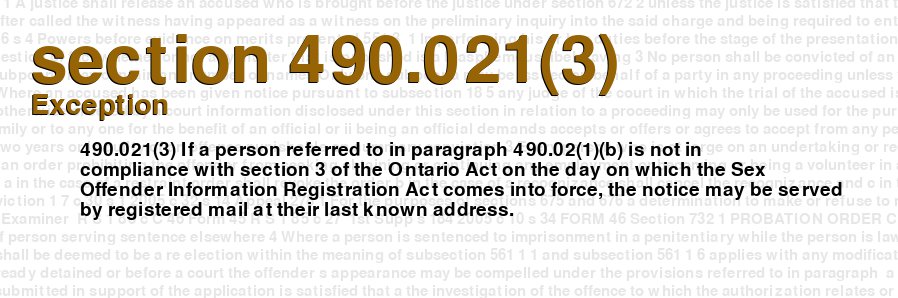
Notice can be served to a non-compliant person under the Ontario Act through registered mail at their last known address under 490.021(3).
Statutory Text
Explanation
Section 490.021(3) of the Criminal Code of Canada is a provision that deals with the notification of sex offenders about the requirements to register under the Sex Offender Information Registration Act (SOIRA). The provision applies to individuals who fall under paragraph 490.02(1)(b) of the Criminal Code, which includes those convicted of certain sexual offenses.
Under the Ontario Act, sex offenders are required to comply with certain registration requirements, such as reporting their current address, employment information, and any changes to this information. Section 3 of the Act outlines these requirements in detail.
Section 490.021(3) specifies that if an individual subject to the registration requirements under the Ontario Act is not in compliance with section 3 of the Act on the day that SOIRA comes into force, they may be served with notice by registered mail at their last known address.
In essence, this provision allows for the notification of sex offenders who have not yet complied with the registration requirements of the Ontario Act, even if they are not present at the time of the notification. The use of registered mail ensures that the notification is received by the individual, and that a record of the notification is maintained.
Overall, Section 490.021(3) is an essential tool for ensuring compliance with the registration requirements of the Ontario Act, and for promoting public safety by enabling authorities to keep track of the whereabouts of convicted sex offenders.
Commentary
Section 490.021(3) of the Criminal Code of Canada deals with the registration of sex offenders and the enforcement of the Ontario Act. This section outlines the method by which a notice may be served to a person who is not in compliance with section 3 of the Ontario Act on the day on which the Sex Offender Information Registration Act comes into force.
Under this provision, if a person referred to in paragraph 490.02 (1)(b) is not in compliance with section 3 of the Ontario Act, the notice may be served by registered mail at their last known address. This section lays out the notice mechanism for non-compliant individuals who are subject to registration under the Ontario Act.
The Criminal Code of Canada is a federal law that legalizes and criminalizes various activities in Canada. The section discussed above represents one of the provisions that deal with sex offenders. Its significance lies in the fact that it addresses the enforcement of the registration requirement under the Ontario Act. This Act provides for the registration of sexual offenders in Ontario, requiring them to report certain information, such as their name, address, employment, and offense history, to the local police.
The section that we are discussing outlines the consequences that will befall sex offenders who do not comply with the registration requirements under the Ontario Act. When the Sex Offender Information Registration Act comes into force, those who are not in compliance with section 3 of the Ontario Act will receive a notice informing them of their non-compliant status. This notice will be served by registered mail at their last known address, thereby ensuring that the person is aware of their obligation.
The enforcement of sex offender registration is critical in ensuring public safety because it allows law enforcement officials to keep track of the whereabouts and activities of sexual offenders. It also makes it easier for authorities to investigate and solve crimes committed by these offenders. The registration process is, therefore, a crucial tool in reducing the likelihood of reoffending and ensuring the safety of the community.
In conclusion, section 490.021(3) of the Criminal Code of Canada has an essential role to play in the enforcement of the Ontario Act regarding the registration of sexual offenders. This provision ensures that non-compliant individuals are notified of their status by requiring that a notice be served by registered mail at their last known address. The enforcement of this law is crucial in ensuring public safety and reducing the likelihood of repeat offenses committed by sexual offenders.
Strategy
Section 490.021(3) of the Criminal Code of Canada allows for the service of notice to individuals who may be subject to the Sex Offender Information Registration Act (SOIRA) through registered mail, if they are not in compliance with Section 3 of the Ontario Act on the day SOIRA comes into force. This provision is an important tool for law enforcement agencies to ensure that non-compliant individuals are notified of their obligations under SOIRA. However, there are several strategic considerations that must be taken into account when dealing with this section of the Criminal Code.
One of the key strategic considerations is the timing of the notice. Law enforcement agencies must carefully consider when to serve the notice to non-compliant individuals. They may want to serve the notice immediately upon discovering the non-compliance, or they may want to wait until a later time in order to gather more information or evidence. Additionally, law enforcement agencies will need to ensure that the notice is served in a timely manner in order to avoid any potential legal challenges.
Another strategic consideration is the method of service. While Section 490.021(3) allows for service by registered mail, there may be situations where other methods of service may be more appropriate. For example, if the individual is known to be living at a particular address, it may be more effective to serve the notice in person. Alternatively, if the individual is known to be avoiding service, law enforcement agencies may need to employ more creative methods, such as serving the notice through social media or other online platforms.
There may also be strategic considerations related to the specific circumstances of the non-compliant individual. For example, if the individual has a history of violence or is known to be dangerous, law enforcement agencies will need to take extra precautions to ensure the safety of their officers and the public. Additionally, if the individual is believed to have fled to another jurisdiction, law enforcement agencies may need to coordinate with other authorities in order to locate and serve the notice.
When dealing with Section 490.021(3) of the Criminal Code, law enforcement agencies may employ a variety of strategies to ensure that non-compliant individuals are notified of their obligations under SOIRA. Some of these strategies may include conducting surveillance to locate the individual, coordinating with other jurisdictions to locate the individual, offering incentives for compliance, or taking legal action to enforce compliance. Ultimately, the specific strategies employed will depend on the individual circumstances of each case, as well as the resources and capabilities of the law enforcement agency involved.