Editorial Annotation
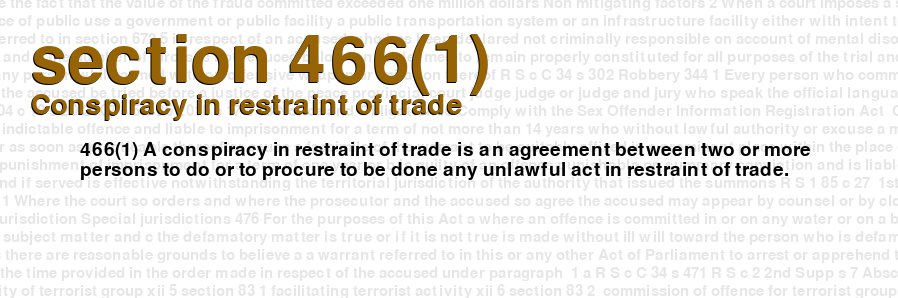
Conspiracy in restraint of trade
Introduction
Statutory Text
Explanation
Section 466(1) of the Criminal Code of Canada is related to the act of conspiracy in restraint of trade. The section makes it illegal for two or more individuals or groups to conspire and execute an unlawful act that restricts free trade practices and market competition. This act of conspiracy aims to limit competition and control the market share by creating a monopoly or cartel, which results in an increase in prices, reduced supply, and hampering of innovation.
The unlawful acts, according to this section, could include, but not limited to, price-fixing, product allocation, bid-rigging, group boycotting, or preventing new entrants into the market. These illicit activities limit the availability of goods and services, restrict customer choices, and sometimes expose the consumers to inferior quality products or services and high prices. This section aims to promote healthy competition among businesses, both domestic and foreign, to safeguard the interest of the consumers and prevent anti-competitive practices from flourishing.
The penalties for violating this section of the Criminal Code of Canada are severe. The maximum punishment includes imprisonment for up to 5 years and fines up to $10 million. To get a conviction under this section, the crown prosecutor would need to prove that the individual or group intended to restrict free trade and promote their illicit interests. Therefore, all businesses are expected to operate within the legal framework, protect their interests, and safeguard the rights of the consumers. The criminal justice system strives to prevent monopolistic and anti-competitive practices, ensuring that free trade practices prevail in the Canadian market.
Commentary
Section 466(1) of the Criminal Code of Canada outlines the criminal offense of conspiracy in restraint of trade. This offense occurs when two or more individuals agree to carry out an unlawful act in order to restrict competition in a certain market or industry.
The main objective of this section is to promote competition in Canada's marketplace. Business practices that reduce market competition by limiting consumer choice, raising prices, or creating barriers to market entry are considered harmful to the economy. Such practices ultimately result in monopolies or oligopolies that have the potential to exploit consumers through higher charges and lower-quality products and services.
Conspiracy in restraint of trade can take different forms, including price-fixing, bid-rigging, market allocation, and collusion. In each case, individuals engaged in such practices come together to eliminate or eliminate competition, create a closed market, and increase profits for themselves or their companies.
For instance, price-fixing happens when two or more competitors agree to establish a minimum or maximum price for a product or service. This agreement enables them to keep the prices artificially high, which can result in higher gains for the suppliers and losses for their customers. Similarly, market allocation happens when competitors agree to divide markets geographically, giving each other an area of exclusive control while preventing new entrants into the market.
The criminalization of conspiracy in restraint of trade is considered a serious offense in Canada. The individuals and organizations involved can face prosecution, resulting in severe penalties such as fines or imprisonment. When companies engage in such practices, they risk damaging their reputations and losing consumer trust. Such practices also hinder free trade and ultimately hurt the economy.
Overall, section 466(1) of the Criminal Code of Canada is a critical element in promoting the country's market competition. It serves as a deterrent to businesses that might consider engaging in anti-competitive practices, protecting consumers' interests and maintaining the integrity of the marketplace. The section ensures fair competition among businesses, leading to innovation, better services, and products, and improving the economy as a whole.
Strategy
Section 466(1) of the Criminal Code of Canada criminalizes conspiracies in restraint of trade. This section prohibits agreements between two or more persons to do or to procure to be done any unlawful act in restraint of trade. This provision is a powerful weapon that can be used by businesses and regulators to combat anti-competitive behavior by firms. However, it is important to note that the application of this provision requires careful consideration of strategic factors.
One of the strategic considerations when dealing with section 466(1) of the Criminal Code of Canada is the need to prove the existence of an unlawful agreement. The Crown must prove that two or more persons agreed to do or procure to be done an unlawful act in restraint of trade. This requires strong evidence that demonstrates the existence of the agreement, its terms, and the parties involved. Therefore, when dealing with section 466(1), a strategic consideration is to build up a strong case that can clearly demonstrate the existence of an unlawful agreement.
Another strategic consideration is the need to establish jurisdiction. Section 466 of the Criminal Code of Canada applies to conspiracies of all kinds, including international conspiracies. However, the Crown must prove that the conspiracy had some effect on trade in Canada. Proving jurisdiction can be a complex legal issue, and it is important to carefully consider the jurisdictional elements of the case.
A further strategic consideration when dealing with section 466(1) is the need to balance the public interest against the business interests of the parties involved. The competition law aims to promote consumer welfare and economic efficiency, and punishing anti-competitive behavior is one of the most effective ways of achieving this objective. However, businesses may have valid and legitimate reasons for engaging in certain activities that could be considered anti-competitive. For example, a business may need to engage in price-fixing to prevent undercutting and ensure a level playing field for all parties involved. When dealing with section 466(1), it is important to consider the public interest and be mindful of its impact on business.
Some strategies that could be employed when dealing with section 466(1) include the use of leniency programs, plea bargaining, and settlement agreements. Leniency programs offer immunity to the first conspirator that comes forward and provides the authorities with evidence of the unlawful agreement. This can be an effective way of gathering evidence and building a strong case against the remaining conspirators. Plea bargaining and settlement agreements can also be used to reach a quick resolution of cases and avoid lengthy and costly litigation.
In conclusion, section 466(1) of the Criminal Code of Canada is an important tool that can be used to combat anti-competitive behavior by businesses. However, its application requires careful consideration of the strategic factors involved. Businesses and authorities must balance the interests of the public with legitimate business interests when dealing with this provision. Additionally, strategies such as leniency programs, plea bargaining, and settlement agreements can be employed to resolve cases efficiently.