Editorial Annotation
Effect of registered order
Introduction
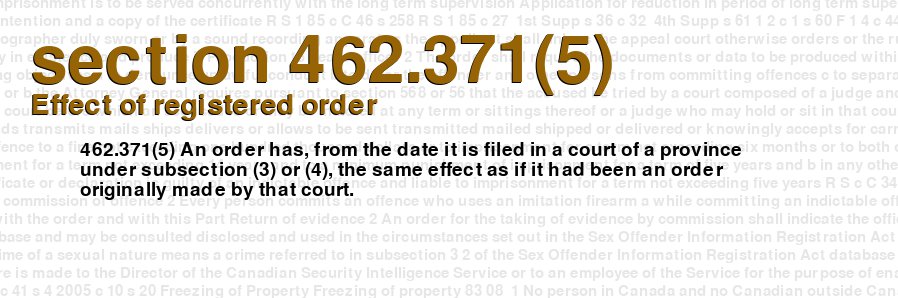
An order filed in a court in a province has the same effect as if it had been originally made by that court, according to section 462.371(5) of the Criminal Code of Canada.
Statutory Text
Explanation
Section 462.371(5) of the Criminal Code of Canada pertains to the effectiveness of forfeiture orders in cases where they have been filed in a court of a province. This section essentially states that once an order has been filed in a court, it will have the same effect as if it had been originally made by that court.
To understand this section in the context of the Criminal Code of Canada, it is important to first understand what forfeiture orders are. A forfeiture order is a legal mechanism that allows authorities to seize and confiscate property that has been obtained through criminal activity or that is instrumental in committing a crime. This can include cash, vehicles, and other assets. The purpose of forfeiture orders is to deprive criminals of the financial benefits of their illegal activities and to prevent them from using those funds to commit further crimes.
Section 462.371(5) of the Criminal Code of Canada ensures that forfeiture orders are recognized and upheld across different jurisdictions within the country. This section acknowledges that a forfeiture order made in one province can be enforced in another province. Essentially, once an order has been filed in a court, it becomes legally binding and has the same force and effect as if it had been issued by that court originally. This provision helps to streamline the process of enforcing forfeiture orders and ensures that law enforcement agencies have the necessary tools to combat organized crime and other criminal activities that involve the proceeds of crime.
In conclusion, Section 462.371(5) of the Criminal Code of Canada is a crucial provision that ensures the effectiveness of forfeiture orders across different jurisdictions in the country. By recognizing and enforcing these orders, the government can better combat criminal activity and disrupt the financial incentives that drive it.
Commentary
The Criminal Code of Canada serves as the backbone of Canadian criminal law. Among its many provisions is section 462.371(5), which outlines the effects of filing a specific type of court order in a provincial court. The phrase "An order has, from the date it is filed in a court of a province under subsection (3) or (4), the same effect as if it had been an order originally made by that court" appears straightforward, but it is important to understand the context in which this rule operates.
To begin with, it is useful to define some of the key terms used in section 462.371(5). An "order" is a ruling or decision made by a court of law, while a "province" is a subnational jurisdiction within Canada. Subsections (3) and (4) refer to the specific grounds that a person can use to file an order in a provincial court. These grounds relate to the seizure or restraint of property that is believed to be used in connection with an offense or a forfeiture-related proceeding.
The effects of the order in question must be understood in light of the context in which it is used. Often, when property is seized or restrained, it remains in the custody of law enforcement until the court has made a final determination as to whether it should be forfeited. During this time, the owner of the property may be deprived of its use or value. Section 462.371(5) seeks to provide a measure of relief to these owners by allowing them to file an order with a provincial court that can either lift the seizure or restraint of the property, or alternatively, speed up the forfeiture proceedings.
By giving this type of order the same effect as if it had been originally made by the provincial court, section 462.371(5) ensures that the order has the force of law necessary to impact the outcome of the forfeiture proceedings. This means that if a person is successful in obtaining such an order, it will have the same impact as if they had won a ruling from the court in the first place. The property would be released from seizure or restraint, or the forfeiture proceedings would progress at an accelerated rate.
It is important to note that section 462.371(5) does not grant absolute authority to the person filing the order. The order must still be considered and ruled upon by the court, and there may be certain criteria that must be met before the order can be granted. However, it does provide a valuable means for property owners to challenge the seizure or restraint of their property or to seek a speedy resolution to the forfeiture proceedings.
Overall, section 462.371(5) serves as an important safeguard for property owners who are impacted by the seizure or restraint of their property. It ensures that they have a legal means to seek relief, even if they are unable to secure a court ruling in their favor through the normal channels. By giving the order the same effect as if it had been originally made by the court, it ensures that the property owner's rights are protected and that they are not unfairly deprived of their property or its value.
Strategy
Section 462.371(5) of the Criminal Code of Canada is crucial in enforcing forfeiture orders for criminal property. The section provides that once an order is filed in a court, it carries the same weight as if it had been an order initially made by that court. Therefore, parties seeking forfeiture orders must make strategic considerations when dealing with this section of the Criminal Code to ensure a favorable outcome. Some of the strategic considerations and strategies that could be employed include:
1. Timing of filing
The timing of filing the forfeiture order is a crucial strategic consideration. Once filed, the order has the same effect as if it had been initially made by the court. Therefore, filing the order at the right time can have a significant impact on the forfeiture process. For instance, filing an order soon after obtaining a conviction may be advantageous, as the court may be more likely to order forfeiture before releasing any seized property.
2. Choice of court
Another strategic consideration is the choice of court where the order is filed. Section 462.371(5) provides that the order has the same effect as if the court had initially made it. Therefore, selecting a court that is more inclined to grant forfeiture orders may result in a favorable outcome. For example, some courts may have established procedures and guidelines for filing forfeiture orders, or they may have more experienced judges who are more likely to grant forfeiture orders than others.
3. Supporting evidence
The strength of the evidence presented to support the forfeiture order is also a strategic consideration. Without strong evidence, the court may refuse to grant the order, or the order may not be enforced. The evidence must be admissible and relevant to the case, and it must prove that the property in question was obtained through criminal activity or is intended for use in criminal activities.
4. Ancillary orders
Parties seeking forfeiture orders should also consider ancillary orders, such as restraining orders, which prevent the disposal of assets pending the hearing or determination of the forfeiture proceeding. Such orders may be critical in preserving assets that would otherwise be lost before the court decides on the forfeiture order.
5. Collaboration with other agencies
Collaboration with other agencies, such as the police or financial regulators, may also be a strategic consideration when seeking a forfeiture order. These agencies may provide valuable evidence to support the order or provide resources to ensure that the order is enforced.
6. Access to legal representation
Seeking legal representation is a crucial strategic consideration when dealing with this section of the Criminal Code. A professional lawyer can provide legal advice and representation throughout the process, which will increase the chances of success. Legal representation may also assist in presenting evidence, procedural and tactical considerations, and negotiating settlements.
In conclusion, seeking a forfeiture order under Section 462.371(5) of the Criminal Code of Canada requires several strategic considerations. Timing, choice of court, evidence support, obtaining ancillary orders, collaborating with other agencies, and access to legal representation, are all factors that can influence the outcome. Employing a strategy that takes these factors into account will increase the chances of success in obtaining a forfeiture order.