Editorial Annotation
Exception
Introduction
This section states that a peace officer or someone acting under their direction is not guilty of an offence if they do something mentioned in subsection (1) for the purpose of an investigation or in the execution of their duties.
Statutory Text
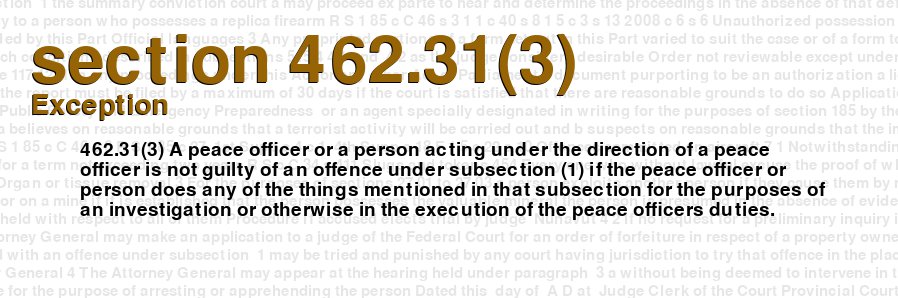
462.31(3) A peace officer or a person acting under the direction of a peace officer is not guilty of an offence under subsection (1) if the peace officer or person does any of the things mentioned in that subsection for the purposes of an investigation or otherwise in the execution of the peace officer�s duties.
Explanation
Section 462.31(3) of the Criminal Code of Canada provides immunity to peace officers or individuals acting under the direction of peace officers who engage in activities related to the seizure of proceeds of crime or the seizure of property used or intended to be used in the commission of an offence. Specifically, the section states that if a peace officer or individual acts for the purposes of an investigation or carrying out their duties as a peace officer, they are not guilty of an offence under subsection (1).
Subsection (1) of this section outlines the circumstances under which an individual may be guilty of an offence. It states that anyone who knowingly, without lawful excuse or justification, possesses, obtains, transfers, exports, uses, offers to sell or purchase any property or proceeds obtained or derived directly or indirectly from the commission of an indictable offence is guilty of an indictable offence and liable to imprisonment.
Therefore, section 462.31(3) is an exemption clause that provides peace officers with immunity from prosecution if they engage in activities that may otherwise be considered a violation of the Criminal Code of Canada, provided that they acted within the scope of their duties and for the purposes of an investigation. This provision is intended to enable law enforcement agencies to effectively investigate and prosecute individuals who engage in criminal activities and to ensure that proceeds of crime are seized and forfeited to the state.
Overall, section 462.31(3) of the Criminal Code of Canada highlights the importance of balancing the need for law enforcement agencies to investigate criminal activities and the protection of individuals' rights and freedoms. By providing this exemption, the Criminal Code of Canada recognizes the critical role that peace officers play in maintaining public safety and upholding the rule of law in Canada.
Commentary
Section 462.31(3) of the Criminal Code of Canada provides protection to peace officers who may be engaged in activities that would otherwise be considered a violation of subsection (1) of the same section. Subsection (1) establishes several offences related to the seizure, detention, and forfeiture of property. However, the exemption provided in subsection (3) enables peace officers to carry out their duties and responsibilities without fear of being charged with an offence.
This section is critically important in providing legal protection and immunity to peace officers who may need to seize and detain property for law enforcement purposes. Criminal activity often involves the use of property, such as illegal drugs, firearms, or stolen goods, making their seizure and detention an essential component of law enforcement activities. However, such actions could be challenged by individuals who believe that their property was unlawfully seized or detained. Section 462.31(3) provides a legal defense for peace officers who act in good faith for the purposes of executing their duties.
Moreover, the provision in subsection (3) confirms that peace officers are authorized to carry out legal responsibilities related to the seizure, detention, and forfeiture of property. This authorization is essential in enabling peace officers to perform their duties effectively, without requiring prior approval from a court of law. The legal immunity provided in subsection (3) ensures that peace officers can carry out their responsibilities without fear of being charged with an offence, providing greater confidence in their ability to enforce the law.
However, it is essential to note that the protection provided in subsection (3) is conditional upon the peace officer acting in good faith and executing their duties lawfully. The section does not provide blanket immunity to peace officers and does not permit the abuse of power or authority. Therefore, any actions taken by peace officers must satisfy the legal requirements for the seizure, detention, or forfeiture of property. If not, the peace officer may still be charged with an offence under the Criminal Code of Canada or sued for damages.
In conclusion, Section 462.31(3) of the Criminal Code of Canada is essential in providing legal protection and immunity to peace officers who are engaged in activities related to the seizure, detention, and forfeiture of property. This provision enables peace officers to carry out their responsibilities confidently and without fear of being charged with an offence. However, the protection provided by subsection (3) is conditional upon peace officers acting in good faith, and any abuses of power or authority will still be subject to legal sanctions.
Strategy
Section 462.31(3) of the Criminal Code of Canada provides an exception for peace officers or individuals acting under the direction of a peace officer who may perform activities that would otherwise be considered an offence under subsection (1) for the purpose of an investigation or in the execution of their duties. This section is critical when dealing with law enforcement in Canada as it acknowledges the complexities of investigating and conducting law enforcement activities while ensuring that the proper legal framework is in place. There are several strategic considerations that one must take into account when dealing with this section of the Criminal Code of Canada. This essay will explore these considerations and propose some strategies that could be employed.
One major consideration when dealing with Section 462.31(3) is the risk of abuse of power. Although this section provides a necessary caveat for law enforcement officers to carry out their duties, there is a possibility that officers could misuse their power and authority to engage in activities that are beyond the scope of their job responsibilities. This risk is why sections such as 462.31(3) are necessary. To prevent such an abuse, it is essential to ensure that officers are correctly trained and regularly updated on the legal framework governing their activities. This could be achieved through regular training, an independent oversight body, or independent audits. Moreover, to increase transparency, police departments and law enforcement agencies could publish their internal guidelines and protocols for conducting investigations.
Another important consideration is the threshold for invoking Section 462.31(3). The Criminal Code has stipulated that officers' actions must be for the purpose of an investigation or in the execution of their duties. However, the threshold for determining when an action is for an investigation or in the execution of their duties remains unclear and ambiguous. Therefore, it is crucial to establish clear guidelines and protocols for invoking Section 462.31(3). Moreover, it is essential to ensure that these guidelines are regularly updated to reflect contemporary legal developments and changing societal needs.
To alleviate public suspicion and mistrust, law enforcement agencies could be more transparent in their approach when invoking Section 462.31(3). For instance, when engaging in activities that would otherwise be considered an offence under subsection (1), the officers could seek a warrant from a judge or an independent third-party body. This would provide accountability and transparency in their activities and reassure the public that officers are following the proper legal framework when carrying out their duties.
A final consideration when dealing with Section 462.31(3) is the delicate balance between protecting individual rights and promoting public safety. Despite the need for law enforcement to conduct investigations and maintain public safety, it is crucial to ensure that the rights and freedoms of individuals are not violated. To achieve this balance, all law enforcement agencies must be guided by the principle of proportionality. This principle requires that officers' actions should not exceed the scope of the investigation or the level of threat posed. Thus, officers must provide a reasonable explanation for any measures they take that could be considered intrusive.
In conclusion, Section 462.31(3) of the Criminal Code of Canada is necessary to provide law enforcement officers with the necessary tools to conduct investigations and execute their duties. However, it is essential to acknowledge the potential misuse of power, establish clear guidelines and protocols for invoking this section, increase transparency, ensure that the rights and freedoms of individuals are not violated, and maintain a delicate balance between protecting individual rights and promoting public safety. Policymakers must take these considerations into account when formulating policies around law enforcement activities.