Editorial Annotation
Exception
Introduction
Statutory Text
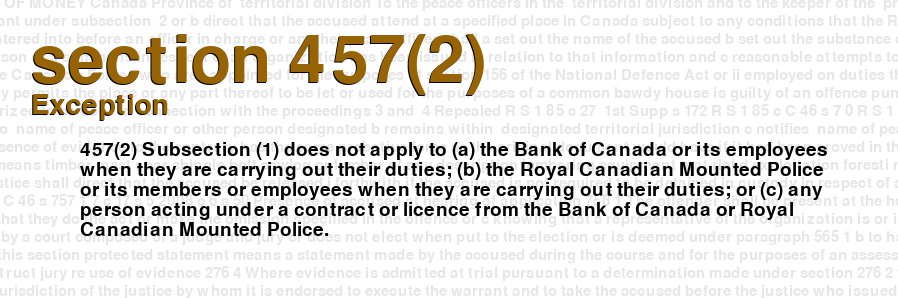
457(2) Subsection (1) does not apply to (a) the Bank of Canada or its employees when they are carrying out their duties; (b) the Royal Canadian Mounted Police or its members or employees when they are carrying out their duties; or (c) any person acting under a contract or licence from the Bank of Canada or Royal Canadian Mounted Police.
Explanation
Section 457(2) of the Criminal Code of Canada is a provision that provides certain exemptions to those who may otherwise be found guilty of mischief if they damage or interfere with property belonging to others. This exemption applies to three categories of individuals: (a) the Bank of Canada or its employees when they are carrying out their duties; (b) the Royal Canadian Mounted Police or its members or employees when they are carrying out their duties; and (c) any person acting under a contract or licence from the Bank of Canada or Royal Canadian Mounted Police.
The purpose of this exemption is to ensure that these individuals are not unjustly penalized for carrying out their lawful duties. For example, if a police officer had to forcefully enter a property in order to make an arrest, they would not be charged with mischief simply because they caused damage to the property. Similarly, if the Bank of Canada or any of its employees had to access a property in order to investigate a financial crime, they would not be charged with mischief for doing so.
However, it is important to note that this exemption only applies if these individuals are carrying out their duties lawfully, and in accordance with the scope of their authority. If they were to damage property while acting outside of their lawful duties, they could still be charged with mischief under Section 457(1) of the Criminal Code.
In summary, Section 457(2) of the Criminal Code of Canada provides an exemption to certain individuals who may otherwise be charged with mischief if they damage or interfere with property belonging to others while carrying out their lawful duties. This exemption is intended to prevent individuals from being unjustly penalized for acting in accordance with their professional obligations.
Commentary
Section 457(2) of the Criminal Code of Canada provides several exemptions to the already existing offence of breaking and entering into a place with intent to commit an indictable offence. The section stipulates that subsection (1) of the offence does not apply to several specific entities and individuals. These include the Bank of Canada and its employees when they are carrying out their duties, the Royal Canadian Mounted Police or its members or employees when they are carrying out their duties, and any person acting under a contract or license from either of these two entities.
The Bank of Canada is the nation's central bank. Among its functions include Canadian monetary policy, currency issuance, and financial system stability. Therefore, it is plain to see why considering this exemption in the Criminal Code is so crucial as it protects Bank of Canada employees who are going about their legitimate duties. The exemption also safeguards the Bank of Canada as a national institution from actions of criminal persons who may wish to gain unauthorized access to its premises with nefarious motives. Any attempt to enter or break into the Bank of Canada without proper authorization constitutes an offence under Criminal Code and can attract severe penalties. Therefore, the exemption protects all parties involved, including the Bank of Canada, its employees, and the offenders who may find themselves on the wrong side of the law.
Similarly, the Royal Canadian Mounted Police is the country's national police service and the Crown's primary law enforcement body. The RCMP have a wide range of duties and responsibilities which include peacekeeping, national security, and law enforcement. The exemption under Section 457(2) protects the commission of crimes against the RCMP when they are carrying out their legitimate duties. It also shields the RCMP from the inconvenience of instituting legal proceedings against individuals who interfere with their work or try to unlawfully gain access to their premises.
It is also worth noting that Section 457(2)(c) of the Criminal Code provides an exemption to any person acting under a contract or license from the Bank of Canada or the Royal Canadian Mounted Police. This provision has significant implications for private companies or individuals that work with either institution. For example, a company that provides cleaning services to the Bank of Canada may need access to its premises outside of regular business hours; thus, they would be required to enter the Bank of Canada building at midnight to clean. The exemption applies to such persons in the course of carrying out their services and protects them from prosecution under Section 457(1) of the Criminal Code.
In conclusion, Section 457(2) of the Criminal Code provides a critical exemption to the already existing offence of breaking and entering with intent to commit an indictable offence. The exemption is crucial in protecting national institutions, their employees, and contractors working with them. It ensures that legitimate work is not interrupted by the actions of criminal elements while still maintaining the integrity of the law. As such, the exemption provides an important balance between facilitating the work of entities mentioned in the provision and preserving the rule of law.
Strategy
Section 457(2) of the Criminal Code of Canada is an important provision that provides immunity to certain organizations and persons from being charged under subsection (1) of the same section, which prohibits the possession, use, or distribution of counterfeit money. The immunity applies to employees of the Bank of Canada and the Royal Canadian Mounted Police (RCMP) while performing their duties, as well as any person acting under a contract or license from these organizations.
Strategic Considerations:
For organizations and persons who deal with money or other financial instruments, the immunity provided by Section 457(2) can be a significant strategic consideration. This immunity can allow these entities to perform their duties without fear of being charged with a criminal offense, which can significantly reduce their legal liability and risk.
However, it is essential to note that the immunity provided by this section has certain limitations. For example, the immunity only applies when the Bank of Canada, RCMP, or their employees or agents are performing their duties. Any other actions by these entities or persons that are not related to their official duties can still lead to criminal charges under the Criminal Code.
Furthermore, even within the scope of their duties, organizations and persons who deal with money or financial instruments must be careful to ensure that their actions do not violate other provisions of the Criminal Code or other relevant laws. For example, even if an employee of the Bank of Canada is protected from charges under Section 457(2), they can still face criminal charges under other provisions of the Criminal Code if they engage in fraud or other criminal conduct.
Strategies
To effectively utilize the immunity provided by Section 457(2) of the Criminal Code, organizations and persons must adopt certain strategies. These include:
1. Ensuring that employees, agents, and third-party contractors understand the limitations and scope of the immunity provided by Section 457(2) and that they are only protected when performing their official duties.
2. Implementing robust compliance and risk management policies and procedures that ensure that all activities are conducted in compliance with the law and that potential risks are identified and mitigated.
3. Maintaining an open and collaborative relationship with law enforcement agencies such as the RCMP to ensure that any suspected criminal activities are identified and reported promptly.
4. Investing in training and education programs to ensure that employees, agents, and third-party contractors are aware of the requirements of the law and best practices for identifying and reporting potential criminal activities.
5. Engaging with industry associations and other stakeholders to share best practices, experiences, and knowledge of regulatory requirements and developments.
In conclusion, Section 457(2) of the Criminal Code of Canada provides immunity to certain organizations and persons dealing with money or financial instruments. While this immunity can be an essential strategic consideration, organizations and persons must still exercise caution to ensure that they do not violate other provisions of the Criminal Code or other relevant laws. By adopting effective compliance, risk management, and educational strategies, organizations and persons can effectively use the immunity provided by Section 457(2) while minimizing their legal and reputational risks.