Editorial Annotation
Prohibition order
Introduction
Statutory Text
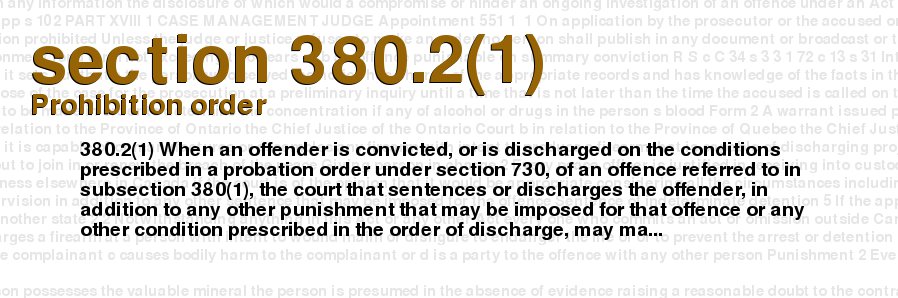
380.2(1) When an offender is convicted, or is discharged on the conditions prescribed in a probation order under section 730, of an offence referred to in subsection 380(1), the court that sentences or discharges the offender, in addition to any other punishment that may be imposed for that offence or any other condition prescribed in the order of discharge, may make, subject to the conditions or exemptions that the court directs, an order prohibiting the offender from seeking, obtaining or continuing any employment, or becoming or being a volunteer in any capacity, that involves having authority over the real property, money or valuable security of another person.
Explanation
Section 380.2(1) of the Criminal Code of Canada pertains to the prohibition order that the court can impose on an offender convicted or discharged on probation for any offence under section 380(1) of the Code. An offence under section 380(1) pertains to theft, fraud, or forgery. This provision allows the court to impose additional conditions to prevent the offender from seeking or continuing any employment or volunteer work that involves authority over the real property, money, or valuable security of another person.
The primary intent of this section is to prevent the offender from committing further crimes related to theft, fraud, or forgery, which may be facilitated by their employment or volunteer work. The court can impose such an order, depending on the circumstances of the case, as an additional measure to prevent the offender from misusing their position of authority and trust. The prohibition order aims to protect the public and prevent any further harm to victims who may be vulnerable to the offender's actions.
In addition, the order may include specific conditions or exemptions as directed by the court. The court may consider the nature and severity of the offence, the offender's criminal history, risk of reoffending, and the potential impact on the victim. While the order may restrict the offender's employment opportunities, it is considered necessary to ensure public safety and prevent further criminal activities.
Overall, the Criminal Code of Canada considers the imposition of a prohibition order as an important measure to ensure public safety and prevent the recurrence of theft, fraud, or forgery by offenders in positions of authority.
Commentary
Section 380.2(1) of the Criminal Code of Canada allows a court to impose an order on a convicted offender prohibiting them from seeking, obtaining or continuing employment or volunteer work that involves having authority over the real property, money or valuable security of another person. This provision can be used in cases where the offender has committed offences related to theft, fraud or financial crimes.
The purpose of this provision is to prevent offenders from having access to positions of power or responsibility where they could potentially reoffend or take advantage of vulnerable individuals or organizations. By limiting the offender's ability to work in positions with these responsibilities, the order aims to protect potential victims and prevent future harm.
The provision also allows for exemptions or conditions to be imposed on the order by the court. This means that a convicted offender may still be able to work in certain positions, as long as they do not involve having authority over the real property, money or valuable security of another person.
However, this provision may also have unintended consequences. It may disproportionately affect individuals who have been convicted of minor or non-violent offences, and who would not pose a significant risk in certain employment or volunteer positions. Additionally, it may limit the offender's ability to rehabilitate and reintegrate into society by preventing them from obtaining legitimate employment or volunteer opportunities.
It is important for courts to consider the individual circumstances of each case and the potential impacts of imposing this order on the offender before making a decision. Alternatives, such as counselling, education, or employment assistance, may also be considered as options to prevent future offending.
Overall, while the intention of Section 380.2(1) is to protect potential victims and prevent future harm, it is important for courts to carefully consider the potential consequences of imposing such an order on a convicted offender. A balanced approach that takes into account public safety, rehabilitation, and individual circumstances should be considered when making a decision.
Strategy
Section 380.2(1) of the Criminal Code of Canada gives the court the power to impose a prohibition on an offender from seeking, obtaining or continuing employment or voluntary work that involves having authority over someone's property, money or valuable security. This provision can be a powerful tool for courts to prevent fraudsters from repeating their offences. However, it requires careful consideration when imposed to ensure it is properly tailored to the specific circumstances of the case.
Strategic considerations when dealing with this section of the Criminal Code would include the nature of the offence committed, the offender's criminal history, and their prospects for rehabilitation. For example, if an offender is convicted of a white-collar crime such as embezzlement, it may be appropriate to prohibit them from working in positions that would give them access to financial records or the ability to handle money. However, if the offender has expressed remorse and is unlikely to re-offend, a less restrictive order might be more appropriate.
Another important strategic consideration is the impact on the offender's ability to earn a living. A prohibition order can severely limit an offender's job opportunities and income potential, potentially leading to financial hardship and making it more difficult for them to reintegrate into society. As such, it should only be imposed when necessary, and with careful consideration of the impact on the offender's future.
Strategies that could be employed when dealing with this section of the Criminal Code include tailoring the prohibition to limit the harm caused by the offender's specific offence. For example, if an offender stole from a non-profit organization, a prohibition order could be tailored to prohibit them from seeking employment or volunteering in the non-profit sector specifically. This would allow the offender to pursue other job opportunities while still preventing them from being in a position of authority over a charitable organization's funds.
Another strategy would be to impose the prohibition for a limited time frame, such as a few years. This would allow the offender time to rehabilitate and seek alternative employment while still providing protection to potential victims.
Finally, the court could order the offender to participate in training programs or receive counselling to address the underlying issues that led to the offence in the first place. This could help the offender develop new skills and obtain job opportunities in fields that do not involve having authority over someone else's property, money or valuable security.
In conclusion, while section 380.2(1) of the Criminal Code of Canada can be an effective tool for preventing fraudsters from repeating their offences, it must be used judiciously and with careful consideration of the impact on the offender's future. Strategies such as tailoring the prohibition to the specific offence, imposing it for a limited time frame, and providing training and counselling can help strike the appropriate balance between protecting potential victims and providing rehabilitation opportunities to offenders.