Editorial Annotation
Drawing document without authority, etc.
Introduction
Section 374 of the Criminal Code of Canada outlines the offences and punishments for fraudulent activities related to document forgery and use.
Statutory Text
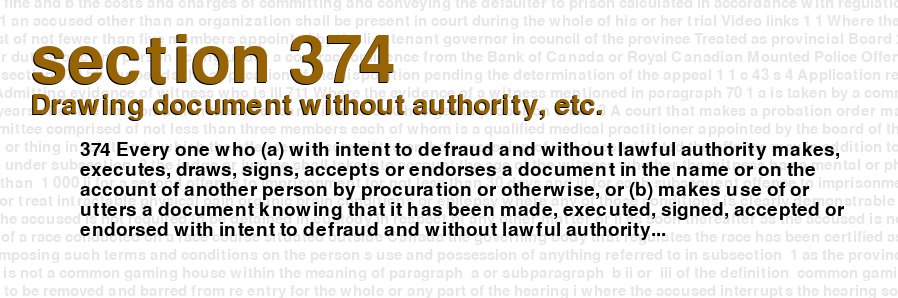
374 Every one who (a) with intent to defraud and without lawful authority makes, executes, draws, signs, accepts or endorses a document in the name or on the account of another person by procuration or otherwise, or (b) makes use of or utters a document knowing that it has been made, executed, signed, accepted or endorsed with intent to defraud and without lawful authority, in the name or on the account of another person, by procuration or otherwise, is guilty of an indictable offence and liable to imprisonment for a term not exceeding fourteen years.
Explanation
Section 374 of the Criminal Code of Canada deals with the offense of fraudulently using someone else's identity or account to create or use a document for personal gain or to cause harm to the other person. The section contains two offenses, both of which are punishable by up to fourteen years' imprisonment. The first offense is creating a document in someone else's name or on their account without their knowledge or permission, with the intention of defrauding others. This type of document could include, but is not limited to, cheques, contracts, or other legal documents.
The second offense is knowingly using a document that was created in someone else's name or on their account without their knowledge or permission, with the intention of defrauding others. This can include presenting a fake ID or using a stolen credit card to make purchases. Both offenses require that the act be committed with the intention of defrauding someone else, so accidental misuse is not considered an offense under this section.
The section is designed to protect individuals from identity theft and fraud. The misuse of someone else's identity can have significant financial and personal consequences for the victim. This section of the criminal code is important in ensuring that those who commit these types of offences are punished accordingly. It also serves a deterrent effect, discouraging individuals from engaging in fraudulent activities. Overall, the aim of this section is to ensure the integrity of legal documents and protect the financial interests of individuals.
Commentary
Section 374 of the Criminal Code of Canada outlines the criminal offense of fraudulently executing or using a document in the name or on the account of another person without lawful authority. This section of the Code aims to protect individuals and businesses from financial harm caused by fraudulent activities.
The offense outlined in Section 374 consists of two distinct elements. First, the accused must have had the intent to defraud. This means that they knew that their actions were dishonest and that they intended to cause financial harm to another person or entity. Second, the accused must have either made, executed, drawn, signed, accepted, or endorsed a document in the name or on the account of another person without lawful authority, or made use of or uttered such a document knowing that it was made, executed, signed, accepted, or endorsed without lawful authority.
One of the key aspects of this offense is the requirement for the accused to act without lawful authority. This means that they do not have the legal right or permission to act on behalf of the other person or entity. For example, if an individual signs a document in the name of their employer without the employer's permission, they would be acting without lawful authority and could potentially be charged under Section 374.
The penalties for this offense are significant, with individuals facing up to 14 years in prison if found guilty of an indictable offense. This reflects the seriousness of the offense and the potential financial harm that can be caused by fraudulent activities.
Overall, Section 374 of the Criminal Code of Canada is an important provision that aims to protect individuals and businesses from fraudulent activities. It serves as a deterrent to individuals who may be considering engaging in such behavior and provides a framework for law enforcement officials to prosecute those who do engage in such activities. By enforcing this section of the Code, the justice system can help ensure that financial transactions are conducted in a fair and honest manner, promoting the overall integrity of the Canadian economy.
Strategy
Introduction
Section 374 of the Criminal Code of Canada deals with fraudulently making, executing, signing, accepting, endorsing, or using a document in the name or on the account of another person without lawful authority. It is a very serious offence that carries a maximum penalty of 14 years imprisonment. This code can be used by individuals who have been defrauded to seek redress.
Strategic considerations
When dealing with Section 374 of the Criminal Code of Canada, several strategic considerations are essential. These considerations include:
1. Retain an Experienced Lawyer: As this offence carries a severe penalty, it is essential to retain the services of an experienced lawyer. A competent defence lawyer would have a clear understanding of the law and any possible defences available.
2. Investigate the Evidence: A thorough investigation of the facts and evidence in the matter is crucial to determine the strength of the case against the accused. A defence lawyer would ensure that the evidence relied on by the prosecution is reliable and admissible in court.
3. Seek Legal Advice Quickly: As with any criminal offence, it is crucial that legal advice is sought as quickly as possible. The earlier a lawyer is retained, the better the chances of securing the best outcome for the accused.
4. Consider Potential Defences: There are several potential defences available to individuals charged with an offence under Section 374 of the Criminal Code. These defences include lack of intent to defraud, lawful authority, mistake of fact, and duress or coercion.
Strategies that could be employed
1. Negotiation with the Crown: In some cases, negotiation with the Crown could be a viable strategy. A competent defence lawyer would be able to assess the strength of the Crown's case and negotiate reduced charges or a plea bargain.
2. Challenging the Evidence: A thorough investigation of the facts and evidence in the case could reveal flaws in the prosecution's case. Strategies such as cross-examination of the prosecution witnesses or challenging the admissibility of evidence could be employed.
3. Restoration of Funds: In some cases, restitution, or the restoration of funds to the victim could be a mitigating factor at sentencing. A defence lawyer could negotiate a repayment plan with the prosecution or seek a conditional discharge if the restoration of funds is made.
4. Mental Health Defences: In some cases, mental health defences such as diminished capacity or fitness to stand trial could be employed as a strategy. A defence lawyer would work with a qualified mental health professional to assess the accused's mental state at the time of the offence.
Conclusion
Section 374 of the Criminal Code of Canada is a serious offence that carries significant penalties. When dealing with such offences, it is essential to consider strategic options that could be employed to minimize the accused's legal exposure. Ultimately, the key to success is the retention of an experienced and competent defence lawyer.