Editorial Annotation
False pretence
Introduction
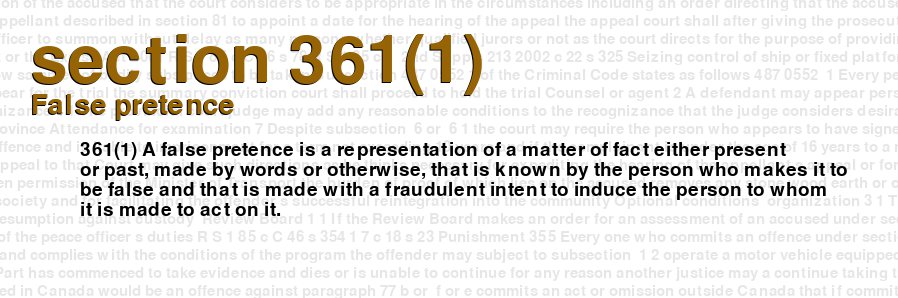
Section 361(1) of the Criminal Code of Canada defines false pretence as a representation of a matter of fact that is knowingly false and intended to induce someone to act on it.
Statutory Text
Explanation
Section 361(1) of the Criminal Code of Canada defines the criminal act of making false pretences. This section stipulates that a person who makes a false representation of a matter of fact, either present or past, by words or otherwise, that they know to be false and with the intention to induce another person to act on it commits the offence of making false pretences.
For example, if a person knowingly misrepresents the condition of a used car they are trying to sell by stating that the vehicle is in excellent condition when in reality, it has a significant mechanical issue, they are committing the offence of making false pretences. If the misrepresentation was made with the intention of inducing the potential buyer to purchase the car, the seller has committed a criminal offence.
The penalty for making false pretences under the Criminal Code of Canada can vary depending on the severity of the offence. A court may impose a penalty ranging from a fine to imprisonment for up to two years, or both.
The purpose of Section 361(1) is to protect individuals from being deceived by others for financial gain. It is illegal to intentionally deceive a person to induce them to act on false information to benefit the deceiver financially or in any other way. This provision helps to ensure that individuals conduct themselves in an honest and ethical manner in their interactions with others.
Commentary
Section 361(1) of the Criminal Code of Canada defines the offence of false pretence. False pretence is a type of fraud that involves the making of a false representation to induce someone to act on it to their detriment. It is an offence that strikes at the heart of the relationship of trust between individuals and society.
The section requires the constituent elements of a false pretence to be fulfilled in order for the accused to be found guilty. Firstly, there must be a representation of a matter of fact, whether present or past. This representation can take many forms, including words, actions or omissions. It must be a positive assertion, rather than a mere silence or failure to disclose information.
Secondly, the accused must know the representation to be false. This means that the accused must have actual knowledge that the representation is untrue, or that they are recklessly indifferent to the truth of the representation. Mere negligence or mistake will not be sufficient to establish this element of the offence.
Thirdly, the representation must be made with a fraudulent intent to induce the person to whom it is made to act on it. Fraudulent intent means an intention to deceive or defraud, with the knowledge that the representation is false or without belief in its truth. This element requires that the accused must intend to cause the victim to act on the representation, and that the victim actually does so to their detriment.
The offence of false pretence has a wide application, as it can apply to a range of situations. For example, it can apply to situations where individuals make false representations to obtain goods or services, or to obtain credit or loans. It can also apply to situations where individuals make false representations to obtain employment or to obtain an advantage in a legal proceeding.
The offence of false pretence is a serious one, as it strikes at the integrity of commerce and undermines the rule of law. It is punishable by imprisonment for up to 14 years, which reflects the seriousness of the offence. It is also a specific intent offence, which means that the Crown must prove that the accused had a fraudulent intent at the time of making the false representation.
In conclusion, section 361(1) of the Criminal Code of Canada defines the offence of false pretence, which is a serious offence that strikes at the heart of the relationship of trust between individuals and society. It requires the Crown to prove that the accused made a false representation, knew it to be false, and made it with a fraudulent intent to induce the victim to act on it. The penalties for this offence are severe, reflecting the serious nature of the offence and the harm that it can cause. It is an important offence that seeks to protect the integrity of commerce and the rule of law.
Strategy
When dealing with Section 361(1) of the Criminal Code of Canada, there are several strategic considerations that must be taken into account. The most prominent of these considerations is the need to prove that the accused made a knowingly false representation with the intention of inducing the victim to act upon it. This burden of proof can be difficult to meet, especially if the accused's conduct was not overtly fraudulent or glaringly criminal.
One of the most common strategies employed in cases involving false pretences is to provide a clear and compelling narrative that establishes the accused's intent beyond a reasonable doubt. This can involve presenting evidence of the accused's prior knowledge, their previous dealings with the victim, and any relevant documentation that supports the prosecution's case. Additionally, it may be necessary to call expert witnesses or other individuals who can provide specialized knowledge or insight into the specific matter at hand.
Another key consideration when dealing with this section of the Criminal Code is the potential for the defence to challenge the credibility or reliability of the prosecution's evidence. The defence may attempt to cast doubt on the accuracy or authenticity of key documents, question the veracity of witnesses, or challenge the methodology used to gather and interpret evidence. In response, the prosecution may need to present additional evidence or call on expert testimony to reinforce its case.
In some cases, it may also be necessary to pursue alternative or complementary charges in order to fully capture the accused's conduct. False pretences cases can often involve elements of fraud, theft, or other forms of criminal activity, and charges related to these offences may be necessary in order to obtain a conviction. Additionally, alternative charges may provide the prosecution with more flexibility when constructing its case, as they may be less dependent on proving the specific elements of Section 361(1).
Strategies for dealing with false pretences cases may also vary depending on the specific circumstances involved. For example, cases that involve scams or fraudulent schemes may require different evidence-gathering techniques than cases involving isolated instances of deception. Similarly, cases that involve vulnerable victims (such as seniors or individuals with disabilities) may require greater sensitivity and focus on issues related to capacity and consent.
Overall, successfully prosecuting cases under Section 361(1) of the Criminal Code requires careful planning, thorough investigation, and strategic decision-making. By understanding the key legal and evidentiary elements involved, and by tailoring their approach to the unique circumstances of each case, prosecutors can maximize their chances of securing a conviction and ensuring justice for victims of false pretences.