Editorial Annotation
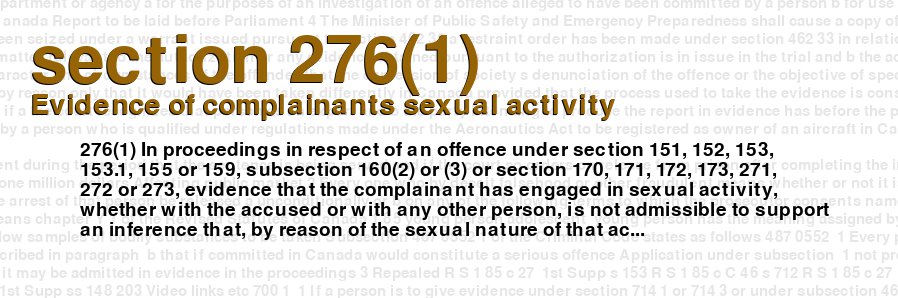
Evidence of complainants sexual activity
Introduction
Evidence of a complainants past sexual activity is not admissible to suggest they are more likely to have consented or less credible in sexual offence cases.
Statutory Text
276(1) In proceedings in respect of an offence under section 151, 152, 153, 153.1, 155 or 159, subsection 160(2) or (3) or section 170, 171, 172, 173, 271, 272 or 273, evidence that the complainant has engaged in sexual activity, whether with the accused or with any other person, is not admissible to support an inference that, by reason of the sexual nature of that activity, the complainant (a) is more likely to have consented to the sexual activity that forms the subject-matter of the charge; or (b) is less worthy of belief.
Explanation
Section 276(1) of the Canadian Criminal Code restricts the use of evidence related to the sexual history of a complainant in certain criminal proceedings. Specifically, it prohibits the use of evidence that a complainant has previously engaged in sexual activity, whether with the accused or with another person, as a means of inferring that the complainant is more likely to have consented to the sexual activity that is the subject of the charge. It also prohibits the use of such evidence to argue that the complainant is less credible or trustworthy.
The provision applies to a range of sexual offences, including sexual assault, sexual interference, invitation to sexual touching, and incest, among others. The goal of Section 276(1) is to prevent the use of sexual history evidence as a means of victim-blaming or discrediting complainants in sexual offence cases. In the absence of Section 276(1), complainants may face challenges in pursuing justice due to societal biases and assumptions about sexual behaviour and consent.
However, it is important to note that Section 276(1) does not absolutely bar the use of evidence relating to a complainant's sexual history. The section allows for such evidence to be introduced if it has "significant probative value" and is not being used for the prohibited purposes. The provision also allows for the court to impose restrictions on the evidence to protect the dignity and privacy of the complainant.
Overall, Section 276(1) serves an important function in protecting the rights of complainants in sexual offence cases and preventing the misuse of evidence related to their sexual histories.
Commentary
Strategy
Section 276(1) of the Criminal Code of Canada is an essential provision in criminal proceedings involving sexual offence charges, as it ensures that victims of sexual abuse are not humiliated or discredited during proceedings through evidence of their sexual history. However, when dealing with this section, certain strategic considerations need to be taken into account to ensure that the complainant's interests are protected, and the accused gets a fair trial.
One of the primary strategies that can be employed is to seek early legal advice from a criminal defence lawyer. The defence lawyer can provide advice on how to manage the discovery process, the witnesses to call, and the evidence to rely on. Additionally, they can help navigate the complicated interplay between Section 276 and other provisions of the Criminal Code that deal with sexual misconduct.
Another key strategy is to engage expert witnesses who can provide testimony on specific topics relevant to the charges. For instance, an expert psychologist can provide evidence on the emotional and mental trauma resulting from sexual abuse, which can help establish a complainant's credibility. Similarly, an expert pathologist can provide evidence on how injury patterns relate to alleged sexual abuse, which can help corroborate a complainant's account of events.
A common strategy associated with Section 276 of the Criminal Code is seeking a judicial hearing on whether or not evidence of the complainant's previous sexual activities is relevant and necessary. The hearing aims to assess whether the evidence is admissible to support a particular inference or whether it is merely being used to stigmatize or humiliate the complainant.
In some cases, the defence may also try to question the reliability and credibility of sexual assault allegations through cross-examination and challenging the prosecution's evidence. This approach, however, can be dangerous and requires scrutiny to ensure it does not unnecessarily harm the complainant.
Lastly, it is crucial to be mindful of the sensitive nature of sexual offences and the potential impact that legal proceedings may have on the victim. As such, all who are involved should prioritize sensitivity and care to establish a safe and supportive environment for the complainant and all concerned.
In summary, strategizing and taking the necessary steps to engage legal representation, experts, and secure admissible evidence while considering the needs of the complainant is essential in successfully navigating Section 276 of the Criminal Code. Ultimately, these considerations help to ensure that all involved parties receive fair treatment under the law.