Editorial Annotation
Disarming a peace officer
Introduction
It is an offence to try to take a weapon from a peace officer without their consent when they are performing their duty.
Statutory Text
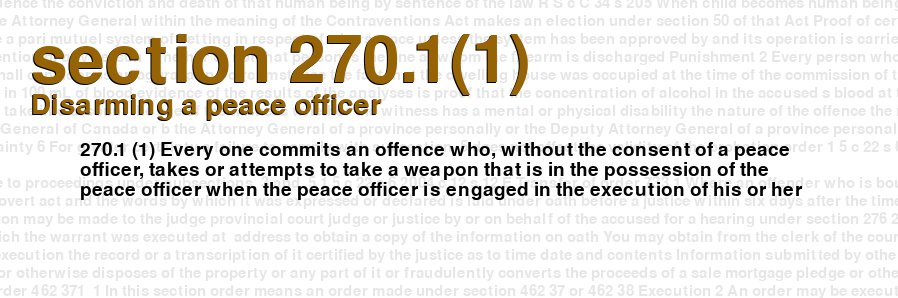
270.1 (1) Every one commits an offence who, without the consent of a peace officer, takes or attempts to take a weapon that is in the possession of the peace officer when the peace officer is engaged in the execution of his or her duty.
Explanation
Section 270.1(1) of the Criminal Code of Canada pertains to the unauthorized taking or attempted taking of a weapon that is in the possession of a peace officer who is in the execution of their duties. Simply put, it is a criminal offense for anyone to attempt to or succeed in taking away a weapon from a peace officer during the course of their duties without their consent.
This section is a part of the criminal code that seeks to protect peace officers and prevent situations where they can be harmed by suspects or other individuals who may seek to use their weapons as a means of escape. When a police officer is engaged in the execution of their duties, they may need to use their weapons as a means of defense or to prevent a dangerous situation from escalating. In these instances, the unauthorized taking of the officer's weapon may put them in grave danger and hinder their ability to carry out their duties effectively.
In such cases, this section of the Criminal Code of Canada allows for the prosecution of any individual who attempts to take a weapon from a peace officer without proper consent. The consequences for engaging in such an act can be grave and may include incarceration, fines, or other criminal sanctions.
It is important to note that the protection of peace officers is a core responsibility of any society. With this in mind, individuals who engage in activities that seek to harm or prevent peace officers from carrying out their duties are a threat to society as a whole and must be severely punished. No one should take the law into their own hands, and this section of the Criminal Code of Canada seeks to ensure that all individuals understand that such behavior will not be tolerated.
Commentary
Section 270.1(1) of the Criminal Code of Canada outlines the criminal offense of attempting to take a weapon that is in the possession of a peace officer. The section highlights the importance of respecting the authority of peace officers and acknowledging the risk associated with interfering with their ability to perform their duties.
The legislation effectively provides a clear and unambiguous definition of the offense, through which individuals can understand the nature of the crime. This clarity is essential for the effective implementation of the law and for ensuring that offenders are held accountable for their actions. Such an offense is necessary to protect peace officers who are at risk of facing harm while carrying out their duties, as they often find themselves in tense, hazardous, and high-pressure situations.
Furthermore, the gravity of the offense is reflected in the severity of the punishment, which can include imprisonment for up to ten years. This severe punishment is justified as it reflects the importance of upholding the sanctity of the peace officers' work and serves as a deterrent to those who may consider interfering with their duties.
The provision recognizes that the amount of force a peace officer may use to carry out their duties is constrained by the law, and the use of potentially lethal force may only be used under specific circumstances. By attempting to take a weapon from a peace officer, individuals are potentially endangering not only the officer's life but also that of the public. Consequently, upholding the law helps protect and ensure the safety of the public.
The provision also acknowledges that peace officers have a legal and ethical obligation to respect the rights of individuals under their care, including the right to be treated humanely and with dignity. Therefore, the legislation offers a reasonable balance between the use of force by a peace officer and its constraints, ensuring that the legal framework upholds the rights of both the individual and the peace officer.
However, as with any legal provision, there may be errors in the application, interpretation, and implementation. It is critical to ensure that the legislation is used only in appropriate circumstances. Law enforcement agencies must provide adequate training to their officers, ensuring that they understand their powers and the extent to which they can use force to carry out their duties. This training should emphasize the importance of de-escalation and diffusion skills while recognizing the need to use force in specific instances.
In conclusion, Section 270.1(1) of the Criminal Code of Canada is an essential provision that reinforces the need to respect the authority of peace officers and the potential dangers that can arise when interfering with their duties. It reflects the gravity of the offense, upholding the rights of both the individual and the peace officer, while ensuring the safety of the public. However, it is necessary to exercise caution while implementing the code and provide adequate training to the personnel that will justify its application to specific instances.
Strategy
Section 270.1(1) of the Criminal Code of Canada is a provision that seeks to discourage the disarmament of peace officers who are in the line of duty. It criminalizes any act of taking or attempting to take a weapon that is in the possession of a peace officer without the officer's consent. This provision, however, presents various strategic considerations that should be assessed when dealing with instances of non-consensual weapon-taking.
One strategic consideration when dealing with this provision is understanding the circumstances surrounding the attempt to disarm the peace officer. The law recognizes that some circumstances necessitate the use of force, even against a peace officer, to prevent harm to oneself or others. Therefore, if a person can prove that their actions were necessary to protect their life or those around them, then they may not be found guilty of an offense under this section. Thus, assessing the risks and benefits of using force in such situations is a crucial precautionary measure that individuals should consider.
Another strategic consideration involves the tactical approach that a person should adopt when dealing with this provision. For instance, disarming a peace officer in the presence of other officers or members of the public could result in a more severe response from the authorities. Therefore, a better strategy would be to wait for an opportunity when the officer is alone or vulnerable before attempting to disarm them. Alternatively, seeking the officer's permission to access the weapon may be a smarter approach as it would avoid the criminal consequences of taking the weapon without their consent.
Moreover, the consequences of this offense are severe. The maximum sentence for this offense is imprisonment for life. This reality underscores the importance of exercising caution and critical thinking when dealing with this provision. Individuals should seek legal advice before taking any actions that could lead to charges under this section. By doing so, they can prepare a defense that considers the specific circumstances surrounding the attempted disarmament, which could mitigate the severity of the punishment if found guilty.
Additionally, using alternative strategies to resolve any issues involving a peace officer's weapon could be a wise approach. For instance, de-escalating the situation, seeking alternative forms of assistance, or negotiating with the officer could be constructive solutions. If an individual feels aggrieved by the actions of a peace officer, they can file a complaint with the relevant authorities. At the same time, authorities can take measures to ensure that their officers are more respectful, transparent, and accountable to avoid any potential confrontations.
In conclusion, Section 270.1(1) of the Criminal Code of Canada is a provision that requires individuals to exercise caution when attempting to disarm peace officers. Strategic considerations when dealing with this section include evaluating the situation's risks and benefits, adopting tactical approaches that minimize the risks of exposure, seeking legal advice, and analyzing alternative strategies. Employing these strategies could minimize the likelihood of injury, legal charges, or other negative consequences.